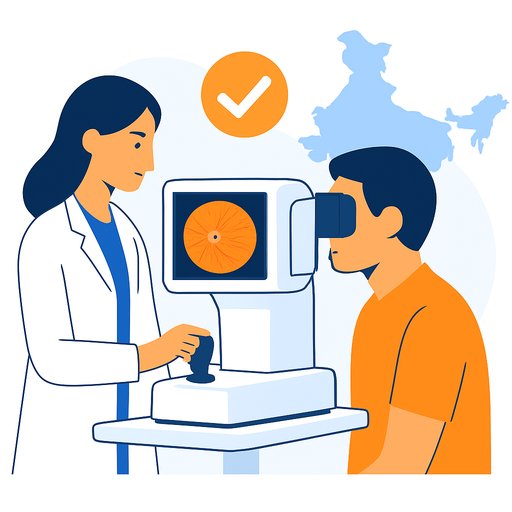
Forus Health secures CDSCO approval for AI-led diabetic retinopathy screening tool in India
Forus Health has received Central Drugs Standard Control Organization (CDSCO) approval for FH-POISE DRT, its AI-based diabetic retinopathy screening software. The tool analyses retinal images using deep learning to flag patients at risk and estimate severity, supporting earlier evaluation and timely intervention.
FH-POISE (Precision Ocular Intelligence for Systemic & Eye Health) is an AI-powered retinal image analysis platform built to assist screening for ocular and systemic diseases. The approval covers use as a screening aid and classifies the software as Class C SaMD, one of the most stringent risk categories in India.
What the approval covers
FH-POISE DRT uses trained deep learning models to examine retinal images and provide risk-based outputs aligned to disease severity. The approach has been validated on real-world images drawn from diverse populations, supporting suitability for routine care settings.
CDSCO clearance as Class C SaMD signals higher risk controls, with expectations on quality systems, clinical validation, and post-market oversight. More on CDSCO classifications is available from the regulator's site: CDSCO.
Why this matters for care delivery
India has one of the largest diabetes populations globally-about 89.8 million adults in 2024, according to the International Diabetes Federation (IDF). Estimates suggest 12%-17% of people with diabetes have diabetic retinopathy, with wide variation by region and access to care.
Screening coverage remains low, especially outside major cities where specialists are scarce. Earlier identification at the point of care can reduce avoidable vision loss and ease the load on ophthalmology services. The economic case is clear too-vision impairment and blindness are linked to productivity losses exceeding ₹11,000 crore annually.
How it fits into your workflow
FH-POISE DRT is intended for use in general hospitals, diabetes clinics, community health centres, and outreach programmes-where patients already receive routine diabetes care. The software supports image capture via fundus cameras and provides AI-assisted screening outputs to guide referrals.
- Screen near the point of care to improve coverage and follow-up
- Use risk-tiered outputs to prioritise patients for ophthalmology review
- Standardise image quality checks to reduce unusable scans and repeat visits
- Integrate reports into EMR or referral systems for continuity of care
Note: FH-POISE DRT is a screening tool. Confirmatory diagnosis and treatment decisions remain with eye-care specialists.
What the leadership says
Chandrasekhar K., Founder and CEO, Forus Health: "India's challenge with diabetic retinopathy is not awareness alone, but scale. Embedding reliable screening into routine diabetes care is essential if we are to prevent avoidable vision loss. Regulatory approval for FH-POISE™DRT enables technology-focused screening closer to where patients already receive care, helping strengthen early detection while making better use of limited specialist capacity."
RJ Venkataraman, Chief Manufacturing and Regulatory Officer, Forus Health: "From a regulatory standpoint, this CDSCO approval reflects rigorous validation, quality systems, and alignment with India's clinical and safety requirements. This clearance allows us to responsibly scale deployment across diverse healthcare settings while maintaining consistency, reliability, and patient safety."
Practical steps for providers
- Define your screening pathway: eligibility, frequency, and referral thresholds
- Select sites with consistent patient flow (diabetes OPDs, NCD clinics, PHCs)
- Standardise imaging protocols: pupil dilation criteria, fixation, and retake rules
- Set clear escalation routes to ophthalmology for moderate/severe findings
- Embed results in EMR and automate reminders for annual re-screening
- Run quality audits: image gradability, positive predictive value, and turnaround time
- Train staff on image capture, data privacy, and patient communication
- Establish governance: consent, data security, bias monitoring, and incident reporting
Deployment outlook
With CDSCO approval in place, Forus Health plans rollouts across hospitals, public health initiatives, and screening programmes. The focus is early identification, efficient referrals, and better use of specialist time, particularly in regions with limited ophthalmology coverage.
For healthcare teams, the opportunity is straightforward: bring screening closer to where diabetes is managed, close the follow-up loop, and protect sight at scale.
Your membership also unlocks: