
AI news ·
Central bankers call for guardrails to protect financial system from agentic AI
European central bankers warn agentic AI risks financial stability. They call for circuit breakers to stop market meltdowns from faulty models.
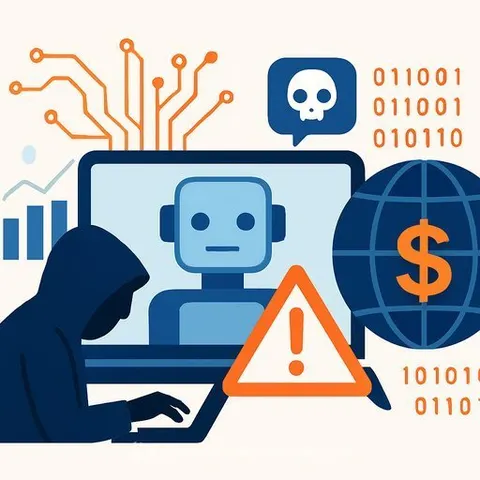
European central bankers and regulators warned this week that agentic artificial intelligence poses serious risks to financial stability, from amplifying market volatility to deepening cybersecurity threats. They said traditional rulemaking cycles are too slow to manage the technology's pace, and called for new guardrails - including trading circuit breakers - to protect the financial system.
Bank of England deputy governor Sarah Breeden told the European Central Bank's annual meeting in Sintra, Portugal, that agentic AI could worsen volatility during periods of market stress. She questioned whether guardrails are needed "analogous to circuit breakers or kill switches that would limit or stop trading market-wide if faulty AI models cause market meltdown."
Calls for guardrails and faster regulatory tools
Nikhil Rathi, CEO of the UK's Financial Conduct Authority, said the speed of AI development has broken the traditional model of rule-writing. "Technology moves incredibly fast, and we need to think differently about some of the innovations that we are seeing on AI," Rathi told CNBC. "The traditional cycle of rulemaking simply doesn't work in that way, so we need to think about new tools and a different way of working with the market in a more collaborative way."
His comments reflect a growing frustration among watchdogs who see agentic AI - systems that can act autonomously - outstripping their ability to draft and implement effective rules. The risk, they argue, is that a technology shock could hit markets before regulators can respond.
Lagarde flags a 'major risk' from AI acceleration
European Central Bank President Christine Lagarde warned in an interview with French outlet Les Echos that AI now represents a much greater threat than earlier cybersecurity concerns. "For about a decade now, we have been talking about cybersecurity risks, hacking, data theft, and so on," she said. "But with the acceleration and deepening of AI models, we are confronted with a much more serious risk, because it is happening very, very quickly, and because the means of defense - and the funding required for them - have yet to be found."
The warning underscores a shift in central bank thinking. Where once the focus was on data breaches, the new concern is that AI systems themselves could behave unpredictably, triggering cascading failures across interconnected financial networks.
AI exuberance and rising debt create bubble fears
The Bank for International Settlements cautioned on June 28 that AI-driven "exuberance" could have significant financial consequences. If central banks tighten monetary policy to contain inflation, the BIS said, a "sharp pullback in [AI] asset prices after a prolonged period of exuberant risk-taking" could trigger "disruptive macro-financial feedback loops."
Breeden noted that debt financing tied to AI investments is rising rapidly. "We therefore judged that the financial stability consequences of any fall in AI-related asset prices could well increase," she said. Separately, Tobias Adrian, Director of the IMF's Monetary and Capital Markets Department, told Bloomberg on June 30 that there is a "potential maturity mismatch in between the duration of the physical assets and the duration of the debt."
Why this matters for finance professionals
For anyone managing risk, portfolios, or regulatory compliance, these warnings signal that agentic AI is no longer a theoretical concern. Regulators are openly discussing market-wide kill switches and preparing for scenarios where autonomous AI models trigger flash crashes or liquidity freezes. That could reshape trading infrastructure, margin requirements, and stress-testing protocols. Understanding these evolving risks is critical, and targeted training - such as AI for Finance courses - helps professionals bridge the gap between fast-moving technology and practical risk management. The message from Sintra is clear: the next shock might not come from familiar sources, but from an AI model no one fully controls.