CES 2026: AI-Powered Wearables Move From Tracking To Clinical Insight
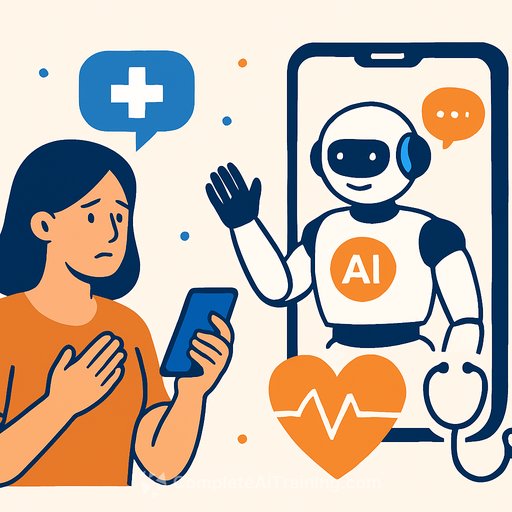
CES returned to Las Vegas with 4,100+ exhibitors and a clear signal: AI in wearables is moving from step counts to clinical-grade insight. For healthcare leaders, the message was simple-better sensors, smarter context, less screen time and stronger trust.
"Three out of every seven of us will have a neurodegenerative disease by our 80s and 90s," noted Stanford's Walter Greenleaf. We'll also live decades longer than prior generations. That longevity dividend only pays off if enabling tech keeps brains and bodies healthy-and wearables will carry a lot of that load.
Hardware First: Sensors Set The Ceiling For Software
"The software will be easy. All of the complex stuff is going to happen at hardware level," said Kia Nazarpour of Neuranics. Think electromyography (EMG) that senses finger gestures to toggle an exoskeleton, or application-specific chips that pull clean signals from noisy environments. If the sensor can't capture reliable physiology, no model can fix it.
- Insist on clinical-grade signal quality: validated EMG, PPG, skin temp, and inertial data with documented accuracy across skin tones and movement.
- Prioritize edge compute: on-device preprocessing and inference to reduce latency, protect privacy, and contain cloud costs.
- Plan for co-design: hardware, firmware and models developed together-plus access to raw data and an open SDK for Research and integration.
- Test in motion: evaluate performance during real ADLs, not just resting states. Battery life under continuous sensing matters.
AI That Adds Context, Not Just Scores
Noise's Luna Ring tracks sleep, stress, HR and 70+ biomarkers. Swapnil Vats made the core point: health is nuanced. Poor sleep might be day-one menstruation stress-or late caffeine after a late workout. AI should infer the context and adjust guidance without asking users to type a diary 100 times a day. Voice assistants can add lightweight context, while models translate biomarkers into actions.
- Reduce input burden: allow voice tags ("espresso at 6 pm," "day 1 cycle") and let models learn routines over time.
- Model interactions, not silos: link sleep, menstrual phase, training load, caffeine and mood to prevent one-size-fits-all advice.
- Guardrails for care: set thresholds for escalation, clinician review and avoiding over-alerting that drives alert fatigue.
- Equity checks: validate across age, sex, skin tone, comorbidities and meds that affect physiology (e.g., beta blockers).
Fewer Screens, More Real-World Help
Snap's next-gen Spectacles bring AR and agentic AI to wearables you actually wear. The goal: hands free, eyes up, useful in the moment-directions overlaid in your field of view, not buried in a phone. That approach fits care, too, and reflects modern Design principles focused on usability and minimal disruption.
- Rehab and PT: posture prompts, gait cues and step-by-step exercises delivered in the room, not in an app.
- Clinical workflows: wayfinding for float nurses, sterile-field checklists in OR training, medication ID overlays for home care.
- Safety and privacy: on-device processing in public spaces, no default recording, clear signals to bystanders when capture occurs.
Trust Decides Adoption
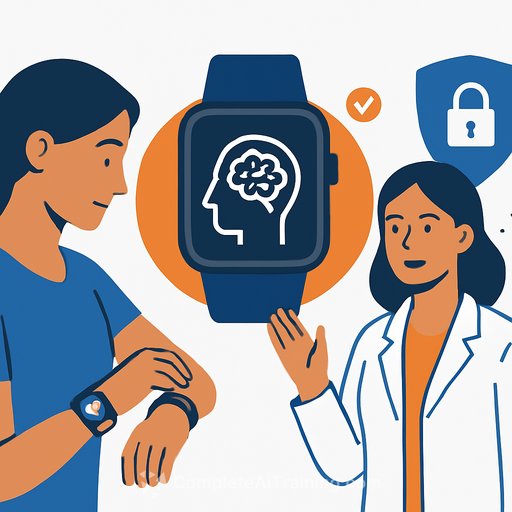
Health and behavioral data can improve lives-or manipulate them. Greenleaf urged more on-device computing and strong data protections. SuitX CTO Wayne Tung emphasized transparency: tell users what you collect, why it helps and what the risks are-and accept that people have different sharing thresholds.
- Privacy by default: minimize data, process locally first, and use encrypted sync with least-privilege access.
- Granular consent: per-signal, per-use, with easy revocation and clear value exchange.
- Auditability: model cards, versioning, drift detection and human-in-the-loop review for higher-risk use cases.
- Follow established guidance: see the FDA's Digital Health Center of Excellence (FDA DHCoE) and the NIST Privacy Framework (NIST).
How Healthcare Teams Can Pilot AI Wearables Next Quarter
- Pick one outcome and population: e.g., reduce post-op readmissions in hips/knees by 10% within 6 months.
- Select devices with proven sensors and edge AI; require raw data access, APIs and independent validation data.
- Co-create protocols with clinicians and patients; define alert thresholds, escalation paths and "quiet hours."
- Stand up governance early: DPO/IRB review, data inventory, consent flows, retention limits and vendor DPAs.
- Plan integration last: start standalone, but map HL7/FHIR endpoints and EHR inbox routing before scale.
- Measure beyond engagement: track clinical outcomes, PROs, adherence, staff time saved and total cost of care.
- Run a 60-90 day pilot with weekly checkpoints; adjust prompts, thresholds and education scripts quickly.
- Publish results internally; if effective, standardize training, playbooks and procurement criteria.
Better sensors, smarter context and transparent data practices are here. If you pick a high-value use case and keep trust front and center, AI wearables can move from wellness novelty to a dependable piece of care delivery.
Want your team fluent in practical AI for clinical and operational workflows? See curated programs by role here: Complete AI Training - Courses by Job.
Your membership also unlocks: