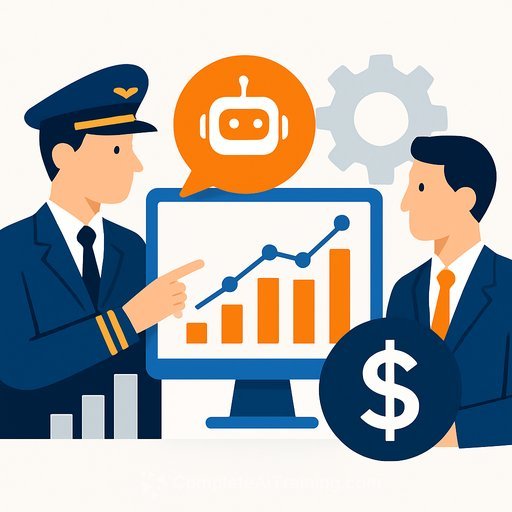
The Strategic Imperative for CFOs to be AI Entrepreneurs
Finance leaders are sitting on the leverage the rest of the business needs: clean data, rigorous controls, and a mandate for accuracy. As agentic AI and predictive planning reshape performance management, the CFO is the one role positioned to turn scattered data into enterprise intelligence and measurable outcomes.
The mandate is clear: build the data foundation, select the right use cases, and operationalize AI with accountability. Do that, and finance becomes the engine of faster decisions, tighter forecasts, and higher enterprise value.
Corporate Performance Management is Changing
Agentic AI can compress planning cycles, run deeper analysis in seconds, and surface drivers that were impossible to see in spreadsheets. Predictive planning has already shown it improves forecasting quality and automates routine steps, reducing the drag on FP&A.
But none of this materializes without trustworthy data and discipline in how it's produced, governed, and used. AI doesn't fix weak foundations. It amplifies them.
AI Delivers Only With Trusted Data
Finance needs data that is consistent, clean, and contextualized. BARC research shows 34% of organizations cite unsuitable data architecture as a blocker to AI value, and 33% struggle with data integration and quality. Those are finance problems as much as they are IT problems.
The CFO's office lives at the intersection of finance, data, and intelligence. That makes it the logical owner of the AI foundation: how data flows, how models are monitored, and how outcomes tie to financial impact.
The CFO Role Is Evolving-From Scorekeeper to AI Entrepreneur
Spreadsheet sprawl is fading. In fact, 68% of companies now rely on specialized planning tools for core planning activities. Predictive planning is already used productively by 27% of organizations; 65% are achieving or expecting significant benefits, and 64% report better accuracy with less effort.
This shifts the CFO from report producer to architect of enterprise insight. The job expands to designing data pipelines, setting governance for model transparency, and scaling intelligent automation with clear accountability.
A Practical Playbook for CFO-Led AI in FP&A
- Start with value theses: Prioritize 2-3 high-impact use cases (rolling forecasts, scenario modeling, demand and cash forecasting, working capital optimization). Define the decision, owner, and success metric up front.
- Stabilize the data foundation: Inventory critical data elements, fix quality at the source, standardize definitions, and implement lineage. Create data contracts between finance, operations, and HR to cut rework.
- Stand up governance that scales: Establish decision rights, model documentation, and monitoring for bias and drift. Align with proven guidance like the NIST AI Risk Management Framework.
- Select tech that fits your process: Use planning platforms with native predictive and agentic capabilities. Integrate with ERP, CRM, and HRIS so models train on the same truth finance trusts.
- Build the operating model: Create a Finance Analytics COE. Define roles for data engineering, analytics, model risk, and FP&A. Keep humans-in-the-loop for approvals on material decisions.
- Raise data and AI literacy: Train finance and business partners on data context, scenario thinking, and prompt discipline. Pilot fast, share outcomes, and scale what works.
- Engineer auditability: Version every dataset, model, and forecast. Log feature changes and decisions. Make explanations standard, not special requests.
- Measure impact relentlessly: Track forecast accuracy, plan cycle time, scenario throughput, close time, and cost-to-plan. Tie every AI initiative to a P&L or balance sheet lever.
Where to Start in the Next 90 Days
- Form a finance-led data council with IT and the business. Agree on definitions and decision rights.
- Pick one use case with clear ROI (e.g., revenue forecasting or cash prediction) and run a 6-8 week pilot.
- Fix the 3-5 data issues blocking that pilot at the source-don't patch in spreadsheets.
- Publish lightweight AI governance: model approval, monitoring cadence, and exception handling.
- Report progress to the executive team and board with simple, financial metrics.
The Bottom Line
Tomorrow's CFO isn't just reporting results. They're building the foundations that make AI useful and safe, and turning those foundations into better decisions across the enterprise.
AI will do what your data allows. Make that data trusted, govern the models, and point both at the decisions that move the P&L. That's the work of an AI entrepreneur in finance.
Want a practical starting point? Explore a curated set of AI tools built for finance teams: AI tools for finance.
Your membership also unlocks: