
AI news ·
Charities to Crypto: AI Exposes Terror's Money Trails Before They Become Weapons
Terror finance flows through banks, trade, and crypto, but the data trail is there. AI flags patterns rules miss; teams act sooner-unify data, model relationships, and triage fast.
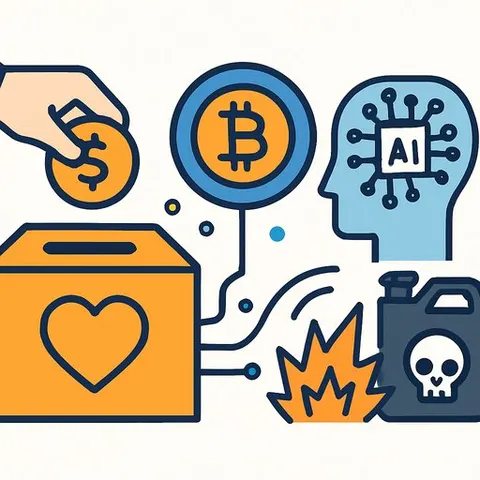
AI vs. Terror Finance: What Banking and Compliance Teams Need to Do Now
Terrorist financing doesn't move in straight lines. It runs through banks, trade networks, investments, cryptocurrencies, and charities-often in parallel. Groups like Hezbollah and Hamas, backed by Iran, have used every channel available to move value with minimal friction.
Two decades ago, Sheikh Yusuf al-Qaradawi's "Union of Good" showed how deep these pipelines can run. Charities raised millions for Hamas under the cover of legitimate activity. Even after bans in Israel and the US, the networks rebranded and kept the infrastructure intact.
The playbook keeps shifting
When charities drew scrutiny, funds moved to bank transfers and trade finance. When those tightened, drug trafficking took a share. Then crypto filled the gaps. The latest crypto bear market erased roughly $2 trillion and took down firms like Celsius, Voyager Digital, and Three Arrows Capital-yet the channel still moves funds where controls are weak.
Stack those methods together and you get a multi-layered system built to sustain operations over time.
The data trail exists-your systems just need to see it
Cash disappears. Digital transfers don't. Wires, trade invoices, and crypto wallets all leave footprints. At scale, those traces become patterns.
Traditional compliance tools rely on rules and thresholds. They catch what they're told to look for, and miss what falls outside those templates. By the time an alert fires, the money is often cleaned, converted, and spent.
How AI spots what rules miss
Instead of chasing fixed red flags, AI learns what "normal" looks like by customer, corridor, product, and time. It flags what breaks that pattern-fast enough to act.
- A charity rounding donations in ways that defy real-world behavior
- Trade shipments priced well below market or misclassified to dodge checks
- Wallets or clusters linked to sanctioned entities through indirect paths
Recent actions against Hezbollah-linked operations in Paraguay and on the Ivory Coast followed this logic. The financial flows were masked as legitimate commerce. The trail was still there-hidden in the data.
What finance teams can implement now
- Unify your data: Bring KYC, payments, trade docs, correspondent messages, and crypto exposure into one model-ready layer. Resolve entities across systems.
- Model the graph: Build relationship graphs across customers, accounts, counterparties, wallets, and trade partners. Capture indirect links and common controllers.
- Behavioral baselining: Learn normal at the entity and network level. Score anomalies by deviation, seasonality, and peer groups.
- Typologies + anomalies: Combine known patterns (TBML, use of fronts, funnel accounts, smurfing) with anomaly detection to surface the unknowns.
- Crypto risk integration: Screen wallets, trace flows through mixers/bridges, and score on/off-ramps. Link blockchain entities back to customers where possible.
- Real-time triage: Prioritize alerts by risk and consolidation proximity. Freeze funds earlier in the flow, not after settlement.
- Analyst-in-the-loop: Let investigators label outcomes. Feed those decisions back into models to improve precision and reduce noise.
- Governance + auditability: Keep features and decisions explainable. Log model versions, thresholds, overrides, and outcomes for regulators.
Signals that matter in trade, payments, and crypto
- Trade finance: Price-to-market gaps, route anomalies, shell counterparties, recycled bills of lading, overuse of advance payments, split shipments near sanctions risk.
- Payments: Rapid fund pass-throughs, circular flows, donation bursts tied to events, corridor shifts after enforcement actions, cash-heavy on-ramps to high-risk merchants.
- Crypto: Exposure to sanctioned clusters, hops through mixers, peel chains, bridge usage after fiat off-ramps flag accounts, wallet reuse across entities.
KPIs to run and report
- Detection lead time (from first suspicious activity to alert)
- Precision/false positive rate (analyst hours saved per true case)
- Case consolidation speed (number of related alerts auto-linked)
- Frozen value before consolidation or off-ramp
- Regulatory outcomes (SAR quality, consent orders closed, model validations passed)
This is bigger than compliance
Banks with AI-driven monitoring aren't just checking boxes-they're part of the security perimeter. Detect earlier. Freeze faster. Disrupt funding before it becomes weapons, salaries, and propaganda.
Every new concealment method creates a new pattern. That complexity is the weakness. AI turns those patterns into action, at scale.
Policy and cooperation
- Align with guidance from bodies like the FATF and national authorities.
- Expand information sharing within legal bounds (MISPs, 314(b)-style programs, vetted consortium models).
- Keep fairness and privacy controls in place to avoid blunt de-risking while still acting with speed.
Next steps for leaders
- Fund a cross-functional AML/CTF AI program (compliance, data, risk, product, legal).
- Stand up a model factory: feature store, graph infrastructure, monitoring, and validation.
- Pilot on one corridor or product with known exposure; measure lift vs. rules alone.
- Train investigators on graph thinking, crypto tracing, and AI explainability.
AI won't end terrorism. But it can expose and dismantle the financial plumbing that keeps it alive. The data is already in your systems. The question is whether you can read it in time.
Upskill your team
If your analysts and risk leads need a practical starting point for AI in finance, see this curated set of tools and learning paths: AI tools for finance.