Why CIOs need AI fix-engineers for chatbot success
Chatbots shine in demos and early pilots. Then real users show up, edge cases pile up, and the wheels start to wobble. Without ongoing maintenance, performance slips, trust erodes and ROI gets stranded.
The risk is not theoretical. In 2025, the Commonwealth Bank of Australia cut staff assuming a chatbot would reduce workload; failure drove call volume up instead. In 2024, Air Canada's bot gave wrong fare guidance, and the mistake cost money. These are process failures as much as technical ones.
Why chatbots fail
Context drift and technical degradation
Bots lose track of business-specific meanings and relationships over time. Integration gaps with CRMs, ERPs and data lakes create blind spots. As users try real work, edge cases surface and model behavior drifts.
Leaders are adding semantic layers, knowledge graphs and rule engines to stabilize results across use cases. These techniques create consistency when the underlying model behavior shifts.
The ownership gap
Many failures are human, not technical. After launch, no one truly "owns" the system. Without a clear owner, chatbots degrade quietly until trust collapses.
Amplification in agentic workflows
Chaining dozens of model calls magnifies small errors. A tiny parsing mistake or a brittle tool call that would go unnoticed in a simple Q&A can derail an entire workflow, trigger rework and burn user confidence.
Organizational barriers
Change management is often an afterthought. If the business case isn't clear, and stakeholders don't trust the process, adoption stalls. AI governance needs to be visible, fast and credible.
External model instability
APIs change, checkpoints update, default settings shift. Frontier models like OpenAI GPT and Google Gemini evolve frequently, which can introduce sudden behavioral changes. Without versioning, monitoring and rollback plans, you're flying blind.
The new role: Chatbot fix-engineer
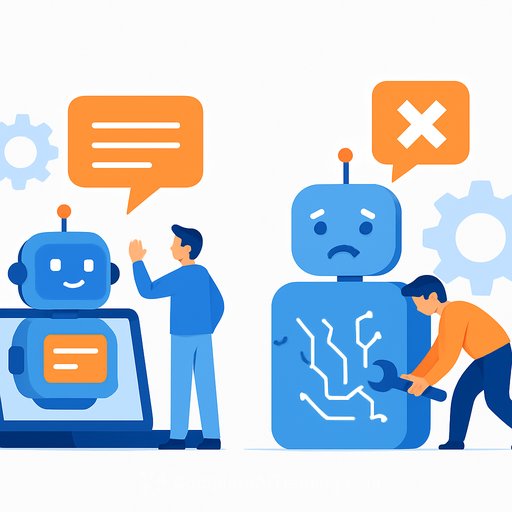
The AI fix-engineer (often called a forward-deployed engineer) keeps conversational systems healthy after go-live. Think DevOps for the conversational stack: model, prompts, retrieval, guardrails, tools and integrations.
This is a hybrid skillset-software engineering, data engineering, product sense and a practical grasp of human conversation. The best ones diagnose where a bot fails with real people, not just lab tests, then ship targeted fixes quickly.
- Debug hallucinations and loops
- Repair flaky integrations and tool calls
- Tune prompts and policies
- Fix and optimize RAG pipelines and retrieval logic
- Instrument observability and feedback loops
Why IT executives should care
- ROI: Ongoing tuning is often the difference between a prototype that dies and a tool that compounds value.
- Talent pipeline: You may already have candidates-platform engineers, data engineers and SREs-who can be reskilled and given a clear mission.
- Vendor strategy: Fix-engineers help you demand measurable commitments on performance, data protection and incident response.
- Risk management: As agentic workflows call APIs and move data, small errors can create outsized damage without controls.
- User trust: Treat AI as an ongoing discipline (like cybersecurity), not a one-and-done project.
How to respond strategically
Start with an honest assessment
Do you know when accuracy drifts? Can you trace prompts, inputs, retrieval sources and outputs over time? Most teams discover they lack basic visibility into day-to-day behavior.
Identify and develop hybrid talent
Prioritize engineers who are comfortable with LLM quirks, data pipelines and enterprise integrations. Give them real systems to own, not endless prototypes.
Build cross-functional pods
Stand up small pods embedded with business lines: product owner, FDE lead, data engineer, prompt engineer, QA/SRE and a risk/compliance partner. Give them a clear charter, a backlog, SLAs and on-call responsibility.
Restructure vendor contracts
Write in continuous performance monitoring, incident escalation paths and shared accountability for model drift and retraining. Specify who owns updates, how often you test and what triggers rollback.
Establish central controls
Create a lightweight board that approves deployments, practices and shared investments. Standardize prompts, retrieval patterns, safety policies and model update procedures.
AI fix-engineer best practices
- Create clear ownership: Assign accountable owners for every bot and workflow. No orphans.
- Establish observability from day one: Log prompts, inputs, outputs, citations and tool calls. Track accuracy drift and containment rates.
- Define shared standards: Common prompt libraries, retrieval blueprints, safety rules and model versioning.
- Enable fast governance: Guardrails and review cycles that move as fast as the issues, without sacrificing compliance.
Common pitfalls to avoid
- Treating go-live as the finish line
- No feedback loop with real users
- One-off fixes without shared standards
- Underinvesting in ongoing maintenance
- Ignoring model and API changes from providers
Executive checklist (30/60/90 days)
- 30 days: Inventory all bots and agentic workflows. Turn on logging. Define ownership and SLAs. Freeze model versions.
- 60 days: Stand up one cross-functional pod. Implement evals for top tasks. Add retrieval and tool-call monitoring. Start a weekly drift review.
- 90 days: Standardize prompts and RAG patterns. Update vendor contracts with clear accountability. Publish reliability and trust metrics to stakeholders.
Bottom line
The companies winning with GenAI aren't the ones with the most experiments. They're the ones treating AI as a living system-owned, observed and improved continuously by fix-engineers with the mandate to keep it useful and trustworthy.
If you're building this capability and want to upskill your team on prompts, retrieval and agentic patterns, explore curated programs by role at Complete AI Training.
Your membership also unlocks: