
AI news ·
ChatGPT-5 matches instructor performance in pilot eFAST ultrasound training study
ChatGPT coached medical students on trauma ultrasound as effectively as human instructors in a small pilot study. Post-training scores hit 87.5% with AI versus 85% with faculty.
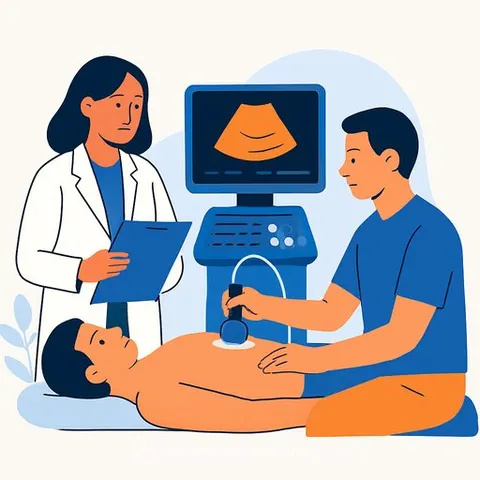
AI Coaching Shows Promise for Trauma Ultrasound Training
Conversational ChatGPT can teach emergency medicine students to perform eFAST exams as effectively as human instructors, according to a pilot study presented at the American Institute of Ultrasound in Medicine annual meeting in Philadelphia on May 29.
eFAST-extended focused assessment with sonography in trauma-uses ultrasound to detect internal bleeding, fluid around the heart, and collapsed lungs in trauma patients. The exams are operator-dependent and time-sensitive, making them difficult for novice learners.
Researchers at California University of Science and Medicine studied 16 first-year medical students with no prior ultrasound training. Half worked with ChatGPT-5; half worked with instructors. Students in the AI group typed questions and uploaded ultrasound images, receiving feedback on probe positioning, landmarks, image quality, and troubleshooting.
Both groups improved substantially. Post-training knowledge scores reached 85% with instructor assistance and 87.5% with AI assistance. Confidence ratings rose from baseline 1.54 to 5.25 with instructors and from 1.40 to 4.98 with AI. The differences were not statistically significant.
The finding addresses a real constraint: only one in five U.S. medical schools prioritizes ultrasound education, despite three in five schools offering some ultrasound training. Faculty bandwidth remains a barrier.
The AI workflow required no embedded ultrasound algorithms-just a conversational interface where students could ask questions and share images. This simplicity makes it reproducible across institutions.
Researchers cautioned that the study involved a small sample and cannot measure long-term retention. The results also do not support unsupervised clinical use of AI coaching.
Future work will examine whether AI research shows AI works best alone or paired with faculty instruction, and whether findings hold across larger student cohorts.