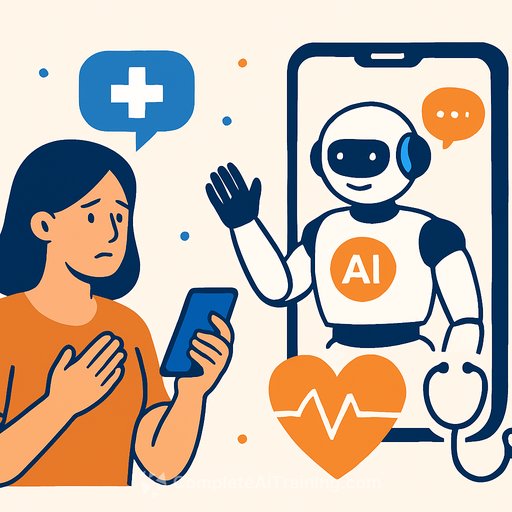
40M people a day ask AI about symptoms and coverage - here's what payers and providers should do
Consumers are treating AI like a front desk. OpenAI reports more than 40 million people ask health-related questions each day, with 1.5-2 million insurance questions every week. Health topics account for over 5% of all ChatGPT messages. About 70% of these chats happen after typical clinic hours.
People are asking about plan comparisons, billing, claims, and price transparency on top of symptom checks. That highlights where the friction is-and where fast, clear answers pay off.
Uneven access is pushing usage higher in certain regions
In a four-week stretch late in 2025, users in underserved U.S. areas sent an average of 580,000+ health messages per week. Wyoming drove the largest share at 4.15%, followed by Oregon, Montana, South Dakota, and Vermont.
"Hospital deserts"-areas more than 30 minutes from a general or children's hospital-often lack specialty care, leading to longer trips and delays. AI won't reopen a shuttered facility or bring back services like OB, but it can help people interpret information, prepare for visits, and reduce back-and-forth for the few clinicians on the ground.
The behavior shift: patients rely on AI, even for symptoms
An OpenAI survey from December found three in five U.S. adults used an AI tool for medical questions in the prior three months. Among them, 55% checked symptoms, 48% decoded medical terms or instructions, and more than 40% explored treatment options.
Separately, a Mesothelioma Center report found over half of Americans use ChatGPT for symptoms. Nearly one in three would delay or skip seeing a doctor if an AI labels their issue low risk. About half of symptom-checkers said the tool "led to a diagnosis," which raises obvious safety concerns if there's no clinical follow-up.
Clinicians are using AI too - mostly for workload relief
According to the American Medical Association, two-thirds of U.S. physicians used AI for at least one work task in 2024, up from 38% the year before. That aligns with what many health systems report: AI is helping with documentation, patient education, and administrative tasks that drain time.
What insurers and providers should implement now
- Offer after-hours coverage answers. Stand up AI assistants that explain benefits, cost sharing, in-network options, and claim status. Push clear next steps and contact routes if the user needs a human.
- Make price transparency usable. Let people estimate out-of-pocket costs, compare sites of care, and see prior authorization requirements in plain language.
- Build warm handoffs. For anything clinical, symptoms, or high-risk keywords, route to a nurse line, telehealth, or next-available scheduling. No dead ends.
- Equip front-line teams. Give CSRs and care managers AI copilots for benefits explanations, EOB explainers, and appeal guidance, with quick links to policies and medical necessity criteria.
- Localize for hospital deserts. Surface the nearest appropriate care, virtual care options, transport support, and community resources. Keep instructions short and actionable.
- Use patient-friendly language. Swap jargon for examples: "This visit will likely cost…"; "Because your plan has… you'll pay…"; "Here's when to seek urgent care."
- Close the loop on safety. Prominent disclaimers, clear triage boundaries, and urgent-care guidance. Reinforce that AI is not a diagnosis and doesn't replace a clinician.
Governance and risk controls
- Accuracy audits. Regularly test prompts and responses against policy documents and clinical guidelines. Track error types and fix root causes.
- PHI safeguards. Prevent sensitive data from leaving your environment, apply role-based access, and log all conversations for quality review.
- Bias checks. Review responses for geographic, language, and disability bias. Validate that rural and low-bandwidth users get equally clear paths to care.
- Transparent UX. Label AI clearly, show data sources when possible, and make escalation obvious within one tap or click.
Measure what matters
- Containment rate for benefits, claims, and price questions (without human handoff).
- Escalation quality: time to nurse/agent, abandonment, and issue resolution.
- First-contact resolution and reduction in repeat calls.
- Prior auth cycle time, claims rework, and denied-claim appeals prevented.
- After-hours utilization that results in booked visits or appropriate self-care instructions.
Where to focus next
- Plan comparisons that people actually understand. Side-by-side, scenario-based explanations that reflect real usage (chronic meds, imaging, urgent care, maternity).
- Integrated triage. Safe symptom guidance that leads to scheduling, virtual visits, or nurse advice-with guardrails and clear language.
- Multilingual access. Offer consistent benefit and care guidance across top languages in your markets.
For context on adoption trends, see OpenAI and the American Medical Association.
If your team needs practical upskilling on prompts and workflows for health and insurance work, explore role-based options at Complete AI Training.
Your membership also unlocks: