How ChatGPT Can Guide Your Retirement Planning and Ensure Financial Security
AI can accelerate your retirement research. It can't replace judgment, context, or fiduciary advice. If you work in finance, treat ChatGPT as a fast analyst-useful for first drafts, scenario framing, and education-but keep a human advisor in the loop for strategy and execution.
Where ChatGPT Helps
- Clarifies concepts: Safe withdrawal rates, sequence-of-returns risk, Roth conversion windows, asset location, and Medicare IRMAA.
- Outlines options: When to claim Social Security, which accounts to tap first (taxable → tax-deferred → Roth), RMD planning, and QCD opportunities.
- Summarizes trade-offs: Longevity risk vs. spending needs, annuities vs. bond ladders, paying off a mortgage vs. investing.
- Speeds up prep: Drafts checklists, compares strategies, and creates questions to take to your advisor.
Where It Falls Short
- No real critical thinking: It connects ideas from sources-it doesn't form judgment. See Research on AI and judgment from London Business School (read more).
- Quality varies by source: It can echo outdated, biased, or incomplete guidance.
- Gaps in personalization: It doesn't know your full tax picture, liquidity needs, or behavior under stress unless you provide detail-and you shouldn't share sensitive data.
How to Use ChatGPT Like a Pro (Fast, Safe, Practical)
- Insist on receipts: Ask for citations with links and the publication date. Then click through and verify.
- Force assumptions into the open: "List every assumption you used and show the math."
- Cross-check with primary sources for anything tax or benefits related (e.g., Social Security).
- Compare multiple paths: "Give 3 withdrawal sequences and rank by after-tax income volatility."
- Stress test: "Model a 2000-2002 and 2008-style downturn in the first 5 years and show portfolio survival odds."
Prompts That Actually Move the Needle
- "Explain the trade-offs between postponing Social Security to 70 vs. 67 for a high earner with a 60/40 portfolio and a 30-year horizon. Include breakeven analysis."
- "Create a withdrawal order for taxable, traditional, and Roth accounts that minimizes lifetime taxes. State assumptions for brackets, IRMAA, and state taxes."
- "Outline a Roth conversion schedule from 62-70 to fill the 12% and 22% brackets before RMD age. Include impact on ACA subsidies and IRMAA."
- "List 5 ways to reduce sequence-of-returns risk in retirement and provide pros/cons: cash buckets, dynamic spending rules, annuities, TIPS ladders, guardrails."
Source Reliability: Your Quick Checklist
- Look for primary sources: IRS pubs, SSA, CMS, academic journals, regulator sites.
- Check dates: Tax rules, IRMAA thresholds, and RMD ages change.
- Scan conflicts: If advice sells a product, increase your skepticism.
Security and Compliance
- Don't paste PII, exact account numbers, or full tax returns.
- Aggregate and anonymize: "Couple, age 63/61, $2.1M investable, 60/40, 25% marginal, HSA $9k/yr."
- Use enterprise or privacy modes if available; store sensitive workpapers in firm-approved systems.
Bring AI to the Advisor Conversation
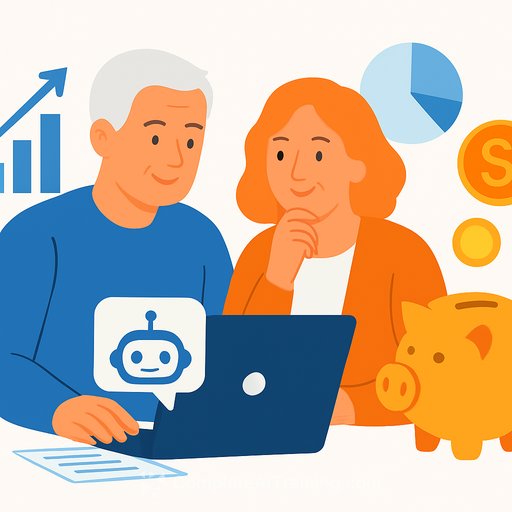
Use ChatGPT to prep. Then sit down with a human advisor to calibrate around taxes, goals, and behavior. Real value shows up in implementation: timing Roth conversions, coordinating RMDs with charitable giving, aligning asset location with expected return and tax drag, and rebalancing with guardrails.
- Arrive with a one-pager: assets, liabilities, cash flows, spending floor, must-keep goals, and AI-sourced questions.
- Ask the advisor to sanity-check assumptions and run a formal Monte Carlo and tax projection.
- Agree on rules you'll follow during selloffs and rallies to avoid costly reactions.
Practical Use Cases for Finance Pros
- Client education: Generate plain-English explainers on IRMAA, RMDs, and spousal benefits.
- Draft policy memos: Portfolio withdrawal guardrails, cash bucket sizing, and annuity evaluation frameworks.
- Tax-aware workflows: Create checklists for annual bracket management, NUA decisions, and QCD timing.
- Scenario planning: Build side-by-side outlines for retiring at 62 vs. 67 vs. 70 with cash-flow timelines.
What Not to Do
- Don't accept any output without checking sources and dates.
- Don't use AI to replace fiduciary advice for complex cases (RSUs, NQDC, NUA, multi-state taxes, business exits).
- Don't feed sensitive data into public models.
The Bottom Line
ChatGPT is a fast starting point for retirement planning research and client education. Treat it like an assistant that drafts, explains, and frames choices-then validate with primary sources and a human advisor before you act.
Further Reading and Tools
- On why judgment still matters: London Business School
- Building an AI toolkit for finance workflows: AI tools for finance
Your membership also unlocks: