China's five-year AI plan for healthcare: what clinicians and administrators should prepare for
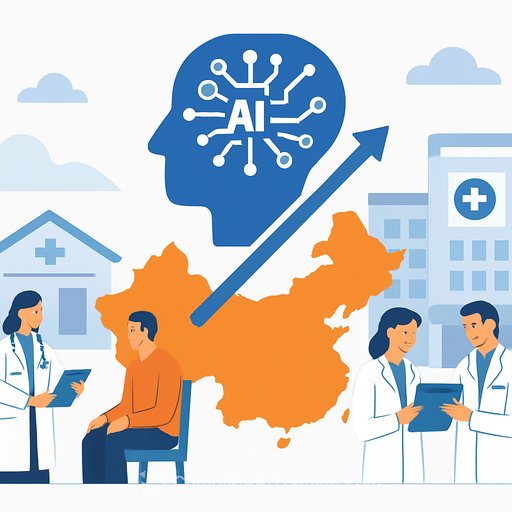
China has set a clear path to embed AI across care delivery, from village clinics to national centers, over the next five years. The plan centers on stronger primary care, better imaging and clinical decision support in hospitals, modernized traditional Chinese medicine (TCM), and safer data use.
Key milestones: by 2027, high-quality datasets and trusted data spaces to support disease-specific models and routine use of AI in primary care, clinical decision support, and patient services. By 2030, AI-assisted diagnostics become standard in primary care, while secondary and tertiary hospitals routinely use AI for imaging analysis and clinical decision support, under a mature regulatory framework.
Primary care: elevate frontline capacity
The priority is clear: give grassroots providers practical tools. Expect AI to assist with common disease management, diagnosis, prescription review, and follow-ups. Primary care teams will also gain access to TCM consultations supported by AI.
For chronic diseases, tools will suggest personalized lifestyle plans and tighten oversight in elderly and nursing care services. The win for clinics: faster triage, cleaner documentation, and fewer missed follow-ups.
Hospitals: from single findings to multi-condition analysis
Imaging will shift from single-disease detection to multi-condition analysis within an organ. This should reduce time-to-report and raise consistency across radiology teams.
National and provincial centers will lead development of advanced clinical decision support for complex cases in pediatrics, psychiatry, and oncology. Expect closer integration with EHRs and more structured outputs that fit existing workflows.
Patient flow and bedside care: less friction, more visibility
Hospitals will deploy intelligent preconsultation, precise appointment systems, and virtual accompaniment to coach patients through visits. Bedside devices will support real-time monitoring and routine nursing tasks to free up staff time for higher-value work.
An intelligent referral system will route patients based on regional capacity, departmental workload, and urgency. Done right, this reduces bottlenecks without adding new ones in triage.
Traditional Chinese medicine: data, devices, and traceability
TCM will benefit from specialized knowledge bases and datasets to inform diagnostic and treatment models. The plan calls for end-to-end traceability for herbal medicines and intelligent management from cultivation to clinical use.
Expect innovation in TCM equipment-intelligent diagnostic devices, acupuncture and massage robots, and smart decoction machines-to bring consistency and auditability to long-standing practices.
Public health, research, and training
AI will support stronger surveillance and emergency response, faster research cycles, and new education pathways for clinicians. Authorities emphasize oversight and early-warning mechanisms to protect care quality, privacy, and data security.
As liver cancer specialist Fan Jia noted, this direction helps tackle uneven distribution of high-quality resources and bottlenecks in treating complex diseases.
What this means for your organization
- Data foundations: inventory your clinical data, imaging archives, and device feeds. Map gaps, especially labels and outcomes. Set up data quality checks and de-identification by default.
- Workflow fit first: pilot AI where signal-to-noise is high-triage, imaging pre-read, order sets, medication review, and discharge planning.
- Safety and governance: adopt a model registry, bias testing, human-in-the-loop checkpoints, and clear rollback plans. Track metrics like diagnostic agreement, turnaround time, and adverse events.
- Infrastructure: prepare for edge devices at bedside and secure connections to trusted data spaces. Clarify vendor integration with your EHR/PACS and single sign-on.
- Skills: upskill clinicians on strengths/limits of AI outputs, prompt quality, and error modes. Train nursing teams on bedside device workflows and alert fatigue control.
- TCM readiness: standardize herb sourcing data, lot IDs, and preparation logs. Evaluate device validation, maintenance, and clinical protocols.
- Privacy: apply data minimization, consent management, and audit trails. Align with guidance such as WHO's recommendations on AI ethics in health.
Suggested metrics to track from day one
- Imaging: time-to-report, sensitivity/specificity by condition, discrepancy rates, recalls avoided.
- Primary care: guideline adherence, antibiotic stewardship, referral appropriateness, follow-up completion.
- Nursing: time on documentation vs. patient care, alarm rates, unplanned transfers, falls and pressure injuries.
- Patient experience: appointment lead time, no-show rate, check-in to consult time, patient-reported satisfaction.
- Safety: override rates, model drift alerts, PHI exposure incidents, downtime minutes.
Near-term actions (next 90-180 days)
- Stand up a clinical AI steering group with radiology, primary care, nursing, pharmacy, IT, and compliance.
- Select 2-3 use cases with measurable ROI and low workflow disruption (e.g., imaging triage, prescription review, referral routing).
- Run a sandbox pilot with retrospective data, then a limited live trial with human oversight and weekly safety reviews.
- Draft procurement requirements: data security, interoperability, audit logs, and model update transparency.
- Launch short, role-based training modules for clinicians and nurses; schedule refreshers every quarter.
Governance and standards
Plan for model lifecycle management: validation, versioning, monitoring, and decommissioning. Require vendors to provide performance by subgroup, clear explanations, and incident reporting.
For ethical and safety guidance, see the WHO's framework on AI in health. It offers practical guardrails for privacy, accountability, and clinical risk management.
WHO: Ethics and governance of AI for health (guidance)
Upskilling your teams
Clinical adoption succeeds when teams understand model limits, documentation needs, and how to escalate issues. Consider short certificates focused on AI in clinical workflows and data governance.
Curated AI courses by job role
Your membership also unlocks: