China's AI Gap Has Shrunk to Months. Treat It Like a Strategic Deadline
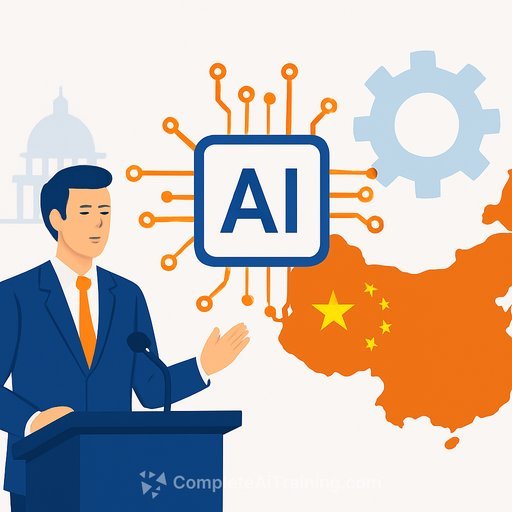
The conversations in Davos were blunt: the West's edge in AI is down to months, not years. Executives and policymakers put it plainly-this is now a strategic contest with economic and national security stakes, not just a race for market share.
Export controls were supposed to slow China. They didn't. Three years on, the assumption that progress depends mainly on raw compute has been challenged by better algorithms, ruthless efficiency, and focused deployment.
Where the Gap Stands
Leaders pointed to a six-month distance between top Western labs and China. Demis Hassabis noted Chinese models are close to the frontier despite hardware limits. The shockwave from Deepseek's 2025 release-strong results at far lower cost-still lingers.
Compute and Energy: The Real Bottlenecks
Access to high-end chips remains the flashpoint. Dario Amodei criticized decisions that allow even limited shipments to China, warning they could scale cyber operations and accelerate weapons development.
Sam Altman argued the West is underestimating China while debating whether the AI buildout is a bubble. He framed hyperscale data center investment as essential infrastructure-comparable to the largest build project in history-and a security requirement.
Elon Musk took the opposite stance on caution, touting Colossus 2, a cluster running at gigawatt scale. His message: speed and massive compute are the counter.
Jeff Bezos cautioned against industrial overreach. Like early factories that built their own generators before shared grids, many AI players will overspend and fail-technology may win, but plenty of balance sheets won't.
Why Export Controls Fell Short
China invested in nuclear, solar, and hydro to feed data centers. Its firms optimized models for domestic chips like Huawei's Ascend series, and stitched tens of thousands together with advanced optical networking. Reports also point to gray-market channels moving advanced hardware into universities and military-linked labs.
For executives tracking policy, see the U.S. Bureau of Industry and Security's guidance on semiconductor controls: BIS. For broader context on global coordination, review the World Economic Forum's ongoing AI policy work: WEF.
Data: China's Quiet Advantage
The edge isn't just chips-it's data. With 1.4 billion users across multipurpose apps like WeChat, Chinese firms train on real-world behavior at a scale the West struggles to match due to privacy law, litigation, and public scrutiny. That data machine also raises concerns about collection tied to consumer tech abroad.
Different End Goals: AGI vs. Industrial AI
Silicon Valley talks about general intelligence. Beijing is shipping factory, vehicle, and city systems that move P&L today. BYD and Xiaomi are building language and vision models into cars to drive autonomy and lower unit costs.
Talent Flows Are Reversing
After years of brain drain, many Chinese researchers trained in the West are returning. They bring elite training and networks into labs in Beijing and Shanghai, where academia, industry, and the military are tightly linked.
The Strategic Risk to the West
Western leaders warned against viewing China through a Western lens. The likely outcome isn't a clone of U.S. models-it's cheaper, good-enough AI embedded into physical products, exported at scale across Africa, Asia, and Latin America.
A six-month gap isn't a comfort zone. It's a window that can close.
What Executives Should Do Now
- Set a compute strategy: Secure long-term GPU and datacenter commitments. Model scenarios where access tightens further. Build multi-region redundancy.
- Treat energy as a board topic: Lock in renewable PPAs or colocate with low-cost generation. Energy pricing will decide unit economics.
- Make cost-to-quality the metric: Track model performance per dollar, not just benchmarks. Prioritize efficient architectures and fine-tuning over blind scale.
- Industrial AI first: Fund use cases that hit cash flow in 12 months-quality inspection, demand forecasting, code migration, claims automation. Kill pilots that don't move numbers. For practical, role-focused training on deploying industrial models, see the AI Learning Path for Production Planners.
- Data advantage without backlash: Build privacy-safe pipelines, synthetic data programs, and first-party capture through products users actually value. Keep audit trails clean.
- De-risk China exposure: Map supplier and JV dependencies. Assume export rules tighten. Prepare China-off/China-on product variants and go-to-market paths.
- Talent and incentives: Pair elite model engineers with ops leaders who own P&L. Add compensation tied to deployed impact, not prototypes.
- Security posture: Upgrade red-teaming, model safeguards, and incident response. Assume adversaries have near-parity capabilities.
- M&A and partnerships: Acquire missing capabilities-data rights, model efficiency, or vertical distribution-before valuations spike again.
- Board reporting: Quarterly review on compute, energy, data pipelines, deployment ROI, model risk, and policy exposure. Treat this like currency risk-constant and material.
If You're Building Capability Internally
Stand up an internal academy tied to job roles and use cases, not theory. If you need a curated starting point for role-based upskilling, see courses by job.
The Bottom Line
AI is now inseparable from geopolitics. Every improvement in software or silicon shifts leverage somewhere. Move with urgency, spend where it compounds, and measure everything against cash flow and resilience.
Your membership also unlocks: