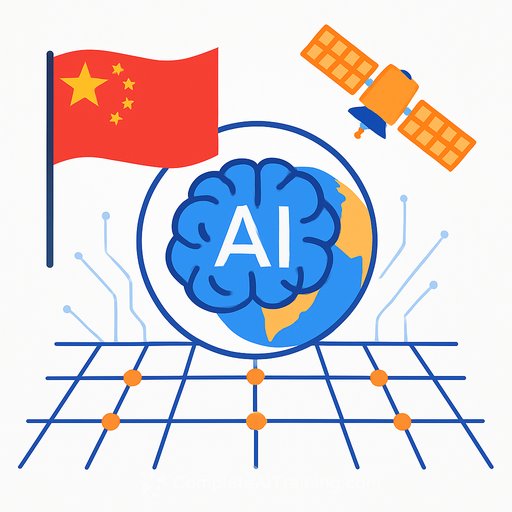
China deploys an autonomous AI science system across its supercomputing network - one month after the US announced the Genesis Mission
China has built and deployed an AI system that connects directly to the country's national supercomputing network and runs high-level research with minimal human oversight. The launch happened on December 23. It arrives a month after US President Donald Trump announced the Genesis Mission - an "AI Manhattan Project" with proof-of-progress due within 270 days. China's system is already serving more than a thousand potential institutional users nationwide. See Research for related coverage and analysis.
What this system likely includes
- Direct integration with supercomputing schedulers to allocate jobs, track utilization, and move data efficiently across centers.
- Autonomous research agents that plan experiments, run simulations, monitor outputs, and iterate without manual prompts.
- Domain model stacks for materials, biology, climate, and physics tied to large shared datasets and curated benchmarks.
- Federated data access with policy controls across universities, labs, and enterprises.
- Interfaces for lab automation and simulation workflows to close the loop from hypothesis to result.
Why this matters for research teams
- Shorter cycles from idea to result as AI agents manage compute queues, parameter sweeps, and error recovery.
- More consistent baselines across institutions when datasets, checkpoints, and workflows are standardized.
- Higher utilization of national compute by reducing idle time and failed jobs.
- Faster cross-disciplinary work as shared infrastructure lowers the friction to test ideas in new fields.
US Genesis Mission vs. China's deployment
- Timeline: the US plan sets a 270-day proof-of-progress window; China moved straight to nationwide deployment.
- Scale: China's system is already accessible to 1,000+ potential institutional users; US details will hinge on how quickly infrastructure consolidates.
- Focus: both aim to secure technological leadership; execution will depend on data access, compute orchestration, and safety guardrails.
Risks and guardrails to get right
- Reproducibility: autonomous loops can drift. Log everything - data versions, seeds, configs, and environment hashes.
- Safety: enforce evaluation gates before large-scale runs. Borrow from the NIST AI Risk Management Framework for policy and audits.
- Misuse and data leakage: strict role-based access, synthetic data where possible, and privacy-preserving training.
- Compute fairness: prevent queue starvation by few large teams; institute quotas, priority classes, and transparency.
What you can do now to prepare
- Package your workflows in containers with pinned dependencies; publish minimal, reproducible examples.
- Adopt clear metadata standards (dataset cards, model cards, provenance) across your lab or department.
- Instrument experiments for automated evaluation and early-stop criteria; make failure states explicit.
- Stand up data governance: access policies, retention rules, red-teaming for sensitive datasets. IT and infrastructure leaders should consult the AI Learning Path for CIOs.
- Refactor pipelines for large batch runs: checkpointing, resumable jobs, and cost/quality trade-off presets.
- Train your team on AI-for-science tooling, distributed training, and HPC schedulers; project leads can follow the AI Learning Path for Project Managers.
Likely early wins
- Materials discovery: inverse design via generative models plus high-throughput simulation.
- Drug and protein design: structure prediction, docking, and automated screening workflows.
- Climate and weather: ensemble forecasting, downscaling, and policy-constrained scenario testing.
- Energy systems: grid optimization, fusion simulation, and control policies for complex facilities.
How to track progress
Watch national compute trends and benchmark disclosures. The TOP500 list provides signals on hardware capacity, but the real insights will come from published pipelines, evaluation suites, and shared datasets tied to reproducible results.
Skills and resources
If you're leading a research group and need your team to level up on AI-for-science workflows, see practical training options by job role here: Complete AI Training - Courses by Job.
Bottom line: the race is active. China has production infrastructure in play; the US has a deadline-driven initiative. For scientists, the advantage goes to teams that standardize their pipelines, log everything, and prepare to let autonomous agents run - with tight checks at every critical step.
Your membership also unlocks: