China's 2026 AI push: What IT and dev teams should build next
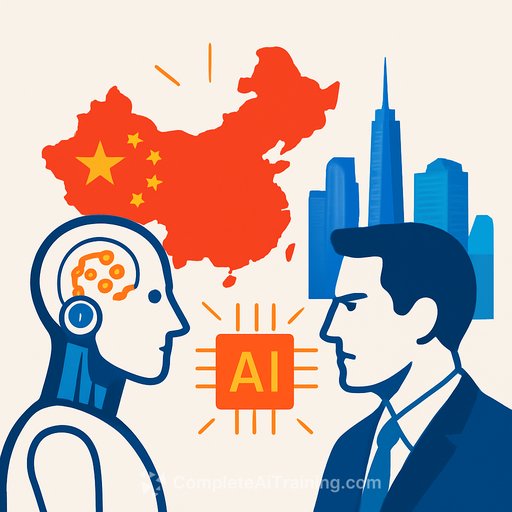
On the final day of 2025, Deepseek dropped a dense paper on "manifold-constrained hyper-connections" - a training framework aimed at scaling foundation models. It was a quiet flag planted at the peak of holiday downtime: China's AI players are moving with intent.
After DeepSeek-V3 and the reasoning model DeepSeek-R1 hit benchmarks last year at far lower cost than the usual US buildouts, markets took notice. Expect more of that pressure in 2026: policy support, capital, and a widening talent pipeline are pushing Chinese AI forward.
Why this matters for your stack
Cheaper, competitive base models are now a given, not a surprise. That reshapes unit economics for fine-tuning, inference, and product iteration.
- Benchmark a China-inclusive model slate (e.g., DeepSeek, Qwen) alongside your incumbents (GPT family, Claude, Mixtral, etc.).
- Track cost per successful task, not just tokens. Include latency, function-calling reliability, and eval pass rates.
- Adopt model routing and fallbacks. Let price and performance data, not preference, pick the model per request.
Open models: capability and adoption are converging
Stanford-linked research suggested China's open models have caught up - in some cases pulling ahead on capability and adoption. One signal: Meta reportedly used Alibaba Cloud's Qwen during training for a new model, while Airbnb said it relies heavily on Qwen in production.
For teams, the practical takeaway is simple: treat Qwen as a first-class option in prototyping and production, then let evals decide. Keep an eye on license terms and regional deployment constraints.
- Reference: Stanford's AI Index for trend baselines AI Index.
- Qwen open-source entry points (docs and repos) are widely available; include them in your bake-offs.
Beyond chat: agents, on-device, and humanoids
Consumer-facing AI in China moved from chat to agentic patterns and on-device form factors. Alibaba launched Quark AI Glasses; ByteDance tested an agent-first smartphone before dialing back features due to app restrictions.
Humanoid robots are getting real R&D momentum (embodied AI), with leaders predicting major progress in three to five years. That said, insiders still say the "ChatGPT moment" for robotics isn't here yet.
- Pilots to run now: on-device inference for private data, offline capabilities, and low-latency UX.
- Agent design: clear tool use, memory boundaries, and human-in-loop checkpoints. Rate-limit actions; log everything.
- Robotics: treat 2026 as learning and prototyping. Focus on simulation, control policies, and safety tooling.
Market structure: profitability, IPOs, and M&A
Chinese AI firms face a 2026 test: turning research into revenue. MiniMax and Zhipu AI moved toward Hong Kong listings, while Moonshot AI raised a sizable round and can wait longer.
Meta's acquisition of Manus shows another route: get traction, then scale under a larger parent. For buyers, this means vendor continuity can improve post-acquisition - but negotiate data protections and model migration clauses up front.
Policy tailwinds and talent density
Leadership messaging in China has placed AI at the center of economic upgrades, with domestic chips making progress. Provincial adoption is already visible, with officials using AI to draft documents.
For enterprise teams, that means more integrations across supply chains and state-linked sectors. Prepare for stronger compliance requirements and clearer KPIs tied to productivity, cost, and safety.
Engineering playbook for 2026
- Model portfolio: maintain at least three families (US closed, US/EU open, China open). Build a thin abstraction layer so you can swap without rewrites.
- Eval-first development: create task suites (code-gen, retrieval QA, tool-use), track weekly deltas, and fail models fast.
- Cost control: streaming by default, structured outputs, function calling, LoRA fine-tunes for niche tasks, and token budgets per feature.
- Data strategy: RAG over fine-tune unless behavior change is required. Separate knowledge from behavior; cache aggressively.
- Agent safety: permissions per tool, timeboxed plans, deterministic steps where possible, and audit trails.
- On-device pilots: test small models on phones/glasses for private workflows, low-latency UX, and offline modes.
- Compliance: track data residency, export controls, and vendor risk. Mirrors and fallbacks for critical paths.
- Developer tools: if you push code assistants (like Cursor) org-wide, measure output quality and defect rates - not just usage. Reward fewer bugs and faster reviews, not prompts per day.
Signals to watch
- DeepSeek's follow-ups on "manifold-constrained hyper-connections" and any open training details.
- New Qwen releases and enterprise-grade guardrails or tool-use upgrades.
- Policy moves affecting compute, chips, and cross-border model access.
- Agent frameworks maturing (planning, memory, tool orchestration) and real-world ops metrics.
- Humanoid pilots in logistics and manufacturing; look for safety certifications and unit economics.
Career and team upskilling
The talent story cuts both ways. Adoption is surging, and so is anxiety among engineers as code assistants get better.
Lean into skills that compound: data pipelines for RAG, evaluation tooling, distillation, system prompts and tools, and secure deployment. If you're building a talent plan, get your developers certified where it impacts delivery and hiring.
- AI Learning Path for Business Unit Managers - align leadership and KPI expectations across units.
- Generative Code - tooling and best practices for code-generation workflows.
Bottom line
China's AI push is shifting the price-performance curve and expanding your options - from open models to on-device and agents. Treat 2026 as the year you build a model-agnostic foundation, lock in cost discipline, and ship features that prove value in days, not quarters.
The teams that win won't bet on a single model. They'll run the evals, swap fast, and let results choose the stack.
Your membership also unlocks: