China's AI-driven Military Logistics: What Operations Leaders Can Learn
"Before the troops and horses move, provisions and fodder must go first." Logistics decides tempo, not just costs. The PLA is rebuilding its sustainment engine around real-time data, automation, and cross-sector integration. The goal is clear: keep units supplied under stress, at speed, and with fewer bottlenecks.
The Joint Logistic Support Force (JLSF)
Formed in 2016, the JLSF unifies logistics across the Army, Navy, Air Force, and Rocket Force. It runs theater-level support centers, depots, and integrated information systems that pull data from units, bases, and civilian contractors. The result is a single operating picture for planning and execution.
Core Features of the JLSF Network
- Continuous demand sensing: Moving from periodic reports to live visibility on equipment status, inventory, and consumption.
- Smart depots: Item-level identifiers, automated tracking, and condition monitoring to cut delay and shrink loss.
- Shared warehouses: Pooled stock accessible across units to reduce redundancies and transport overhead.
Advanced Demand Sensing and Resource Allocation
Manual checks are giving way to AI-assisted planning. Field units place requests in apps (e.g., "Xueyu"), central systems aggregate demand, and algorithms match needs to supply in near real time. This shortens the loop from request to fulfillment and prioritizes what matters first.
Inventory Innovations
- Real-time data integration: IoT sensors track quantities, locations, and storage conditions to keep counts honest and usable.
- Public-access warehouses: Centralized hubs that let units draw as needed, lowering dead stock and smoothing flows.
Partnering with Civilian Logistics
Since 2017, the PLA has leaned on major logistics providers for scale, speed, and modality options. JD Logistics supports a large share of orders from procurement through quality control. SF and Deppon add refrigerated transport and multimodal freight to handle sensitive or complex loads.
Autonomous Last-Mile Delivery
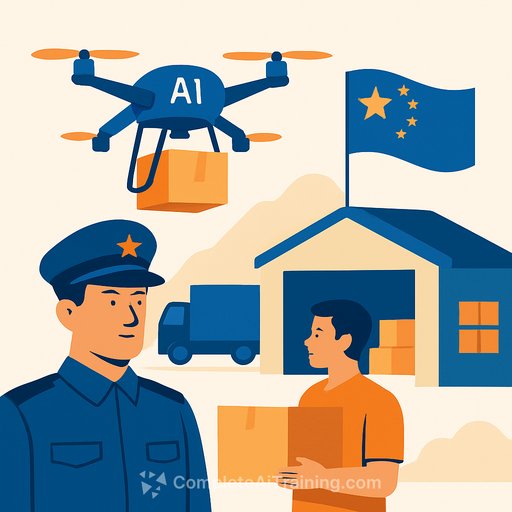
For terrain and threat environments that strain conventional transport, UAVs and unmanned ground vehicles (e.g., Mule-200) handle resupply runs. Automation extends reach, keeps people out of harm's way, and preserves tempo when routes are uncertain.
Benefits
- Greater reach: Supplies move where trucks can't or shouldn't go.
- Lower exposure: Fewer personnel at risk during contested missions.
- Flexible resupply: More options to sustain front-line units under shifting conditions.
Implications for Operations Leaders
- Build a live demand picture: Instrument assets and inventory with sensors and telemetry. Latency hides shortages until it's too late.
- Standardize unique IDs: Create a clean item registry so every part, SKU, and kit is traceable end to end.
- Adopt shared inventory pools: Centralize stock with allocation rules to reduce carrying costs and increase agility.
- Tighten vendor integration: Link planning, ordering, and QA with civilian partners through SLAs and shared systems.
- Automate the last mile: Pilot drones and UGVs for remote, hazardous, or time-critical runs. Start with narrow, high-value use cases.
- Get your data house in order: Clear ownership, access controls, and audit trails. Bad data breaks automation fast.
- Design for resilience: Preposition critical items, dual-source suppliers, and rehearse fallback logistics paths.
- Track the right KPIs: Fill rate, order cycle time, mean time to resupply, forecast accuracy, and loss/damage rate.
Strategic Considerations
PLA planners treat logistics as a decisive factor, including scenarios across the Taiwan Strait. New sensing, shared warehouses, and autonomous delivery change assumptions about sustainment speed and endurance. Any analysis of force readiness now has to include the JLSF's data flows, depot access, and civil-military interfaces.
What to Watch
- Updated assumptions: Expect faster resupply cycles and better cross-theater coordination than legacy models predicted.
- Network risk: Logistics systems are attractive targets in conflict; interdependencies and key nodes matter for both defense and continuity planning.
Bottom Line
The PLA is moving to a data-driven, automated sustainment model that closes the gap between demand and supply under pressure. For any operations team, the lesson is simple: sense earlier, integrate across partners, and automate the last mile where it removes the most friction.
If you're building AI skills for operations teams, explore the AI Learning Path for Supply Chain Managers.
Your membership also unlocks: