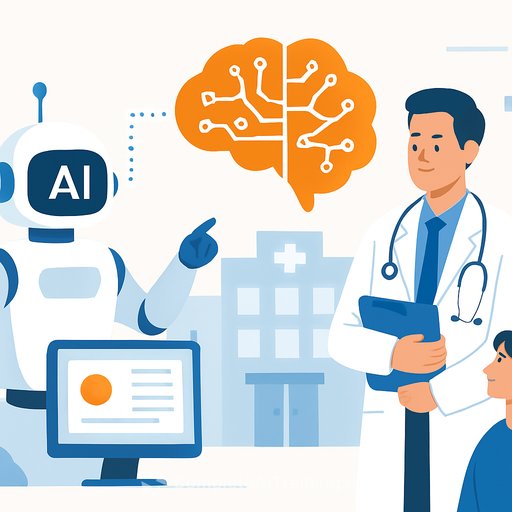
China's AI-in-Healthcare Plan: What Clinicians and Hospital Leaders Need to Know
China has released a national directive to embed AI across its healthcare system, from top-tier hospitals to rural clinics. The policy sets deadlines, names priority use cases, and commits to building the data backbone needed for scale. If you work in care delivery, this plan signals what to expect on clinical workflows, procurement, and training through 2030.
Timeline and adoption targets
- By 2027: Build high-quality health datasets and make AI diagnostic tools accessible nationwide.
- By 2030: Routine AI-assisted diagnosis in primary care; AI image analysis and clinical decision support standard in all Grade 2+ hospitals.
Infrastructure and data strategy
A unified national health information platform will link federal, provincial, city, and county systems using citizens' national ID numbers. The end goal is a centralized medical data center with strict data protection, access controls, and clear oversight.
Expect stronger rules on data quality, security, and algorithm supervision. For context on governance principles, see the WHO's work on AI ethics in health here and China's National Health Commission here.
Imaging: the near-term win
Medical imaging is front and center. By 2030, major hospitals are expected to use AI for image analysis, with provinces coordinating deployment. The focus is moving from single-disease algorithms to multi-condition analysis within the same organ.
The market is crowded, with many vendors offering similar products. Expect consolidation and tighter performance scrutiny on sensitivity, specificity, workflow impact, and integration with PACS/RIS/EMR.
Vertical large models: specialty-grade assistants
China is promoting "vertical" large models tuned to specific domains. Notable examples include a rare-disease model ("Xiehe-Taichu"), a pediatric model ("Futang-Baichuan"), and a cardiology model ("CardioMind") that draws on a digital twin of expert Ge Junbo for advanced diagnostic training.
For clinicians, these tools point to deeper specialty support: differential diagnosis, risk stratification, and decision support tied to local guidelines and care pathways.
Primary care and rural clinics
AI assistants will extend into grassroots care to ease the urban-rural gap. Priority functions include diagnostic support, prescription review, and chronic disease management.
Early results show value in pediatrics, where models help local doctors distinguish routine cases from rare but serious conditions such as viral encephalitis. Success here will depend on connectivity, device availability, and straightforward workflows that don't add clicks.
Unresolved issues: payment, safety, and competition
- Reimbursement: No clear framework yet for paying for AI-enabled services-still the biggest barrier to scale.
- Data security and ethics: Stronger safeguards and audit trails will be mandatory, especially with centralized data infrastructure.
- Market competition: Many lookalike tools; health systems will need rigorous evaluation standards to pick and keep what works.
What hospital leaders and clinicians can do now
- Set governance: Create an AI oversight group (clinical, IT, legal). Define approval, monitoring, and decommissioning processes. Require model cards, validation evidence, and post-deployment reports.
- Start with imaging pilots: Pick 1-2 high-volume studies (e.g., chest CT, mammography). Track KPIs-turnaround time, sensitivity/specificity, recall rates, workload reduction, and downstream cost.
- Tight integration: Ensure seamless links to PACS/RIS/EMR. Assign clinical owners for each tool and standardize handoffs when AI flags urgent findings.
- Data readiness: Improve labeling quality, de-identification, and access controls. Document data lineage and versioning for audits.
- Budget and billing: Map potential reimbursement codes and cost offsets. Build a business case around avoided repeats, shorter length of stay, and fewer adverse events.
- Vendor due diligence: Check security practices, drift detection, human-in-the-loop safeguards, and uptime SLAs. Require local validation on your patient mix.
- Train the workforce: Provide short, role-based modules for clinicians, techs, coders, and quality teams. For structured upskilling, see Complete AI Training by job.
- Primary care enablement: Equip rural sites with simple UIs, offline fallback, and remote consult channels. Prioritize pediatrics and chronic disease programs for early benefit.
How this may look by 2030
Primary care routinely uses AI for triage and decision support, with clear escalation paths. Grade 2+ hospitals run AI-driven image analysis and clinical support as part of standard workflow, supervised by clinician review.
Data flows across levels of care, with audit-ready logs and outcome tracking. Reimbursement rules recognize AI's role in diagnostics and care management, creating a viable path from pilots to system-wide deployment.
Bottom line: the policy sets a clear direction. The winners will pair careful validation with everyday usability-and show measurable gains in access, quality, and cost.
Your membership also unlocks: