AI has a hand on day-to-day care: what China's push means for healthcare teams
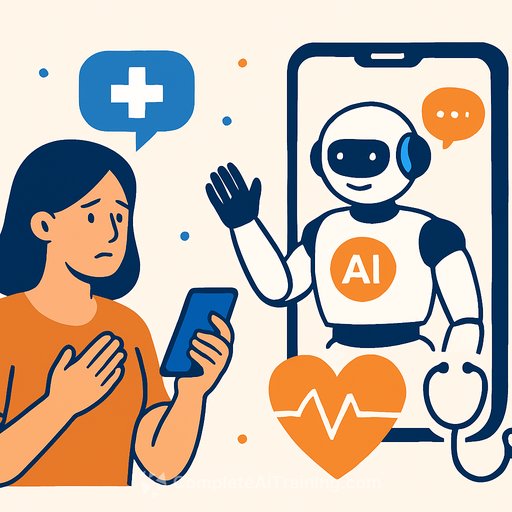
A 32-year-old office worker in Beijing tracks workouts, diet, sleep, and health questions in a single app. She uploads images, speaks into her phone, and gets real-time responses plus a plan she can follow. It feels like a friendly doctor, a nutritionist, and a coach in one place-then hands off to real clinicians when needed.
This is where consumer demand is heading. For hospitals, clinics, and payers, that shift matters. It's changing patient expectations, redistributing touchpoints, and moving triage, education, and follow-up into always-on, AI-assisted channels.
Where the momentum is coming from
China's elder care market is forecast to exceed 20 trillion yuan by 2030. AI healthcare spend reached 97.3 billion yuan in 2023 and is projected to hit 159.8 billion yuan by 2028 (CAGR 10.5 percent). Policy is pushing, too: national guidelines call for high-quality AI health assistants, wider use of imaging AI and decision support, and primary care coverage with intelligent diagnostic support by 2030.
Translation for your organization: expect more virtual-first entry points, standardized workflows backed by AI, and tighter links between consumer apps, clinicians, and payers.
What leading platforms are doing right now
Ant Afu (Ant Group) reframed its AI health app from a tool to a companion. More than 15 million monthly active users ask over 5 million health questions every day; 55 percent are in third-tier cities and below. The app syncs with devices from Apple, Huawei, Vivo, and Omron to track heart rate, blood pressure, sleep, and activity. It supports multi-user family records, sets goals across exercise, diet, and lifestyle, and connects to a network of 300,000 doctors for online consults. The company is clear: responses are guidance, not medical diagnoses.
Baidu Health upgraded its assistant toward an "all-in-one family doctor" model. Total order volume has passed 47 million. The service handles text, image, audio, and video with reported recognition accuracy above 95 percent, and sits on top of 600 million pieces of health content, 360,000 doctor services, and 100+ AI tools. The goal: prevention, education, and ongoing management in one flow, available 24/7.
JD Health is rolling out a medical LLM-based system for online care. It assists doctors with data collection, analysis, paper drafting, and hospital operations, with an emphasis on privacy and record security. Its "AI doctor digital twin" learns a physician's clinical style to offload routine tasks, provide patient education, manage post-care touchpoints, and propose diagnostic options-while keeping final decisions with the human clinician.
Signals for clinicians and administrators
- Consumer-facing AI is setting the pace. Patients will expect fast answers, clear next steps, and seamless escalation to a clinician.
- Primary care and community settings will see AI-backed decision support as standard, especially in imaging and triage.
- The competitive edge is moving from simple traffic to end-to-end capability: data quality, integrations, compliance, payments, and fulfillment.
- AI agents are cutting documentation time and helping generate orders, freeing clinicians for higher-value work.
Guardrails that matter
- Clinical oversight: Keep final diagnostic and prescribing authority with licensed professionals. Escalation paths must be clear.
- Data governance: Protect PHI with encryption, access controls, and audit trails. Define retention and model training policies.
- Bias and quality checks: Benchmark outputs against guidelines; monitor error types, drift, and performance across subpopulations.
- Regulatory fit: Map use cases to current regulations and hospital policies. Document indications for use and limitations in patient-facing flows.
High-yield use cases to pilot now
- Clinical documentation: AI-generated notes, summaries, discharge instructions, and patient letters reviewed by clinicians.
- Triage and symptom guidance: Clear, conservative advice with escalation triggers and warm handoffs to telehealth or in-person care.
- Imaging and CDS: Second-reader tools in radiology and decision support for order sets and risk scoring, with audit and feedback.
- Remote monitoring: Device data ingestion (heart rate, BP, glucose) with thresholds, alerts, and care team routing.
- Medication support: Regimen education and reminders tied to pharmacy services and refill logistics.
- Population health outreach: Proactive nudges for screenings, vaccinations, and chronic disease check-ins.
Technical checklist for procurement
- Interoperability with EHR/HIS and device ecosystems; support for common standards like FHIR.
- Multimodal input (text, image, audio, video) and clear data lineage.
- Role-based access, audit logs, and environment isolation for PHI.
- Configurable guardrails: allowed sources, citation policies, and escalation logic.
- Model lifecycle controls: versioning, evaluation, rollback, and continuous quality monitoring.
Metrics that prove value
- Time saved per note, per order set, and per triage interaction.
- Guideline adherence in AI-assisted encounters.
- Patient engagement: completion rates, response times, follow-through on care plans.
- Access and equity: wait time reductions, reach into lower-tier cities and rural areas.
- Cost per resolved inquiry and cost per appropriate escalation.
What to expect by 2030
Intelligent diagnosis and treatment assistance will be routine in primary care clinics across China, with broader use of imaging AI and decision support in secondary and tertiary hospitals. New service formats-AI health checkups, consultations, and ongoing management-will be normal, and vertical medical models will get more specialized.
Analysts point to a clear pattern: the winners integrate health management, diagnosis, payment, and pharmacy delivery into a closed loop that centers the user, stays compliant, and collaborates across industries. With large user bases and data, tech platforms have the reach. Health systems that partner well-and set strong guardrails-will see the benefits first.
Bottom line for healthcare teams
AI isn't replacing clinicians. It's removing repetitive work, extending coverage, and improving consistency when used with oversight. Start with low-risk, high-volume workflows, measure outcome deltas, and scale what proves safe and useful.
For governance and safety frameworks, see the WHO guidance on AI in health here. If your team needs structured upskilling on practical AI skills, explore the AI Learning Path for Training & Development Managers.
Your membership also unlocks: