China’s Strategic Push to Become a Leading A.I. Power
China is investing billions in artificial intelligence to close the gap with the United States. The government is driving this effort with a strong industrial policy, similar to strategies used in electric vehicles and solar power. This approach targets the entire A.I. ecosystem—from semiconductor manufacturing to data centers and talent development.
State-Backed Development Across the A.I. Tech Stack
For over a decade, Beijing has pushed domestic companies to build capabilities in high-tech sectors. This has helped China become a top manufacturer globally and a leader in sectors like electric vehicles and solar panels. Now, the focus is on A.I. essentials: chips, data infrastructure, skilled engineers, and large-scale data.
Unlike the U.S., where private tech giants invest billions in data centers, China’s government plays a direct role in financing infrastructure and hardware. It supports labs focused on advanced A.I. research, often collaborating with companies such as Alibaba and ByteDance. Local governments also actively fund start-ups through loans and subsidies, creating hubs like Dream Town in Hangzhou, a city known for its A.I. talent.
Open-Source A.I. as a Strategic Lever
After U.S. companies like OpenAI restricted access to their advanced systems, Chinese developers turned to open-source alternatives. Chinese firms such as DeepSeek, Alibaba, and Huawei have released open-source A.I. systems that rank among the world’s best. This open approach lowers barriers for engineers globally and speeds up innovation.
Open-source A.I. provides a competitive edge, allowing Chinese companies to quickly catch up with Silicon Valley. It also offers the potential to influence global standards for A.I. technology, as these systems gain traction worldwide.
Balancing Innovation with Government Controls
China’s A.I. development is carefully aligned with government regulations. Unlike U.S. models trained on diverse web content, Chinese A.I. systems must comply with strict censorship rules. To address this, the government provides approved datasets, such as collections based on state media articles, to train A.I. while adhering to official narratives.
Chinese companies also leverage vast amounts of domestic user data, enabling successful applications like those developed by ByteDance. This blend of controlled data and open-source technology reflects China’s unique approach to A.I. development.
Challenges in a State-Driven Model
The top-down approach has drawbacks. Many A.I. start-ups compete intensely, often pushing prices down to attract customers. Rapid shifts in technology, such as the rise of generative A.I., have exposed difficulties in quickly reallocating resources. Unlike stable industries, A.I. demands agility that the government’s centralized strategy sometimes struggles to provide.
Additionally, Chinese chipmakers like Semiconductor Manufacturing International Corporation (SMIC) are working to produce A.I. chips that can replace those made by Nvidia. However, these alternatives often lag behind in performance and volume, limiting widespread adoption. The goal is to ensure China has viable options if cut off from U.S. technology, maintaining steady progress rather than stagnation.
Implications for Global A.I. Competition
- China’s government-backed investments are leveling the playing field against U.S. tech giants.
- Open-source releases by Chinese companies encourage global collaboration and adoption.
- The fusion of state control and innovation creates a distinct model that may appeal to international engineers and markets.
- Restrictions on technology exports and data access continue to influence the pace and direction of A.I. development.
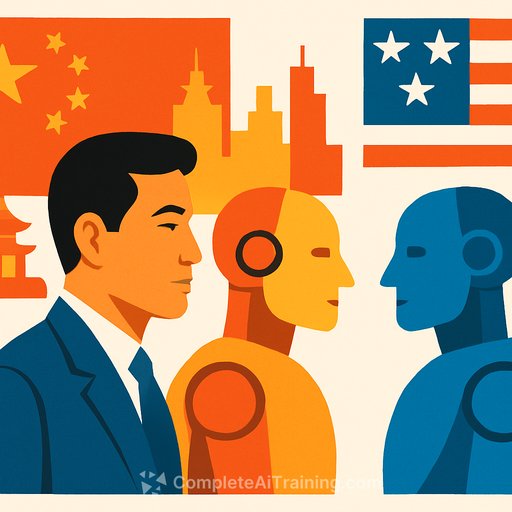
American leaders view this rivalry as ideological, with concerns about the implications of authoritarian-controlled A.I. versus democratic approaches. The competition extends beyond technology to the influence on global standards and governance of A.I. systems.
For government professionals monitoring technology policy and international competition, understanding China’s comprehensive industrial policy on A.I. is crucial. It highlights how state resources can accelerate innovation, but also the trade-offs involved in a centrally planned ecosystem.
Those interested in deepening their knowledge about A.I. technologies and policy impacts may find relevant courses and resources at Complete AI Training.
Your membership also unlocks: