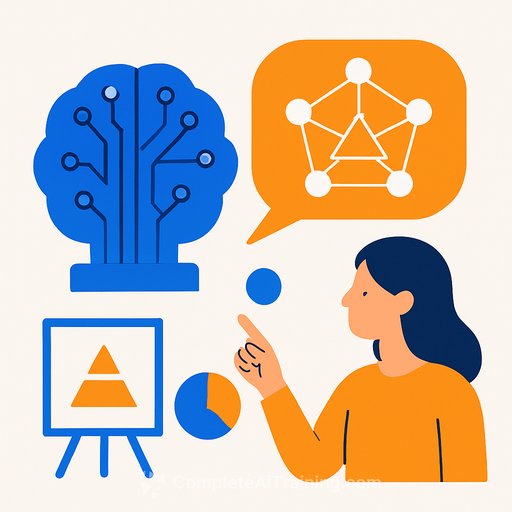
Chinese researchers create neural network for modeling human concept formation
Chinese scientists have introduced a neural architecture that learns concepts directly from raw sensory data like sight and sound. The work, published in the journal Nature Computational Science, aims to capture a core feature of human cognition: forming abstract ideas from lived experience and using them flexibly without constant sensory input.
What's new
The team developed a framework called CATS Net with two key parts: a concept-abstraction module and a task-solving module. It can process visual inputs (e.g., images), form higher-level concepts, then apply those concepts to tasks such as recognition and judgment.
Crucially, the system can generate a rich, self-constructed "concept space." Different AI systems can bring their concept spaces into correspondence and exchange knowledge using these concepts-without retraining on the original data. That mirrors how humans use language to share ideas, not raw sensory streams.
Why this matters for research
Most large language models learn from text, which caps their ability to build new concepts strictly from experience. A model that builds concepts from sensorimotor input could move AI research closer to studying how ideas emerge from perception, action, and feedback-more like how humans learn.
The study also connects machine learning to neuroscience. Brain-imaging results show that CATS Net's conceptual structure tracks human cognitive and linguistic logic, and its operation corresponds to activity patterns in concept-processing regions. That suggests a potential computational account of how the brain might form and use concepts.
Practical implications scientists should consider
- Data efficiency: Concept-level transfer may reduce the need to share or retrain on raw datasets.
- Knowledge exchange: Models can communicate through concept representations, accelerating multi-system collaboration.
- Multimodal grounding: Learning from sight and sound enables richer, less brittle abstractions than text-only training.
- Interpretability: A defined concept space could make model behavior easier to probe and compare to human judgments.
- Neuroscience synergy: Comparable representational structure opens doors to tighter model-brain benchmarking.
Method at a glance (from the paper)
CATS Net separates learning abstract concepts from applying them to tasks. The concept-abstraction module builds an internal space of concepts from sensory input. The task-solving module uses that space to perform downstream tasks with targeted instructions.
Because each instance can build its own concept space, systems need a mapping step to bring those spaces into correspondence before exchanging knowledge. Once mapped, they can transmit conceptual knowledge directly, avoiding raw-data sharing.
What to watch next
- Generalization beyond vision: Performance and stability across additional modalities and environments.
- Standards for concept-space mapping: Methods, metrics, and safeguards for cross-system knowledge transfer.
- Evaluation protocols: Benchmarks that test human-like flexibility, causal reasoning, and concept recombination.
- Ethics and governance: Controls on what gets transferred when raw data aren't involved.
For working scientists interested in applying concept-based AI to experiments, workflows, and model evaluation, see our resource hub: AI for Science & Research.
Separately, Chinese teams also reported a new molecular mechanism to improve cold resilience and phosphate use in maize-another example of research aimed at practical constraints that limit real-world performance.
Your membership also unlocks: