China's CAC Bans Online and AI Content Discouraging Marriage or Childbearing
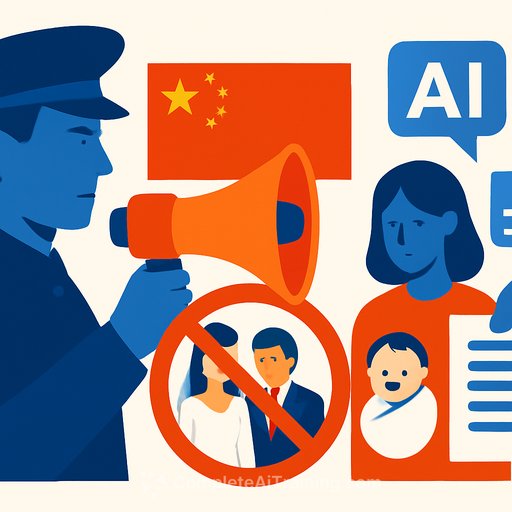
China's top internet regulator has launched a month-long Lunar New Year campaign to remove content it deems harmful to social stability and family formation. The Cyberspace Administration of China (CAC) is targeting posts and AI-generated material that promote "fear of marriage," "childbirth anxiety," or "gender antagonism."
The move lands during a sensitive season of family reunions and questions about marriage and kids. It signals a policy turn: addressing demographic decline by steering the tone of online discourse, not just with subsidies or rule changes.
What's New
The CAC has directed platforms to strengthen moderation and staff up during the holiday surge. Content that amplifies hesitation about marriage or parenthood is flagged as inflaming negative emotions and slated for removal.
The campaign also targets "digital garbage," including mass-produced AI content that dramatizes family conflict for clicks-think in-law disputes or sibling rivalries-and any AI content deemed illogical or empty. Flashy displays of wealth, vulgar or violent videos, and suggestive imagery remain on the do-not-post list.
Why It Matters for Government Actors
China's birthrate slump has become a core policy concern after decades of prior population controls. Economic pressures, housing costs, and work intensity have cooled interest in early marriage and childrearing, and those concerns often surface online.
By treating these narratives as a governance issue, authorities are moving demographic policy into content oversight. Private platforms continue to serve as front-line enforcers translating broad directives into algorithmic and human review.
What Platforms Are Expected to Do
Major social apps have been told to create special task forces, boost staffing, and intensify inspections through the holiday. Platforms that host banned material face investigation and possible sanctions, though penalties for this round were not specified.
The CAC's enforcement model remains consistent: proactive moderation, rapid takedowns, and documented compliance. Past actions in 2025 against Jinri Toutiao, UCWeb, Weibo, Kuaishou, and Xiaohongshu reinforce the pattern.
Operational Checklist for Regulators and Public Institutions
- Clarify definitions: Issue internal guidance translating "fear of marriage," "childbirth anxiety," and "gender antagonism" into reviewable criteria and examples for consistent platform and agency use.
- Update moderation playbooks: Require platforms to tag and downrank content themes covered by the directive; audit AI-content pipelines used for creation, recommendation, and detection.
- Set surge protocols: Mandate 24/7 coverage during peak periods, with escalation paths for cross-platform cases and coordinated takedowns.
- Document enforcement: Track removals by category, source (user vs. AI-generated), and recurrence to support proportional penalties later if needed.
- Guardrails for AI content: Require provenance labels and maintain reference datasets of disallowed dramatized family-conflict tropes for automated screening.
- Counter-messaging: Encourage factual, supportive content on marriage and family benefits while avoiding stigmatization of users expressing personal concerns.
- Legal review: Ensure any platform penalties align with existing licensing, cybersecurity, and data rules; record notice-and-action timelines.
Risks and Open Questions
- Over-removal risk: Platforms may suppress good-faith discussion about costs, childcare, or work-life balance. Clear appeal channels and sampling audits can reduce collateral damage.
- AI evasion: Synthetic content can mutate phrasing faster than rulebooks. Continuous model updates and adversarial testing should be part of the mandate.
- Measurement: It remains unclear how impact will be assessed-volume of takedowns, prevalence reduction, or sentiment shifts-especially during a short holiday window.
Context
Authorities have shifted from limiting births to encouraging larger families, but structural pressures remain. Public data reflect the trend: China's fertility rate has been below replacement for years, and the population has started to contract.
For background on the regulator's remit, see the Cyberspace Administration of China. For demographic reference, see international indicators such as the World Bank's fertility rate data for China.
What to Watch Next
Expect visible takedown activity during the nine-day holiday and public notices spotlighting "digital garbage" clean-ups. Platforms will likely fine-tune AI filters for relationship and family themes to minimize enforcement lag.
If the campaign is extended, watch for formal penalty schedules, required transparency reports, and standardized taxonomies for AI-generated content risks.
Skill Building for Policy Teams
If you're drafting or enforcing content rules that intersect with AI, structured training helps. See the AI Learning Path for Policy Makers for governance, risk assessment, and audit practices that translate well to content oversight.
Your membership also unlocks: