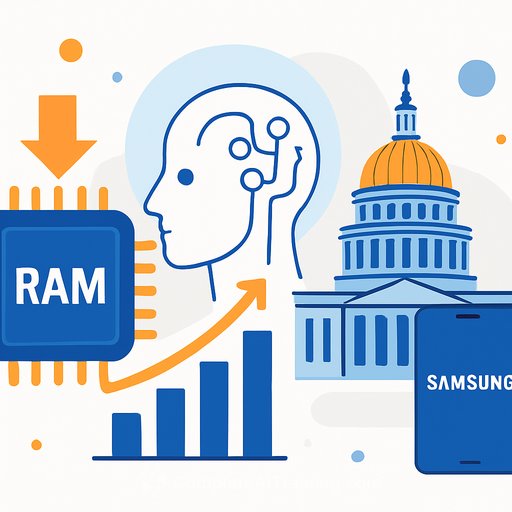
Memory scarcity meets AI build-out: practical signals for scientists and R&D teams
Short version: memory is tight, compute is scaling, and policy is getting involved. The past few days brought clear signals across phones, semiconductors, and national AI initiatives that will affect budgets, timelines, and tooling in 2026.
Phones: DRAM supply is tight, but Samsung stays the course
Samsung sees the memory shortage as an opening and says it has no plans to cut phone memory in 2026. At the same time, multiple brands are trimming specs and raising prices as supply tightens.
Why it matters: memory now accounts for roughly 35% of a mid-range smartphone's build cost. Expect OEMs to juggle RAM, storage, camera, and display trade-offs. For on-device AI work, plan and test under tighter RAM ceilings to avoid surprises in latency and thermal behavior.
Supply chain: investment shifts and local builds
Tata Group is putting another US$170M into Tata Electronics to expand iPhone manufacturing and semiconductor capacity. It's a signal that India's role in advanced electronics will keep growing.
Elsewhere, Taiwan's AIDC is starting small-scale production in the US-another data point for regionalization and resilience. And in data center memory, higher-density DDR5 RDIMMs are clearing key certifications, pointing to a near-term step up in capacity per node.
Policy and infrastructure: new venues for data and compute
Saudi Arabia is advancing a "data embassies" model to attract AI infrastructure investment. The intention is simple: give international organizations stronger guarantees over data jurisdiction to make large-scale deployments more comfortable.
In the US, the Department of Energy announced agreements with 24 organizations under its Genesis Mission to accelerate AI-driven scientific discovery and support national security. For research groups, that likely means more shared access programs, new software stacks, and fresh collaboration windows with national labs.
- DOE AI overview: energy.gov/ai
On the hardware front, upcoming DOE supercomputers are set to use new accelerator lines (e.g., AMD's MI355X), which implies more ROCm-based environments alongside CUDA. If your code hasn't been validated across vendors, put that on the calendar now.
- ROCm docs and tooling: rocmdocs.amd.com
What to do next (practical steps)
- Model efficiency: profile memory peaks for both training and inference; adopt parameter-efficient fine-tuning and integer quantization where acceptable; set hard budgets for activation checkpoints.
- Procurement hygiene: lock in DDR5 RDIMM volumes early; track HBM lead times if you depend on multi-GPU training; keep a multi-vendor plan (CUDA + ROCm) to avoid schedule slips.
- On-device AI: target baseline configs of 6-8GB RAM for mid-range phones and stress-test thermal throttling. Prefer streaming and chunked inference paths.
- Data governance: if exploring "data embassy" hosting, clarify encryption key custody, physical access controls, incident response timelines, and conflict-of-laws handling in the SLA.
- Funding and access: monitor DOE calls tied to Genesis-style programs and coordinate proposals with campus HPC leads; early alignment increases your chance of compute allocations.
- Resilience: if your roadmap depends on specialized parts (sensors, RF, GaN power), map alternates and acceptable substitutions now, not a week before tape-out or field tests.
Signals to watch into 1H26
- DRAM and NAND pricing vs. smartphone ASPs-will OEMs keep RAM steady or pivot to storage-heavy SKUs?
- India's assembly and semiconductor milestones-lead times, yields, and export mix.
- DOE and national-lab procurements-toolchains, container images, and scheduler policies for mixed-vendor GPU fleets.
- Regional "data embassy" agreements-how jurisdictions encode audit, retention, and transfer rules.
Resources for building your team's AI skill stack
If you need to get researchers and engineers up to speed on new stacks and methods, these curated lists can save time:
The through-line is clear: memory costs are pressuring devices, compute is scaling under public programs, and supply chains are getting more local. Plan for leaner memory footprints on the edge and more heterogeneity in the data center. The teams that adapt their code, contracts, and timelines now will move faster when 2026 budgets land.
Your membership also unlocks: