A strategic roadmap for AI integration in the EPCC sector
AI is no longer a side project for EPCC leaders. It's a direct lever on schedule, cost, and risk-especially in oil and gas, energy, marine, and petrochemical projects where scope creep and change orders drain margin.
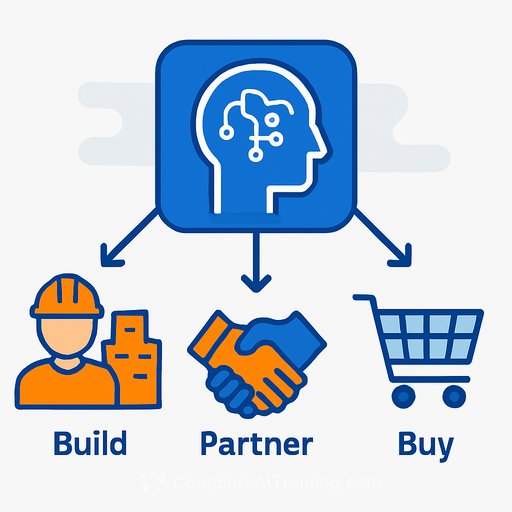
At SEAWING, the priority is clear: focus AI on project execution wins first-design quality, procurement accuracy, and risk foresight-then scale. This guide gives a practical path to build, buy, or partner with purpose.
The imperative for AI in engineering, procurement, construction and commissioning
Large EPCC projects create huge volumes of drawings, data, and decisions. AI can surface inconsistencies early, forecast demand more accurately, and shorten review cycles. The result: fewer reworks, tighter procurement windows, and clearer risk visibility.
This article sets a clear direction for executives: where to start, how to choose an implementation path, and what "good" looks like in deployment and scale-up.
The AI adoption context in EPCC
- Business: If value is vague, funding stalls. Focus on use cases tied to cost, schedule, cash flow, or claim avoidance.
- Architecture: Multinational IT estates, legacy systems, and mixed standards make integration hard. Plan for interfaces, not monoliths.
- Process: Inconsistent data capture and document control limit model performance. Invest in data readiness early.
- Organization: AI talent with EPCC domain depth is scarce. Blend internal SMEs with external experts to move faster.
Analysis of core AI implementation strategies
Strategy 1: In-house development
- Strengths: Full IP control; solutions built for your standards and workflows; durable internal capability.
- Weaknesses: High upfront cost; longer timelines; first deployments can miss targets.
- Opportunities: New service lines and differentiated bids; scalable platforms across projects.
- Threats: Big investment with uncertain ROI; delays if scope expands mid-build.
Strategy 2: Collaboration with third-party platform providers
- Strengths: Proven infrastructure; faster time to first value; knowledge transfer to internal teams.
- Weaknesses: Vendor dependency; recurring license costs; roadmap risk.
- Opportunities: Use partner expertise to accelerate; keep internal focus on core operations.
- Threats: Platform or pricing changes; data security and residency constraints.
Strategy 3: Off-the-shelf and outsourced solutions
- Strengths: Fastest to deploy; predictable cost and schedule; minimal internal lift.
- Weaknesses: No IP; generic fit; ongoing reliance on provider.
- Opportunities: Quick wins on non-core pain points; low-risk pilots to prove value.
- Threats: Product discontinuation; privacy and compliance exposure.
A decision framework for selecting the optimal path
Pick your path with a simple logic: is it core, how fast do you need it, how unique is the need, and what are your constraints?
Quick decision path
- Choose In-house if the use case is a core differentiator, tech readiness is low or highly specialized, data must remain under strict control, and speed is important but not the top constraint.
- Choose Third-party collaboration if you face a specialized need and fast deployment matters, but you still want some configurability and knowledge transfer.
- Choose Off-the-shelf/Outsourced if the problem is not core, time-to-value is critical, and you can accept vendor dependency for a tight, well-defined scope.
Scorecard method (use for governance and portfolio reviews)
- Business value (1-5): Impact on margin, schedule, cash conversion, safety, or claims.
- Data readiness (1-5): Availability, quality, standards, access rights.
- Deployment constraints (1-5): Security, legal, compliance, integration complexity.
- Speed requirement (1-5): Need to deploy within the current project cycle.
- Guidance: High value + high constraints → In-house; High value + high speed → Third-party; Moderate value + highest speed → Off-the-shelf.
Evidence of value: AI applications in EPCC project execution
Case study: Automating quality control in engineering works
A deep learning model was trained to detect correct and incorrect design patterns on P&IDs across thousands of drawings. It learned corporate and industry standards and flagged targeted error patterns with near-perfect hit rates, beating manual checks on both accuracy and turnaround time. The outcome: fewer late-stage design changes and a cleaner handover to procurement.
Case study: Enhancing cost estimation and procurement
A computer vision model read symbols and text from drawings to generate MTOs, while a regression model forecasted material quantities using historical project data. Forecast accuracy ranged from 67.3% to 93% on test sets for key materials-tight enough to shorten bidding cycles and reduce contingency buffers without adding risk.
For further context on AI in engineering and construction, see this academic overview from Eindhoven University of Technology: AI for Enhancing Project Execution in Engineering and Construction.
Strategic recommendations for EPCC leadership
- Start with a clear business case. Prioritize use cases tied to measurable outcomes: rework reduction, RFIs prevented, bid accuracy, procurement lead-time cuts.
- Select the path deliberately. Use the decision path and scorecard. Don't default to build or buy-fit the approach to the constraint.
- Make data governance non-negotiable. Standardize tags, revision control, metadata, and access policies. Good data turns pilots into platforms.
- Design for integration. Plan APIs and event flows with existing EDMS, ERP, P6, and procurement systems. Avoid fragile one-off connectors and review best practices in AI Design Courses.
- Stand up a hybrid team. Pair project engineers and planners with data scientists and ML engineers. Make domain expertise a first-class input, not an afterthought.
- Set guardrails early. Address security, privacy, model risk, and auditability. Define what data can and cannot leave your environment.
- Pilot, measure, scale. Run 8-12 week sprints with tight KPIs. When a pilot clears targets, fund integration and replication across projects.
- Upskill your teams. Equip PMO, engineering, and procurement leads with practical AI literacy to speed adoption; start with role-focused pathways such as the AI Learning Path for Data Scientists.
EPCC companies that embed AI into core execution-without overbuilding or overbuying-will see steadier bids, cleaner delivery, and fewer surprises. The path is simple: pick high-value problems, choose the right build-partner-buy mix, and scale what works.
Your membership also unlocks: