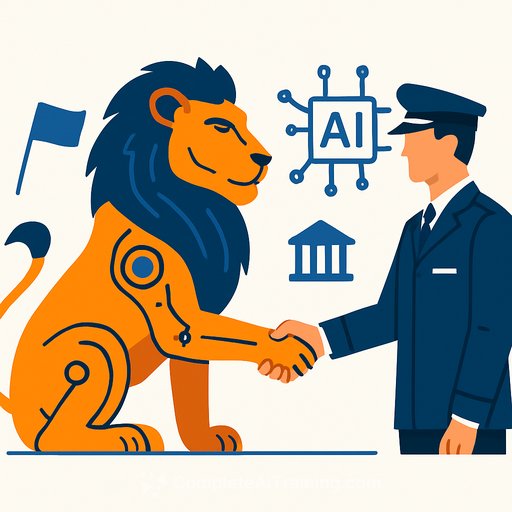
Civil Affairs, AI, and the future of Army readiness
Operations leaders need training that is repeatable, measurable, and scalable. At Fort Bragg, N.C., Civil Affairs teams proved that with an AI-supported certification that removed the bottleneck of human evaluators and delivered hard data on performance.
Photo by Pfc. Kristina Randall: A U.S. Army Soldier assigned to the 96th Civil Affairs Battalion (Special Operations) (Airborne) takes notes during an AI training briefing at the Atlas Lion tabletop exercise, Oct. 27, 2025.
What happened
From Oct. 20-24, 2025, the 91st Civil Affairs Battalion executed a team-level validation to stress core tasks under realistic conditions. Two four-person teams from Bravo Company worked through engagements with local nationals and casualty evacuation under hostile pressure in a large-scale combat operations environment.
"This training environment replicates a large-scale combat operations environment. When we train, we train for the future," said Lt. Col. Michael Veglucci, Commander of the 91st Civil Affairs Battalion. "This gets after our core competencies and our Civil Affairs battle drills."
After the field validation, the 91st partnered with Delta Company, 96th Civil Affairs Battalion, for a company-level tabletop exercise powered by an AI/ML model. For the first full iteration in the formation, the Company certified critical tasks without using human external evaluators.
Why this matters to operations
- Scale without adding headcount: AI lets leaders run more reps, more often, without a proportional increase in evaluators.
- Standardize assessments: A consistent model reduces variance across teams and time, creating apples-to-apples comparisons.
- Faster feedback loops: Results arrive in near real time, which compresses the cycle between training, feedback, and improvement.
- Doctrine-aligned metrics: The model references thousands of pages of doctrine and regulation for evaluation criteria, not hunches.
- Audit-ready data: Tens of thousands of data points roll up into KPIs you can brief, defend, and act on.
How the AI model worked
The exercise placed Soldiers into interactive scenarios with role players and civilian leaders embedded in the model. It tracked decisions and outcomes across key performance indicators tied to doctrine and mission requirements.
"What makes this AI model unique is that it is limitless in complexity and cohesion to give the training audience a valuable and effective training opportunity," said Morgan Keay, CEO of Motive International. "This training provides commanders with an objective assessment of their formation's ability to execute critical tasks before sending anyone overseas."
Instead of a few observer notes, the system analyzed a high volume of signals and produced an unbiased assessment of Civil Affairs tasks essential for mission success.
Operational takeaways you can borrow
- Define the mission-critical tasks and map them to measurable KPIs. If a task can't be observed and scored, it won't improve.
- Codify the rulebook. Feed doctrine, SOPs, and policy into the evaluation layer so every score ties to a standard.
- Instrument your scenario. Capture decisions, timing, comms, and outcomes at each inject to generate actionable metrics.
- Blend machine scoring with human coaching. Let the model measure; let leaders teach judgment, context, and ethics.
- Build a scenario library. Keep variations ready for different environments, partners, and threat levels to avoid training on a script.
- Close the loop. Schedule rapid AARs, update SOPs, and re-test within days, not months.
- Address governance early. Set data retention, access controls, and red-teaming to keep the system credible and secure.
What changes for leaders
Commanders get an objective readiness picture, not anecdotes. Training can run continuously, not only when evaluators are available. Resources shift from staffing observer teams to building better scenarios and coaching.
The payoff: fewer blind spots before deployment, clearer prioritization of weaknesses, and a faster path from training to effect on the ground.
Context links
For teams building their own AI-enabled training
If you're standing up similar workflows, you'll need people who can translate policy into scoring logic and build reliable evaluation pipelines. For structured learning paths by role, explore the AI Learning Path for Training & Development Managers, review available courses by job, or scan the latest options at Complete AI Training.
Your membership also unlocks: