AI Moved From Back Office to Battlespace: What Ops Leaders Need to Do Now
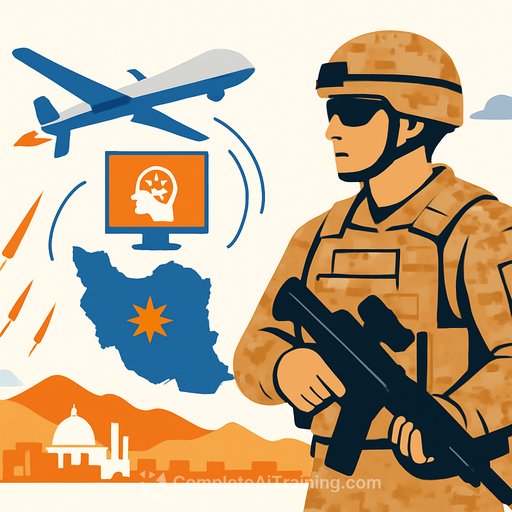
AI isn't just analyzing reports after the fact. It's inside the decision loop. During the conflict with Iran ("Epic Fury" in the US, "Roaring Lion" in Israel), reports say US forces embedded large-language models like Claude into intelligence support, target selection, and operational simulations-even as a federal ban on the tech was announced.
That mismatch between policy and practice is the lesson for operations. When the mission needs speed, teams will route around delays. Your job is to make that speed safe, observable, and accountable.
From Intelligence Support to Operational Acceleration
Field reporting indicates AI was paired with conventional assets-missiles, stealth aircraft, and autonomous systems-to triage sensor feeds, prioritize high-value targets, and run "what-if" scenarios that once took hours. The model didn't pull the trigger; it compressed the time from data to decision.
Commands reportedly resisted an immediate cutoff because AI was already wired into mission workflows through integrators like Palantir. Once AI sits in the workflow, ripping it out mid-operation isn't a neutral act-it's a risk.
The 'AI-First' Directive and Scale-Up
Defense leaders have pushed an AI-first posture: experiment quickly, remove deployment friction, and put models into the core decision cycles. A secure platform like "GenAI.mil" (as reported) signals the intent-bring generative models to classified and unclassified networks at enterprise scale.
Translation for ops: plan for millions of users, mixed classification levels, and continuous model updates. If you don't design for scale and drift on day one, you'll inherit outages and blind spots on day ninety.
Industry Tension: Safeguards vs. Access
Vendors have pushed back on requests to relax safety guardrails around autonomous weapons and mass surveillance; defense officials have applied pressure in return. Inside tech firms, employees are also weighing in. Ethical boundaries aren't abstract-they show up as product settings, audit logs, and API permissions.
If you lead operations, assume policy disputes will land on your desk as access controls, exception requests, and incident reviews. Build a process that can say "yes, with conditions" or "no, here's the alternative" fast.
New Rules of War, Old Rules of Accountability
As AI assists in lethal decisions, scrutiny shifts to human oversight, rules of engagement, and evidence trails. You'll need auditable reasoning, fallbacks, and outcome monitoring that stand up in courtrooms and committees, not just in war rooms.
Useful reference points include defense community guidance on responsible AI and autonomy policy. See the US DoD's Responsible AI principles and strategy and Directive 3000.09 on autonomy in weapon systems for practical guardrails: DoD Responsible AI and DoDD 3000.09.
Operational Playbook: Put AI in the Loop, Keep Humans in Charge
Below is a concrete plan you can run in any high-stakes ops setting-defense, critical infrastructure, or crisis response.
1) Map the decision loop and insert AI where it pays
- Identify the questions that bottleneck decisions (e.g., target nominations, route deconfliction, risk scoring).
- Classify each as recommend, review, or approve. AI can recommend; humans review/approve.
- Define time budgets per step (e.g., 30s ingest, 90s triage, 120s approve) and measure against them.
2) Build your data and model access controls
- Segment data by classification and sensitivity. Enforce "clean-room" prompts for mixed sources.
- Use role-based access for model features (e.g., simulation vs. live target queues).
- Log every recommendation, prompt, and override with time, operator, and model version.
3) Define human-on-the-loop and escalation thresholds
- Set clear "AI can't decide" boundaries: civilian-risk zones, low-confidence detections, novel tactics.
- Auto-escalate to senior review when model confidence drops below a threshold or inputs conflict.
- Require two-person integrity on lethal or irreversible actions.
4) Red-team and simulate before you deploy
- Adversarial tests: spoofed sensors, conflicting feeds, deceptive patterns, prompt injections.
- Failure drills: model outage, stale weights, corrupted data. Practice fallback to manual ops.
- Stress tests: surge traffic, low bandwidth, contested GPS/comm windows.
5) Create the governance you'll wish you had later
- Standing board: ops, legal, safety, intel, vendor. Weekly risk review; 24/7 incident channel.
- Pre-approved playbooks for exceptions; expiration dates on all waivers.
- Post-action audits that tie outcomes to specific AI recommendations and human decisions.
6) Vendor management without the drama
- Contract for safety: require model cards, eval results, and red-team reports.
- Demand control levers: rate limits, feature flags, safety toggles, and kill switches.
- Set measurable SLAs: latency, uptime in degraded networks, time-to-rollback, incident response.
7) Metrics that matter to command
- Sensor-to-decision latency (p50/p95) and time-to-approve for critical actions.
- False positive/negative rates by scenario and human override rate by operator tier.
- COA (course-of-action) simulation throughput and divergence across models.
8) 30/60/90-day rollout
- Day 0-30: Sandbox on synthetic data, red-team, instrument logs, define thresholds.
- Day 31-60: Limited live pilot in a narrow mission thread; daily standups; rapid patch cycle.
- Day 61-90: Scale to adjacent threads; unify telemetry; start quarterly external audit.
Risk Register (Keep It Visible)
- Model drift and silent failure in rare scenarios.
- Over-trust by operators under time pressure.
- Adversarial manipulation of sensors, prompts, or training data.
- Policy lag: legal or political shifts mid-mission.
- Supply chain exposure to single vendors or proprietary formats.
Bottom Line for Operations
AI will be used when the mission is on the line-policy or no policy. Your edge comes from building systems that move fast with guardrails, leave an audit trail, and degrade gracefully under stress.
If you lead ops, start with the loop you own, instrument it, and make one high-friction decision 10x faster without losing judgment. Do that, then scale.
Further practical resources: AI for Operations and AI for Government.
Your membership also unlocks: