Societal Impacts
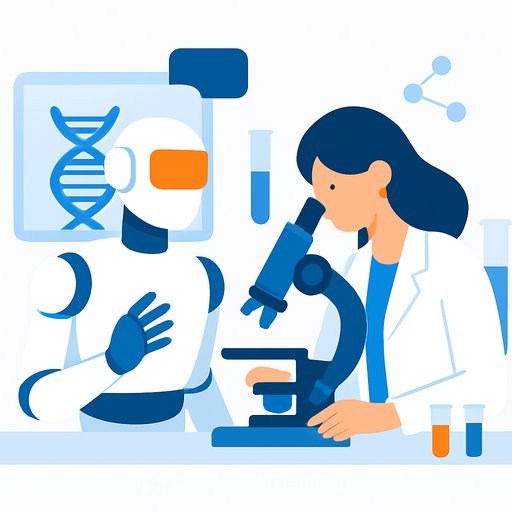
Biology now produces more data than most teams can interpret. The bottleneck isn't collection-it's turning raw data into tested insights. Anthropic is partnering with the Allen Institute and the Howard Hughes Medical Institute (HHMI) to close that gap and put Claude at the center of experimental planning and analysis.
The goal: give researchers AI systems that support hypothesis generation, experiment design, and interpretation-while keeping scientific judgment in human hands. Accuracy, provenance, and interpretability are non-negotiable, and both collaborations are built around those principles. These efforts build on broader Research into AI-driven lab workflows and tools for scientific discovery.
Why this matters for lab teams
- Faster knowledge synthesis across single-cell, multi-omic, and imaging datasets.
- Agent workflows that draft experiments, surface edge cases, and flag confounders.
- Reasoning you can inspect: citations, assumptions, and decision paths exposed for review.
- Tighter loop between instruments, analysis pipelines, and documentation.
- Human-in-the-loop by default-AI suggests, researchers decide.
HHMI: Building the infrastructure for AI-enabled scientific discovery
HHMI's collaboration is anchored at Janelia, a hub known for tools like genetically encoded calcium indicators and advanced electron microscopy. That environment is ideal for testing how AI agents work alongside actual instruments and live experiments.
Since launching AI@HHMI in 2024, the institute has pursued projects across protein design and neural computation. With Anthropic, HHMI will co-develop lab-ready agents that act as a comprehensive source of experimental knowledge-connected to devices and analysis pipelines-so teams can move from idea to validation faster.
Allen Institute: Multi-agent systems for mechanistic discovery
The Allen Institute will work with Anthropic on multi-agent systems that coordinate across multi-omic integration, knowledge graph curation, temporal modeling, and experiment design. The aim is simple: compress months of manual analysis into hours, while surfacing patterns a single analyst might miss.
Researchers stay in control; agents handle computational complexity and keep track of links between data, models, and proposed experiments. This collaboration feeds real-world feedback into model reliability, usability, and failure modes you only see in day-to-day science.
What to expect in practice
- Instrument-aware agents that can read logs, parse metadata, and suggest next steps based on prior runs.
- Transparent reasoning: evidence chains, parameter choices, and assumptions logged for audit and review.
- Multi-modal fluency: from single-cell matrices and EM stacks to behavioral time series and literature.
- Experiment co-pilots that generate protocols, power analyses, and counterfactuals you can test.
- Team workflows: shared prompts, reproducible pipelines, and versioned outputs.
- Reliability work: benchmarks tied to lab outcomes, red-teaming for edge cases, and clear failure reporting.
How to prepare your lab
- Start small: pick one project with clear success metrics (e.g., reduced analysis time, improved hit rate).
- Define data contracts: formats, ontologies, and metadata standards agents must follow.
- Require provenance: every claim linked to data, code, or literature you can verify.
- Keep humans in the loop: set explicit review gates for high-impact decisions.
- Measure drift: track performance over time and flag shifts tied to data or protocol changes.
- Document failures: create a shared log of mistakes and near misses to harden future runs.
Looking ahead
These partnerships will guide how Claude supports life science workflows across contexts-from discovery work to translational pipelines. The priority is clear: scientific rigor, interpretability, and researcher autonomy.
If your team is exploring Claude for lab workflows, consider structured training and certification so everyone speaks the same language and follows the same safety bars. A focused starting point: Claude certification for scientific teams.
Bottom line: AI can help compress analysis time, expose reasoning, and coordinate complex experiments. With HHMI and the Allen Institute as proving grounds, the path forward is practical: integrate with instruments, show your work, and keep scientists in charge.
Your membership also unlocks: