Clinically informed AI beats large foundation models for earlier spinal cord disease prediction
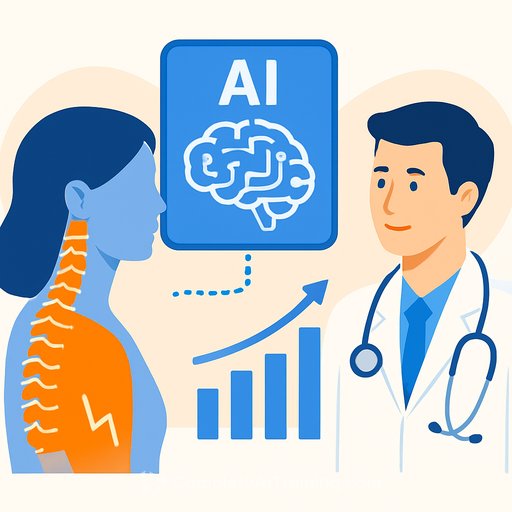
Cervical spondylotic myelopathy (CSM) is the leading cause of spinal cord dysfunction in older adults. It develops slowly, often showing up as neck pain, weakness, or trouble walking-symptoms that are easy to miss until late stages. That delay costs patients options. A Washington University team built an AI approach that flags likely CSM cases up to 30 months before a typical diagnosis.
The study, published in npj Digital Medicine (2026), analyzed electronic health record (EHR) data from more than 2 million people. Researchers tested seven models, from large "out-of-the-box" foundation models to smaller systems grounded in clinical insight. The goal: spot patterns in tests, diagnoses, and care histories that mirror patients already diagnosed with CSM.
What they tested
The team trained and evaluated models on a large, heterogeneous external dataset and a smaller St. Louis-based health system dataset. Foundation models performed best on internal validation of the big dataset. But the smaller, clinically guided model-built from the ground up using only the most relevant variables-traveled better across health systems and held performance more consistently.
Two mid-scale models landed in the middle and underperformed across time horizons. In plain terms: bigger wasn't better once the model left home turf. Focused clinical features helped the simpler model keep its footing across new settings.
Why this matters
- Earlier intervention window: Predictive signals appeared up to 30 months before diagnosis, giving clinicians time to investigate and act.
- Better portability: Clinically informed models were more likely to hold up across different hospitals and EHR environments.
- Lean, practical builds: Smaller models with the right features can match-or beat-complex systems, while being easier to deploy and maintain.
Clinicians on the team emphasized the point: use EHR data to identify patients early enough to change outcomes. They also noted that clinical knowledge still matters-purely data-driven systems tend to get the spotlight, but grounding models in what clinicians already know can be the difference between a great demo and a tool that actually works across sites.
From the AI side, the message was clear: generalizability is the hurdle. A model that performs well in one health system can falter in another. In this study, large models trained on millions of patients didn't transfer as well as compact, clinically focused builds. Embedding clinical judgment into feature selection helped produce models that are more reliable and easier to trust.
What to do next
- Prospective testing: Validate in live workflows with clinicians, not just retrospective charts.
- Workflow fit: Integrate with EHR prompts that nudge appropriate follow-up, imaging, or referral-no alert fatigue.
- Equity checks: Audit performance across age, sex, race, and comorbidities to avoid uneven care.
- Transparent features: Keep inputs interpretable so teams can review why a patient was flagged.
- Outcome linkage: Track whether earlier flags actually lead to earlier diagnosis and better function.
For teams building similar tools, see AI for Healthcare. If you manage health data or EHR workflows, you may find AI for Medical Records Clerks useful.
Need a primer on CSM?
CSM stems from age-related changes in the neck that compress the spinal cord. It's common, progressive, and often overlooked early. A good clinical overview is available from the American Association of Neurological Surgeons.
Bottom line: If you're choosing between a massive model and a clinically informed one for cross-system deployment, start with the latter. Use clinical knowledge to narrow inputs, test transfer early, and prove value where it matters-at the point of care.
Your membership also unlocks: