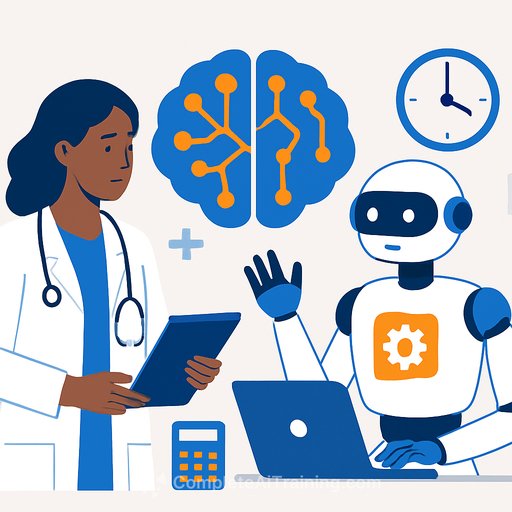
Clinicians Are Already Using AI. Health Systems Need Control Without Slowing Care.
Here's the reality: clinicians are using AI on the job, whether your organization approves the tools or not. That creates risk, but it also signals unmet needs in workflow, documentation, and decision support. The goal isn't to stop AI. The goal is to shape it so it's safe, useful, and compliant.
Why "shadow AI" happens
- Time pressure. Drafting notes, prior auth letters, and patient messages eats hours.
- Consumer tools feel easier and faster than official software.
- Clinicians see real gains in recall, writing, and brainstorming-and they won't wait for long committees.
Move first: set guardrails that enable use
- Create a red / yellow / green list. Green = approved with use cases; Yellow = conditional with clear rules; Red = blocked for PHI or clinical use.
- Define approved use cases. Start with low-risk: note drafting, patient education, inbox replies, discharge summaries, coding suggestions, care coordination messages.
- Require human-in-the-loop. AI output is a draft. The clinician signs off, every time.
- Centralize access. Prefer enterprise accounts or API connections over consumer logins to control data, audit, and updates.
Data rules that keep you out of trouble
- No PHI in public tools. If PHI is necessary, use an enterprise instance with a BAA, logging, and data isolation.
- De-identify by default. Make de-ident templates easy to use inside the EHR or companion apps.
- Log prompts and outputs tied to the patient record when used for care. This supports audit, quality review, and learning.
- Set model update controls. Lock versions used in clinical workflows; review changes before rollout.
Validation that clinicians trust
- Choose the right metrics. Accuracy, completeness, bias checks, readability, and time saved. For drafts, also track edit distance and sign-off rates.
- Run prospective pilots. 20-50 users, 4-6 weeks, with pre/post baselines. Project managers should follow compact pilot playbooks to measure impact and scale safely-see the AI Learning Path for Project Managers.
- Publish a model card. Indications, limitations, sample prompts, failure modes, and supervision requirements.
- Stand up an AI incident process. Easy reporting for near misses, hallucinations, or drift-plus a rapid rollback plan.
Governance that doesn't slow care
- Form a small AI council. Clinician lead, nursing, informatics, compliance, security, and patient safety. Meet weekly, decide fast. CIOs should coordinate policy, risk, and technical oversight-see the AI Learning Path for CIOs.
- Connect with IRB and quality. Some pilots are QI, some are research-label them correctly.
- Consent and transparency. For patient-facing use (education, messages), disclose that AI drafts content with clinician review.
What to approve first
- Documentation support. History summaries, SOAP drafts, after-visit summaries, discharge instructions at appropriate reading levels.
- Communication support. Inbox replies, refills, referral letters, insurance appeals, prior auth narratives.
- Administrative lift. Policy summaries, meeting prep, call scripts, checklists.
What to hold back (for now)
- Automated diagnostic suggestions without strict supervision and validation.
- Autonomous order sets or treatment recommendations.
- Any tool that trains on your prompts by default or lacks a clear BAA.
Compliance anchors
- Map your controls to the NIST AI Risk Management Framework for common language across teams. NIST AI RMF
- Reinforce HIPAA rules for AI workflows-especially around PHI in prompts, storage, access, and auditing. HHS HIPAA Guidance
Training that clinicians will actually use
- Short, job-specific sessions. 30-45 minutes, with before/after examples and approved prompt templates.
- Teach failure modes. Hallucinations, outdated content, template drift, and overconfidence-show real cases.
- Make prompt kits. Common tasks with editable variables and safe defaults baked in.
- Need structured options? See curated AI courses by role at Complete AI Training.
Metrics the C-suite and clinicians both care about
- Time saved per note, per message, per prior auth.
- Edit distance from AI draft to final signed note.
- Inbasket backlog, response times, and after-hours work.
- Safety: near misses, incident reports, override rates.
- Patient outcomes tied to approved clinical use cases (once mature).
Starter policy (copy, then adapt)
- Use allowed tools for approved tasks; no PHI in consumer apps.
- Clinician reviews and signs every AI-assisted output.
- Log AI-assisted clinical outputs in the record.
- Report issues through the AI incident channel immediately.
- Periodic review of models, prompts, and outcomes every quarter.
Bottom line
AI is already in the clinic. Pretending it isn't just pushes use into the shadows. Put guardrails in place, approve the obvious wins, and give clinicians the training and tools to use AI safely. That's how you protect patients, reduce burnout, and keep care moving.
Get Daily AI News
Your membership also unlocks:
700+ AI Courses
700+ Certifications
Personalized AI Learning Plan
6500+ AI Tools (no Ads)
Daily AI News by job industry (no Ads)