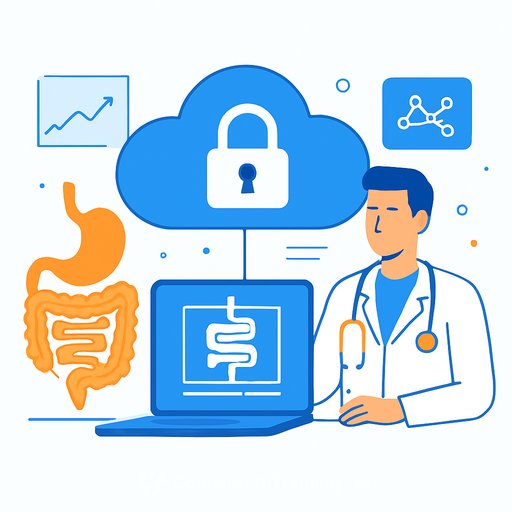
Cloud is becoming the backbone of AI-driven GI diagnostics
Hospitals are managing higher demand, tighter budgets, and stricter rules. Cloud gives AI diagnostics the scale, security, and continuity that on-premise setups rarely deliver. Interoperability is improving, and confidence among clinicians is catching up.
The opportunity is clear in gastroenterology. AI is advancing, but its impact stalls without cloud-enabled deployment, updates, and governance. Providers like Olympus are building with security and compliance at the core-exactly what healthcare needs to move faster without increasing risk.
Why cloud now matters for clinicians and CIOs
Legacy infrastructure struggles with the compute required for advanced imaging and decision support. What works is an ecosystem that connects EMRs, devices, and AI-seamlessly. The practical path forward blends bedside compute (for real-time responsiveness) with always-on cloud (for heavy processing, model updates, and resilience).
In GI care, that's how platforms like OLYSENSE CAD/AI can help reduce misses and streamline workflow. The integration matters as much as the algorithm.
Elastic scalability, without hardware headaches
Cloud-based AI lets you run high-performance models in real time while avoiding expensive on-site upgrades and complex software installs. Edge-cloud hybrids push inference to the endoscopy suite and handle training, versioning, and QA in the cloud.
That means instant access to improved models and features-no clinic downtime. This approach is already being validated in projects such as the Eagle Trial, which assessed safety and clinical performance for cloud-based polyp detection.
Security and compliance built in
Handling patient data demands strict controls. Zero Trust principles, encryption, continuous monitoring, and Cloud Security Posture Management (CSPM) help detect misconfigurations early and keep systems locked down.
Solutions like OLYSENSE CAD/AI minimise risk by anonymising images and videos before upload, so no personally identifiable health information leaves the site. Results link back to the patient only at the point of care-aligning with GDPR's Privacy by Design and supporting governance under the EU AI Act and the European Health Data Space (EHDS).
Innovation without interruption
Cloud lets hospitals deploy new features immediately-no costly hardware refreshes, no clinic downtime. IT teams avoid manual patching; clinicians get the latest models as soon as they're validated.
For GI teams, that means better sensitivity, fewer missed lesions, and smoother workflows. For operations, it means predictable costs and simpler lifecycle management.
What this means for GI teams and hospital leaders
- Clinicians: Real-time AI support, consistent performance, and up-to-date models without changing your hardware.
- CIOs/CTOs: A clear path to interoperability across EMRs, devices, and AI services-scalable, monitored, and resilient.
- DPO/Compliance: Privacy by Design, data minimisation, audit trails, and clear boundaries between PHI and anonymised data.
- IT/Security: Zero Trust, CSPM, encryption in transit and at rest, and continuous validation of configurations.
Quick-start checklist
- Map data flows end to end: device → inference → storage → EHR. Eliminate PHI transfers to the cloud where possible.
- Pick vendors with documented GDPR, EU AI Act, and EHDS strategies, plus third-party security attestations.
- Require edge-cloud hybrids: on-device inference, cloud-based model lifecycle and QA.
- Demand anonymisation by default and clear patient-result linking only at the point of care.
- Automate updates, rollbacks, and monitoring-no manual installs on clinical devices.
- Run clinical validation (e.g., polyp detection sensitivity/specificity) with real-world datasets before scaling.
- Plan for continuity: failover modes, offline operation, and rapid support escalation paths.
The path forward
Cloud is now embedded in GI care transformation. As AI adoption scales, the winning designs lead with security, privacy, and compliance-then deliver speed and accuracy at the bedside.
This future isn't about chasing features. It's about trustworthy systems that protect patients and help clinicians do their best work, day after day.
For practical playbooks and skills, explore AI for Healthcare. If you're leading infrastructure or governance, see the AI Learning Path for CIOs.
Your membership also unlocks: