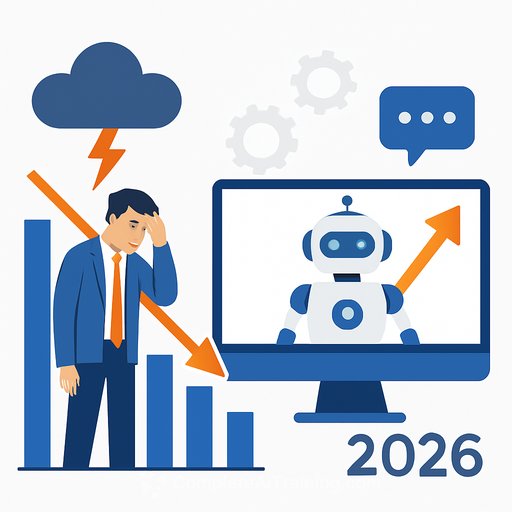
CMO Survey: Pessimism, Budget Cuts, and Accelerating AI Reshape Marketing in 2026
Marketing leaders are more pessimistic than at any point since 2020, cutting budgets while simultaneously doubling down on artificial intelligence adoption. The latest CMO Survey, conducted in early 2026 among senior U.S. marketing executives, shows the profession caught between economic pressure and technological opportunity.
More than half of marketers report worsening economic sentiment compared to the previous quarter. Companies are raising prices to offset tariffs and macroeconomic strain, with far more firms cutting investments than increasing them.
Retention Over Acquisition
Faced with uncertainty, marketers are retreating to what they know. Customer retention has replaced acquisition as the top strategic priority, with spending increasingly directed toward existing customers rather than new market expansion.
This marks a notable reversal. Customer retention has become the strongest driver of performance, surpassing both acquisition and brand investment-a historical shift in how marketing impact is measured.
AI Usage Doubles in Two Years
Despite economic headwinds, AI adoption is accelerating across marketing functions. AI usage has more than doubled in two years, with generative AI expanding even faster.
The survey shows AI now plays a central role in content creation, personalization, and data analytics. Generative Engine Optimization (GEO)-a capability absent from earlier survey editions-is now used by 40% of companies. Marketers expect AI to power more than half of all marketing activities within three years.
Early results show improvements in sales productivity, customer satisfaction, and cost efficiency. Yet this rapid adoption masks a deeper problem.
Technology Adoption Outpaces Organizational Readiness
No marketing technology capability currently meets mid-level performance benchmarks, and results have stagnated over the past two years. The barriers are not technological but structural: limited budgets, integration challenges, talent shortages, and insufficient time and bandwidth.
Companies are investing in technology without matching investments in the capabilities needed to use it effectively. Training budgets have dropped to just 3.8% of marketing spend, and headcount growth has declined 50% year over year.
Most firms continue building capabilities internally despite the sector's shifting skill requirements. Analytics, AI, and technology expertise are increasingly central to marketing work, yet companies are not scaling resources to match these demands.
CMO Responsibilities Expand, Alignment Lags
CMOs are increasingly responsible for revenue growth, customer insights, and public relations, with greater involvement in board-level discussions. Organizational alignment has not kept pace.
Collaboration with finance remains limited, and the CMO-CFO relationship has improved only marginally. Under pressure to prove immediate value, more than 70% of marketers focus on short-term results rather than long-term growth.
Most marketers prioritize stronger performance tracking over deeper customer insights as the primary way to demonstrate value.
Budget Decline and Reactive Spending
Marketing budgets have declined to 9.0% of company revenue, with overall spending growth slowing to just 1.7%. When performance falters, companies are more likely to cut costs than invest in growth.
A strategic inconsistency emerges in how budgets are allocated. Although retention is prioritized, acquisition budgets remain significantly higher despite delivering weaker outcomes. Marketing spending decisions remain more reactive than strategic.
Channel Expansion Amid Inward Strategy
While growth strategies focus inward on existing products and customers, more than half of marketers report expanding their presence across digital, social, retail media, and in-person channels.
This divergence suggests marketers see the customer interface as worth investing in even in a cautious environment. The broad channel expansion stands in contrast to the inward orientation visible elsewhere in strategy.
Long-Term Value Accumulates Longer
The median duration of marketing impact has increased to six months, with a growing share extending to a year or more. Marketing's cumulative value may be underestimated in short-term evaluations.
This matters in an environment dominated by immediate performance metrics. The survey reveals that marketing's enduring value persists despite short-term pressures and budget constraints.
What Comes Next
Marketers face a clear challenge: aligning organizational capabilities with technological ambition while balancing short-term pressures with long-term value creation. Success will depend not just on adopting AI for Marketing but on building the structures needed to make it work.
CMOs navigating this environment should consider developing a formal AI Learning Path for CMOs that addresses both strategic adoption and organizational readiness across their teams.
Your membership also unlocks: