"Kill the clipboard": CMS urges QR-first data sharing and agentic AI across Medicare
On stage at the HIMSS Global Health Conference in Las Vegas, CMS Administrator Dr. Mehmet Oz called for agentic AI for every Medicare beneficiary and a hard pivot to digital tools that start at the first touchpoint-and continue in the home. He shared the stage with HIMSS CEO Hal Wolf, CMS COO and deputy administrator Kimberly Brandt, and Amy Gleason, administrator and senior advisor for the Department of Government Efficiency (DOGE) and CMS.
The message was blunt: healthcare is inflationary, labor is stretched, and the current model won't scale. Technology, used early and responsibly, can bend the cost curve and raise quality.
Why this matters for health systems
Physicians are keeping pace with inflation; hospitals are not. Hospital costs are rising at roughly twice the rate, driven by manpower gaps and administrative overhead. Rural facilities received a $50B lifeline, yet many still can't recruit behavioral health professionals. Throwing money at the problem isn't enough. Workflow change is.
"Kill the clipboard": QR-enabled patient-mediated exchange
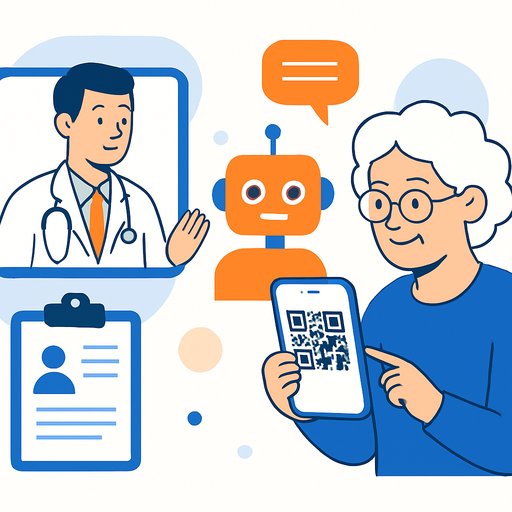
Amy Gleason put it plainly: patients should be able to scan a QR code and bring their data directly to you. Kill paper intake. Kill duplicate forms. Meet patients where they already manage information-their phones and wallets.
For providers, this means standardizing on FHIR-based exchange, embedding QR flows into intake, and mapping what patients share into discrete fields you can trust. Done right, you shorten cycle times, reduce errors, and give clinicians a cleaner chart at the point of care.
What to implement next (practical checklist)
- Stand up FHIR R4 APIs and support SMART-on-FHIR apps across your EHR, portal, and kiosk experiences. See HL7 FHIR overview.
- Add QR scanning to intake workflows. Ingest CCDA/USCDI-aligned data into the chart, not just as PDFs. Validate provenance and timestamps.
- Pilot patient-shared data for meds, allergies, problems, vitals, and prior imaging. Define guardrails for reconciliation and clinician sign-off.
- Strengthen identity proofing and consent management. Make consent easy to grant, easy to see, and easy to revoke.
- Prepare for agentic AI: route scheduling, benefits Q&A, and discharge follow-up to AI assistants with clear escalation to humans and full audit trails.
- Push care into the home: remote monitoring kits, virtual-first triage, and device data that flows straight into the EHR with clinician-approved alerts.
- Measure deflationary impact: minutes saved per intake, duplicate test avoidance, no-show reduction, prior auth cycle time, and documentation time per visit.
Agentic AI for Medicare beneficiaries
Oz called for AI that actively supports every beneficiary-navigating coverage, scheduling, medication reminders, and benefits questions without adding work to your staff. The goal is less friction and fewer handoffs, not more dashboards.
- Start narrow where value is obvious: benefits Q&A, prior auth status, referral routing, post-discharge outreach, and transportation coordination.
- Use explainable models and keep a human-in-the-loop for clinical decisions. Log prompts, outputs, and overrides for compliance.
- Apply data minimization. Encrypt PHI in transit and at rest. Update BAAs and incident response playbooks to cover AI services.
Interoperability and compliance anchors
CMS has already set expectations around patient access, payer-to-payer exchange, and prior authorization APIs. Map your roadmap to the rules and you'll stay aligned with where CMS is heading. Reference: CMS Interoperability initiatives.
Operational questions to ask this week
- Where do clipboards, PDFs, and manual data entry still exist? What's the fastest path to replace them with QR and FHIR intake?
- Can our EHR accept and reconcile patient-held data at the front desk, in the app, and via telehealth?
- Which 2-3 agentic AI use cases will offload the most work in 90 days? Who owns them and how will we measure ROI?
- What's our consent, identity, and provenance story-written in plain English so patients and auditors both understand it?
- How are we moving services into the home without flooding clinicians with noise?
Equip your teams
If you're standing up AI programs across service lines, align clinical, IT, revenue cycle, and compliance with shared language and training. Start with a healthcare-focused foundation: AI for Healthcare.
For front-office and HIM leaders replacing paper workflows, pair policy with hands-on training: AI Learning Path for Medical Records Clerks.
CMS and HIMSS are asking the industry to meet patients where they are, fix intake, and use AI where it actually saves time. The opportunity is clear. The advantage goes to the teams who execute first and measure relentlessly.
Your membership also unlocks: