Coca-Cola expands AI use across marketing and product development
Consumer brands are moving AI from experiments to daily practice. At The Coca-Cola Company, AI now sits inside core workflows: demand creation, product ideation, and market execution. After a stretch of price-led growth during inflation, the focus is shifting to persuasion-led growth-using data and creative testing to nudge demand without leaning on price.
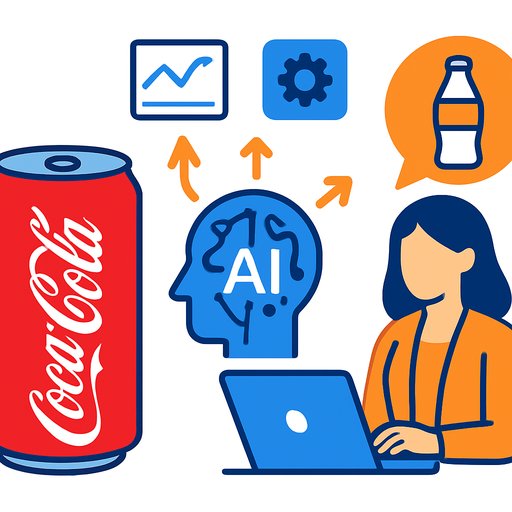
The mindset is simple: improve speed to insight, speed to content, and speed to market. AI is embedded across the marketing pipeline, helping teams produce, localise, and optimise campaigns with tighter feedback loops.
Marketing moves deeper into AI
Coca-Cola has used AI in headline campaigns before. What's different now is the depth of integration. Systems analyse behaviour, test creative variations, and support market-by-market adaptation so local teams can publish faster and stay relevant.
This mirrors broader adoption across enterprises. Research indicates the majority of organisations now use AI in at least one function, and estimates suggest generative AI could add trillions in annual value, with marketing, sales, and customer operations capturing a large share. See McKinsey's analysis of economic impact for context: The economic potential of generative AI.
From campaigns to product ideas
AI isn't just a creative assistant; it's stepping into product development. Coca-Cola Y3000 Zero Sugar-part of the Coca-Cola Creations line-used AI to parse consumer conversations about the "taste of the future," informing flavour direction and packaging concepts. It's a live example of AI accelerating early-stage ideation.
As these experiments expand into select markets, the lesson is clear: when you sell hundreds of SKUs across regions, upstream signal detection matters. Faster pattern spotting shortens cycles from concept to shelf. Explore the broader Creations program here: Coca-Cola Creations.
Coordinating a global network with data
Coca-Cola's system depends on independent bottlers across the world. That structure raises the bar on coordination. Digital platforms now move consumer insights across entities faster, so local teams can act on what's resonating in real time.
Sales systems used by bottlers feed back data from retailers, promos, and activations. Those signals guide media, creative refreshes, and assortment tweaks-turning fragmented inputs into practical direction.
AI becomes routine for marketing teams
Across the industry, AI is now a routine tool for content creation, asset resizing, targeting, and performance prediction. The question has shifted from "Should we try it?" to "Where does it add measurable value?"
Some teams use AI to generate copy and imagery. Others deploy it for uplift modeling, audience clustering, or forecasting. Either way, AI is closer to the daily production line than the experimental lab.
What this means for IT, Marketing, and Product leaders
- Build a clean data spine: Unify product, media, retail, and promo data with shared IDs. Make governance and lineage non-negotiable.
- Start with high-velocity use cases: Creative versioning, audience lookalikes, offer testing, and retail media optimization deliver fast payback.
- Operationalise content ops: Pair a central style system with local prompts. Lock brand voice, claims, and compliance into templates.
- Human-in-the-loop by design: Require expert review for claims, regulated content, and safety. Track where AI assists vs. decides.
- Measurement before scale: Define lift tests (holdouts, geo splits) and a shared KPI stack: CAC, ROAS, creative fatigue, and time-to-publish.
- MLOps and "prompt ops": Version datasets, prompts, and models. Log outputs, approvals, and performance for auditability.
- Localise with constraints: Allow regional edits within brand and legal guardrails. Pre-approve claims libraries and disclosures.
- Privacy and security: Tier data access, scrub PII, and sandbox third-party tools. Review vendor indemnities and content rights.
- Close the loop with commerce data: Pipe retailer, DTC, and promo signals back into creative and media selection.
Product development playbook
- Signal mining: Use AI to scan social, reviews, and customer service notes for flavour, format, and pack-size opportunities.
- Concept compression: Rapidly generate territories, screen with predictive scoring, then validate with small-market pilots.
- Sensory + AI collaboration: Feed consumer language into R&D taxonomies. Translate "future-tasting" into measurable attributes.
- Iterate packaging with constraints: Generate concepts within legal, recyclability, and cost targets. Test for distinctiveness and recall.
Practical risks to manage
- Brand safety and accuracy: Enforce restricted-claims rules. Use fact-check layers and approved data sources.
- Bias and drift: Monitor model outputs across segments. Refresh training data on a schedule.
- IP and rights: Confirm usage rights for AI-generated images, fonts, and music. Maintain clear provenance logs.
- Hallucinations: Route sensitive copy through deterministic checks. Prefer retrieval-augmented patterns for claims.
KPIs worth tracking
- Creative: Time-to-first-concept, variants per week, fatigue rate, asset reuse rate.
- Media: Incremental reach, conversion lift, cost per incremental action, ROAS vs. baseline.
- Product: Concept-to-pilot lead time, pilot-to-launch win rate, forecast accuracy, shelf velocity in first 90 days.
- Operations: Approval cycle time, compliance exceptions, model/prompt reuse, unit cost per asset.
A new phase for consumer brand marketing
The playbook of product, big ads, and periodic price moves is aging out. Digital signals let brands test more, faster, with fewer assumptions. AI doesn't replace strategy or taste-it makes iteration cheaper and learning cycles shorter.
Coca-Cola's approach shows what "routine AI" looks like: data-fed marketing, faster creative turnover, and early-stage product signals guiding R&D. Expect more brands to make the same shift-less hype, more daily usage, tighter feedback loops.
If you're building capability in this area, explore: AI for Marketing and AI for Product Development.
Your membership also unlocks: