EvolveOps.AI: Agentic IT Operations for Hybrid and Multi-Cloud
Coforge has launched EvolveOps.AI, an agentic AI platform for IT operations management across hybrid and multi-cloud environments. It targets operational resilience, lower downtime and a path to more autonomous operations as AI adoption accelerates. If you own uptime, cost, and release velocity, this matters.
What it does
EvolveOps.AI manages the full lifecycle of enterprise systems across edge, private cloud and public cloud. It automates monitoring, incident handling and operational decisions across complex estates. The goal is simple: reduce noise, detect issues faster and resolve them before they spread.
Built for your stack
The platform builds on investments you already have in observability, data fabric and automation. It runs on open-source foundations, with pre-built connectors, a purpose-tuned small language model and agent-based roles that execute tasks across Ops. A unified operational data layer helps cut alert fatigue and raises signal quality for faster MTTD and MTTR. Early enterprise rollouts report less downtime, lower run costs and quicker releases.
Agentic architecture with control
Under the hood, EvolveOps.AI blends fine-tuned small language models with deterministic models for predictable outcomes. It ships with 28 agent personas spanning SRE, infrastructure and cloud engineering, network operations, Kubernetes operations, service management and FinOps. These agents analyze conditions, reason through scenarios and take actions you allow. Governance guardrails support human-in-the-loop or higher autonomy based on risk and compliance. For teams upskilling on agentic workflows and infrastructure automation, see the AI Learning Path for Systems Administrators.
Hybrid and multi-cloud, end to end
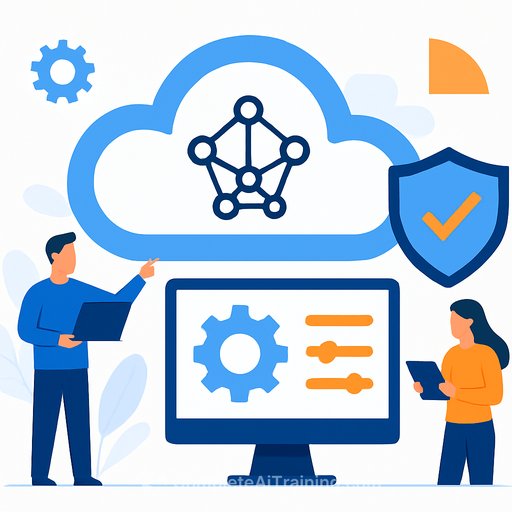
The platform integrates with major hyperscalers and private clouds, supporting policy-driven automation across AWS, Microsoft Azure, Google Cloud Platform and Oracle Cloud Infrastructure. It connects with popular observability, ITSM, security and automation tools to avoid ripping and replacing what works. You get consistent governance, FinOps and reliability practices across distributed environments. Network and cloud engineers looking to deepen skills around Kubernetes, multi-cloud and observability can review the AI Learning Path for Network Engineers.
Why Ops leaders should care
- Reduce alert noise and focus teams on real incidents.
- Shorten MTTD and MTTR with agent-driven triage and action.
- Stabilize services while accelerating safe releases.
- Apply policy and guardrails for auditability and change control.
- Translate usage into cost actions with FinOps-aware agents.
High-impact use cases to start
- Noise suppression and incident correlation across tools.
- Automated triage, runbook execution and escalation.
- Known-error auto-remediation with rollback logic.
- Kubernetes scaling, pod restarts and node health actions.
- Cost optimization recommendations and safe scheduling.
- Change risk checks and release validation against SLOs.
How to evaluate EvolveOps.AI for your org
- List your critical services, SLOs and top noisy alerts.
- Connect existing observability, ITSM and automation tools.
- Start in human-in-the-loop mode with strict guardrails.
- Pick 3 runbooks for pilot automation and define rollback triggers.
- Measure MTTD, MTTR, false positives and on-call load weekly.
- Increase autonomy only when guardrail metrics hold steady.
What this means for day-to-day Ops
Ops teams move from reactive firefighting to proactive control. Agents take the repetitive work, while engineers handle edge cases and improvements. The outcome: fewer pages, cleaner releases and predictable operations across clouds.
If your team is upskilling for agentic workflows and automation in Ops, explore practical training here: AI for Operations.
Your membership also unlocks: