Colleges Turn to Oral Exams as AI-Generated Assignments Raise Questions About Student Learning
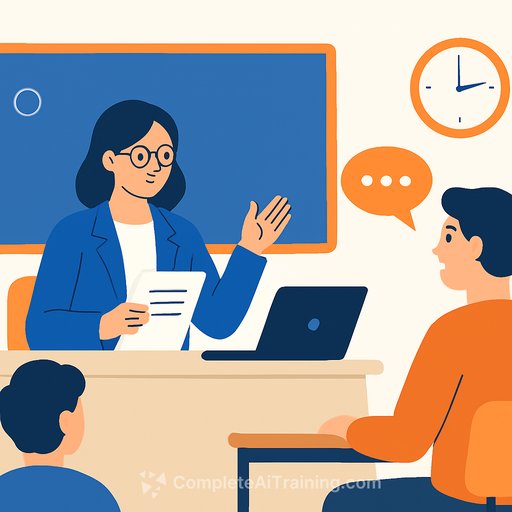
Cornell University biomedical engineering professor Chris Schaffer requires students to defend their work in face-to-face conversations with instructors rather than submit written assignments. He calls it an "oral defense," and he's not alone. A growing number of college professors across the U.S. are adopting oral exams to address a specific problem: students are submitting perfect homework they didn't write.
The issue has become acute as generative AI grows more sophisticated. Instructors report that take-home essays and written work arrive polished and complete. When asked to explain what they wrote, students blank.
"You won't be able to AI your way through an oral exam," Schaffer said.
The Problem Educators Face
Emily Hammer, an associate professor of Middle Eastern Languages and Cultures at the University of Pennsylvania, now pairs oral exams with written papers in her seminars. She forbids AI use on assignments but acknowledges she cannot enforce the rule.
Her reasoning differs from preventing cheating. "Students are actually losing skills, losing cognitive capacity and creativity," Hammer said.
The University of Pennsylvania has launched what Bruce Lenthall, executive director of the school's Center for Teaching and Learning, calls "a massive shift toward in-person assessments." The Ivy League institution is among a small but growing number of universities running faculty workshops on oral exam design.
Oral exams are not standard in American undergraduate education, though they're common in European universities like Oxford and Cambridge, where students meet faculty for weekly discussions. Interest spiked during the COVID-19 pandemic to combat online cheating and has intensified since ChatGPT launched in 2022.
Two Approaches: Traditional and AI-Powered
At New York University, several types of oral assessment are expanding. Faculty are requiring office hours, assigning presentations, and cold-calling students in class. Clay Shirky, NYU's vice provost for AI and technology in education, said instructors are asking: "Do you know this material?"
Some professors are taking a different route: using AI itself to conduct oral exams.
Panos Ipeirotis, a professor at NYU's Stern School of Business, built an AI-powered oral exam for his AI product management course. Students log in from home and speak with an AI agent that uses a cloned voice. The system asks questions about group projects, drills into details based on answers, and provides feedback.
Ipeirotis designed the tool to answer a specific question: "Do you know what your team did? Were you a free rider? Did you outsource everything to AI?"
He grades the exams separately, also with AI assistance. "I don't trust written assignments anymore to be the result of actual thinking," Ipeirotis said. "I want oral exams everywhere now. I want to pair it with every single written assignment."
Student Reactions Are Mixed
Business major Andrea Liu found the chatbot's voice surprisingly human but the conversation awkward. The AI asked multiple questions at once, creating confusion. Pauses felt unnatural, and speaking to a blank screen felt jarring.
"It felt kind of awkward to be talking to what was pretty much a blank screen," Liu said. She acknowledged the underlying concern: "There is no perfect world where AI exists and kids are not abusing it."
Students in Ipeirotis's current class are redesigning the AI agent to address these issues. He plans to use it in all future courses.
Learn more about AI for Education and explore resources for teaching professionals through our AI Learning Path for Teachers.
Your membership also unlocks: