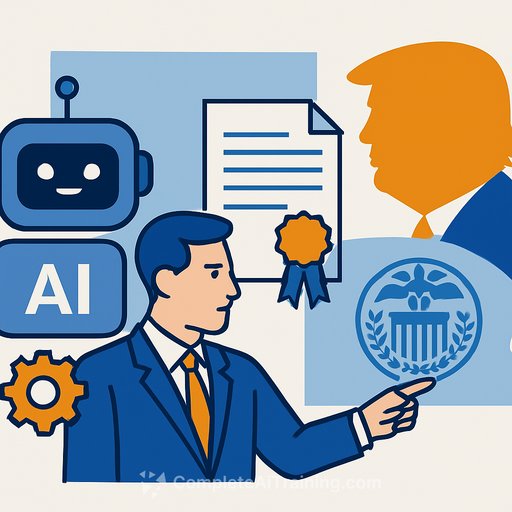
Colorado leaders press ahead on AI regulations despite Trump's funding threats
Colorado lawmakers and state officials say they will keep writing and enforcing state AI rules, even after President Donald Trump issued an order threatening to challenge those regulations and condition federal funding. Expect legal friction, but not a freeze. For context on public-sector AI policy and governance, see AI for Government.
Gov. Jared Polis has signaled he'll refine the 2024 AI statute to reduce grant risk, using executive authority to direct agencies. The stated goal: maintain core consumer protections while avoiding a fight that could jeopardize hundreds of millions in federal dollars.
What's happening now
Senate Majority Leader Robert Rodriguez joined other leaders in August on the west steps of the Capitol to back a bill tightening AI guardrails ahead of a special session. That momentum hasn't faded. Policymakers view the White House posture as a reason to finish the job with cleaner definitions, clearer exemptions, and stronger due process.
Colorado's 2024 law targeted "high-risk" systems tied to consequential decisions and required risk management, testing, and notice. The reform push aims to clarify scope, enforcement, and safe harbors so compliant firms aren't whipsawed by changing federal guidance.
Key legal fault lines for counsel
- Preemption (Supremacy Clause): An executive order alone doesn't preempt state law; Congress must speak, or agencies must promulgate rules with delegated authority. Any preemption claim will likely rely on conflict preemption (impossibility or obstacle) rather than field preemption because there's no comprehensive federal AI statute. See an overview of the Supremacy Clause.
- Conditional spending: The administration may try to tie grant eligibility to "cooperative" state AI policies. Conditions must be unambiguous, related to the federal interest, and not coercive. NFIB v. Sebelius (2012) limits coercion; South Dakota v. Dole permits modest conditions. Expect jousting over what counts as "related" in AI.
- Anti-commandeering: The feds can't order states to legislate or enforce federal priorities. They can incentivize, but they can't conscript. Murphy v. NCAA and Printz still apply.
- Dormant Commerce Clause: If state AI rules effectively regulate out-of-state conduct or create excessive burdens on interstate services, challengers will raise Pike-balancing claims. After Nat'l Pork Producers, extraterritoriality arguments are narrower, but documentation of in-state benefits matters.
- Speech and disclosure: Labeling and transparency mandates can draw First Amendment scrutiny. The state will need evidence that disclosures are factual, not unduly burdensome, and advance concrete consumer protections.
- Procedural due process: For enforcement that affects licenses, benefits, or access to markets, build notice-and-comment rulemaking, appeal rights, and clear standards into agency practice.
Counsel seeking deeper discussion of preemption, due process, and regulatory compliance can consult AI for Legal.
Why Polis's reform track matters
Adjusting the 2024 statute through targeted fixes helps undercut claims of vagueness and overbreadth. It also gives agencies cleaner authority to define "high-risk," set testing thresholds, and recognize recognized frameworks as compliance pathways.
That record will matter in any preliminary injunction fight. Courts will ask whether regulated entities had fair notice, whether compliance is feasible, and whether the public interest favors enforcement. For strategic implications-funding, leadership decisions, and counsel planning-see AI for Executives & Strategy.
What to watch next
- Grant guidance: OMB or cabinet agencies may issue grant conditions or clarifications. Track notice timelines and comment opportunities closely.
- Early test cases: Expect trade associations or platforms to file in federal court seeking to enjoin specific provisions (e.g., algorithmic impact assessments or notice requirements).
- Multistate alignment: If other states adopt similar frameworks, it weakens Dormant Commerce Clause claims and reduces compliance fragmentation.
Action steps for in-house and outside counsel
- Map Colorado's definitions to your AI inventory: consequential decisions, data sources, risk scoring, and human-in-the-loop controls.
- Draft a single risk management plan you can port to other states. Anchor it in NIST AI RMF concepts and document test protocols and fallback procedures.
- Stand up disclosure playbooks: consumer notices, adverse action explanations, and regulator-facing reports. Keep templates short, factual, and verifiable.
- Preserve evidence: version control for models, training data lineage, and sign-offs by product, legal, and ethics teams.
- Prepare grant contingency plans: track funding streams potentially at issue, then assess exposure under any new federal conditions.
Bottom line
Colorado isn't retreating. The legal fight will turn on preemption and spending power-not raw politics-and well-drafted state rules with a solid administrative record will be harder to knock down.
For counsel, the move now is pragmatic compliance that can survive forum shifts. Tight definitions, auditable processes, and clear disclosures travel well, whether you're in Denver or federal court.
Further reading and resources
- Cornell LII: Supremacy Clause and preemption
- Oyez: NFIB v. Sebelius (conditional spending)
- Complete AI Training: Courses by job role
Your membership also unlocks: