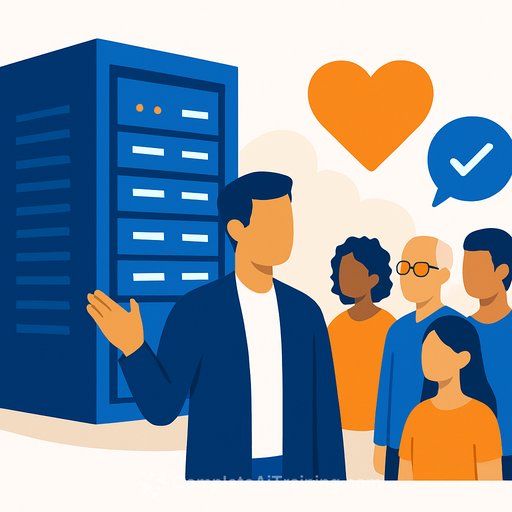
Community-First AI Infrastructure: What engineers and builders should expect
AI needs serious infrastructure: power, cooling, connectivity, and land. The question isn't whether we build it-it's how we build it without stressing the communities where it lands.
Community-First AI Infrastructure is a five-part commitment to build datacenters that carry their own weight, strengthen local systems, and create durable value for residents. If you work in IT, DevOps, or engineering, this directly impacts how you plan capacity, choose regions, and report on sustainability; see the AI Learning Path for Technology Managers for guidance on governance and strategic planning for infrastructure projects.
The 5 commitments at a glance
- We'll pay our way so datacenters don't push up residential electricity rates.
- We'll minimize water use and replenish more than we withdraw-locally.
- We'll create jobs for local residents through training, apprenticeships, and hiring.
- We'll add to the tax base-no requests for local property tax breaks.
- We'll invest in AI training for schools, libraries, small businesses, and nonprofits.
1) Electricity: pay our full freight and expand supply
AI workloads draw significant power. US datacenter demand is projected to triple by 2035, according to the International Energy Agency.
- Rates that reflect true costs: We'll work with utilities and commissions to ensure large-user rate structures cover datacenter-driven infrastructure-without shifting costs to households.
- Plan early with utilities: We'll contract for capacity up front and fund needed transmission and substation upgrades tied to our builds.
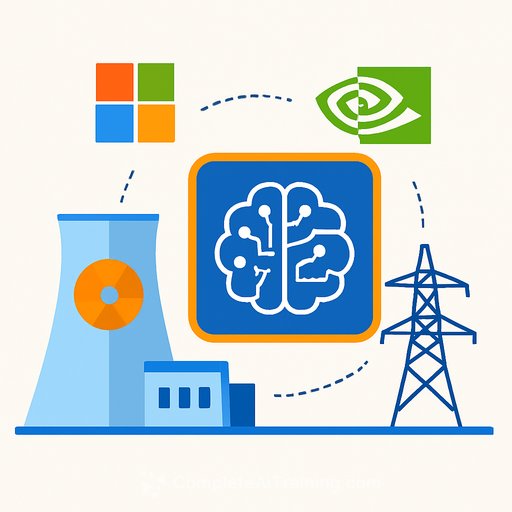
- Efficiency and reliability: We'll use AI and hardware/software optimizations to reduce energy intensity and improve grid operations in partnership with utilities-while supporting new clean generation, including advanced nuclear.
- Policy advocacy: We'll push for faster permitting, smarter interconnection queues, modern grid planning, and large-user rates that are fair and transparent.
International Energy Agency data and market signals matter for regional planning. In the Midwest's MISO market, for example, long-term contracting can directly add generation and stability to the grid. MISO is a useful bellwether if you build in that footprint.
2) Water: use less, reuse more, and give back locally
Cooling AI hardware requires real heat management. The approach: aggressively cut potable water use, invest in local systems, and replenish more than we withdraw in the same water districts.
- Less potable water: Next-gen designs use closed-loop liquid systems and optimize between air and water cooling based on conditions.
- Infrastructure partnerships: Where systems are tight, we co-design with utilities and fully fund upgrades (e.g., water and sewer improvements near Leesburg, VA).
- Reuse where possible: In arid regions like Quincy, WA, we enable water recycling so cooling doesn't tap into scarce drinking water.
- Replenish more than we use: Leak detection projects return water to municipal supply; oxbow wetland restorations recharge aquifers and reduce flood risk across the Midwest.
- Transparency and policy: We'll publish regional water use and replenishment progress and advocate for reclaimed/industrial water as the default for datacenters.
3) Jobs: train local, hire local, and scale apprenticeships
Construction brings thousands of skilled-trade jobs; operations bring hundreds more. The bottleneck is talent supply, not demand.
- Skilled trades pipeline: A new partnership with North America's Building Trades Unions backs apprenticeships and contractor readiness in datacenter regions.
- Datacenter Academy: Community-college partnerships equip students and adult learners for roles in critical facilities, IT ops, and hardware lifecycle (hands-on labs using decommissioned gear included).
- Policy: We support scaling registered apprenticeships and modernizing rules so employers can ramp programs faster and at higher quality.
If you lead teams in infra ops, facilities, or site reliability, this is your hiring tailwind. Expect more certified candidates-electricians, HVAC techs, network hardware specialists-coming from local programs. For individual upskilling paths, see practical AI coursework organized by role at Complete AI Training.
4) Taxes: full share paid-no local breaks requested
Datacenters contribute heavily through property taxes, which fund hospitals, schools, parks, and libraries. The stance is simple: no ask for rate reductions when we acquire land or propose a site-pay the full local share.
In Quincy, WA, long-term investment has supported thousands of construction jobs and hundreds of permanent roles. Poverty rates dropped, county tax revenues more than tripled over two decades, and the city opened a new medical center alongside major school upgrades. That's the bar for every community we operate in.
5) Community AI training and nonprofit support
The communities powering AI should benefit first. We'll deliver age-appropriate AI literacy and tools across schools, libraries, small businesses, and nonprofits.
- K-12 and higher ed: Free, responsible AI learning experiences aligned to standards, built with local schools and colleges (e.g., precision agriculture in Quincy; technical college bootcamps in Wisconsin).
- Libraries as AI hubs: Train librarians, provide certifications, and equip public terminals with AI services so residents can learn and apply skills.
- Small-business enablement: Partner with chambers of commerce to deliver AI training, toolkits, and grants for workforce upskilling and responsible adoption.
- Nonprofit investment: Match $25 per volunteer hour and dollar-for-dollar donations up to $15,000 per employee annually; in 2024, this helped raise $229.1M for 29,000 nonprofits with 964,000 volunteer hours.
What this means for IT and development teams
- Capacity planning: Expect earlier, clearer signals on regional power timelines and constraints. Large-user rates and utility partnerships improve predictability.
- Resilience: Grid upgrades, contracted generation, and AI-optimized operations support more stable SLAs and fewer brownout risks.
- Sustainability metrics: Closed-loop cooling, water reuse, and local replenishment give you credible data for ESG reporting and customer audits.
- Talent: Stronger local pipelines reduce time-to-fill for infra roles and raise baseline skills for multi-year campus expansions.
Engineers implementing and optimizing deployments can find hands-on guidance in the AI Learning Path for Software Engineers, which complements the operational and planning commitments above.
Bottom line
AI infrastructure only works if communities win with it. That means paying full costs, reducing local strain, growing local talent, and funding public services that make growth livable.
If you build products, run platforms, or maintain critical environments, plan around these commitments. They're meant to make your systems more reliable, your reporting cleaner, and your hiring easier-while earning long-term trust where the hardware lives.
Your membership also unlocks: