
AI news ·
Companies that replace workers with AI forfeit the collective intelligence advantage, studies find
Replacing workers with AI may cost more than it saves, according to a Royal Docks School of Business meta-analysis. AI processes information fast; humans supply judgment and accountability-and neither performs as well without the other.
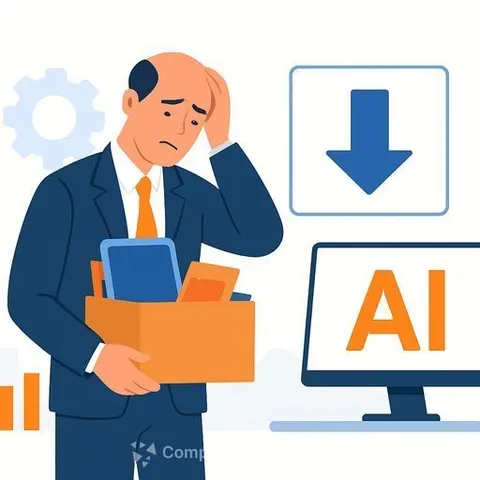
The Cost of Replacing Humans With AI
Executives cutting headcount in anticipation of an AI productivity boom may be optimizing for the wrong metric. A meta-analysis from the Royal Docks School of Business and Law found that the highest-value use of AI isn't replacement-it's augmentation of human judgment.
The research examined how organizations create, store, and share knowledge. The finding: AI performs well at processing complex information quickly, while humans excel at tasks requiring judgment, meaning, and accountability. Neither works as well independently.
Where AI and humans work best together
Consider three examples from the study:
- A hospital where AI surfaces relevant research from specialties outside the treating physician's expertise, but the doctor makes the final call
- A law firm where AI cross-references precedent across jurisdictions in minutes, while partners decide the strongest argument for the client
- A product team where AI synthesizes feedback from support tickets, sales calls, and app reviews-but humans decide what to build
AI also strengthens what researchers call "collective intelligence"-the ability to pull together facts and ideas from different domains into a single coherent picture. But this only works if people retain decision-making authority.
Overreliance on AI erodes human judgment. That's the real risk. AI still needs people for interpretation and ethical choices.
The skills atrophy problem
A separate study titled "AI Assistance Reduces Persistence and Hurts Independent Performance" tested over 1,200 participants on math and reading comprehension tasks. Users who relied on AI chatbots like ChatGPT showed sharp performance drops once the tool was removed. They were also more likely to abandon difficult problems than those who hadn't used AI.
These effects appeared after just 10 to 15 minutes of use.
Some organizations are replacing junior employees with AI used by senior staff. But if that happens at scale, where do tomorrow's senior employees come from? The researchers don't recommend banning AI-they recommend using it to help people grow, not replace them.
Building a knowledge ecosystem
Rather than chasing cost savings through headcount reduction, the Royal Docks study recommends redesigning your organization around human-AI collaboration. The building blocks are:
- Workflow redesign: Map tasks by who or what performs best, then design handoffs, not replacements
- New roles: Hire or develop AI specialists
- Training shift: Move from domain skills alone to metacognition-knowing when and how to combine personal knowledge with AI input
- Documentation: Invest in high-quality documentation. AI can handle the complexity
- Ethical guardrails: Use people to keep AI aligned with human and business-centered goals
Companies that keep people in charge will be more legally defensible, more trusted by customers, and better at catching costly mistakes that AI makes with confidence.
The compounding advantage
Replacement delivers a one-time cost saving. A real knowledge ecosystem where AI makes humans smarter and humans keep AI honest delivers compounding advantages.
Organizations that cut too many employees betting on AI will find themselves at a competitive disadvantage against those investing in knowledge ecosystems and human-AI partnership. The unmeasurable-institutional knowledge, judgment, accountability-matters more than the measurable.
For executives and strategy professionals, the choice is clear: design for augmentation, not replacement.