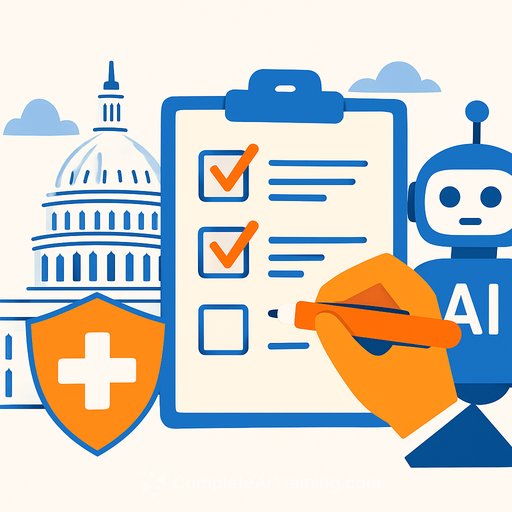
Congress opens final 2025 session: healthcare subsidies and AI policy take center stage
Congress is back from Thanksgiving with a short runway before the holidays and a long to-do list. At the top: a vote on enhanced Affordable Care Act premium subsidies before they expire on Jan. 1, plus a push to tuck AI policy into the National Defense Authorization Act (NDAA).
If you work in healthcare, both moves affect your patients, your payers, and your operating plans for Q1.
Jan. 1 subsidy cliff: what's at stake
Enhanced ACA premium subsidies are set to lapse on New Year's Day unless Congress acts. The Senate is preparing a vote, but details are still in flux and the House hasn't committed to taking it up. The White House signaled it might offer a plan, then pulled back, which adds more uncertainty.
Practically, a lapse means higher exchange premiums for millions of enrollees. Expect churn, delayed care, and a spike in financial assistance requests if Congress misses the deadline, even if a retroactive fix arrives later.
See how ACA premium tax credits work
What the Senate will debate
The Senate HELP Committee, led by Chair Bill Cassidy (R-La.) with Bernie Sanders as ranking member, holds a hearing Wednesday titled "Healing a Broken System." The discussion will focus on healthcare prices and, by extension, the subsidy question.
Observers are split on whether this becomes a partisan show vote or the start of a real deal that could reach President Trump's desk. Timing is tight with lawmakers scheduled to head home around Dec. 18.
Likely paths for subsidies
- Straight extension: Continue enhanced subsidies for 1-2 years. Easiest operationally, high odds if leadership wants a quick win.
- Extension with income limits: Preserve help for lower- and middle-income households, trim upper-income eligibility.
- Broader trade-offs: Pair an extension with policy changes, such as tweaks to health savings accounts or other price provisions.
- Short lapse, then fix: Subsidies expire Jan. 1, premiums jump, and Congress moves under pressure after the fact.
Provider impact if subsidies lapse
- Exchange churn: Patients drop or shift plans; prior auth resets and continuity of care issues increase.
- Bad debt and charity care: Rising out-of-pocket costs drive up uncompensated care and payment plans.
- Front desk friction: More eligibility checks, estimate requests, and rescheduling as premiums change.
- Outreach load: Higher call volume around coverage options and financial counseling.
What to watch this week
- HELP Committee hearing signals on pricing and subsidy contours.
- Any written framework from Senate leaders that narrows negotiations.
- House Speaker Mike Johnson's posture on bringing a Senate bill to the floor.
AI policy tucked into the NDAA: why healthcare should care
Two AI measures are in play as the NDAA text gets finalized. First, a push to block states from regulating AI. The argument: reduce a patchwork of rules. The risk: fewer state guardrails for safety and transparency, which many health systems currently rely on for compliance baselines.
Second, the GAIN AI Act would give U.S. companies priority access to advanced AI chips ahead of foreign rivals. Nvidia opposes it, and CEO Jensen Huang is lobbying against inclusion. For hospitals and life sciences groups building models or deploying inference at the edge, chip availability and pricing could be affected depending on how procurement rules shake out.
Action list for healthcare leaders
- Run two Q1 scenarios: subsidies extended vs. lapsed. Update volume forecasts, payer mix, and charity care budgets.
- Prep patient communications now: simple scripts for premium changes, coverage checks, and financial assistance.
- Tighten eligibility workflows: real-time benefits verification and point-of-service estimates to reduce surprise bills.
- Coordinate with payers: confirm continuity-of-care exceptions and expedited prior auth for plan switches.
- AI governance check: if federal rules preempt states, align your model risk, validation, and audit trails to a consistent, internal standard.
- Procurement hedge: if you run on-prem AI, assess GPU supply options and cloud fallbacks in case chip access shifts.
The broader calendar
Beyond healthcare and AI, Congress still has to finish the NDAA and address new oversight inquiries before leaving town. The next funding deadline looms on Jan. 30, 2026, which could bring another round of fiscal brinkmanship.
If you're building AI capability inside a health system
Use this window to tighten policies, training, and deployment standards so you're ready regardless of how Congress lands on AI. If you need structured options for upskilling non-technical teams, explore focused tracks by role here: Complete AI Training - courses by job.
The next few weeks will be noisy. Keep your plans simple, your scripts clear, and your teams ready to flip between scenarios without burning time.
Your membership also unlocks: