
AI news ·
Consciousness researcher doubts Anthropic's claims that Claude is sentient
Anthropic found a mental workspace in Claude resembling human consciousness. Neuroscientist Anil Seth argues this shows intelligence, not true sentience.
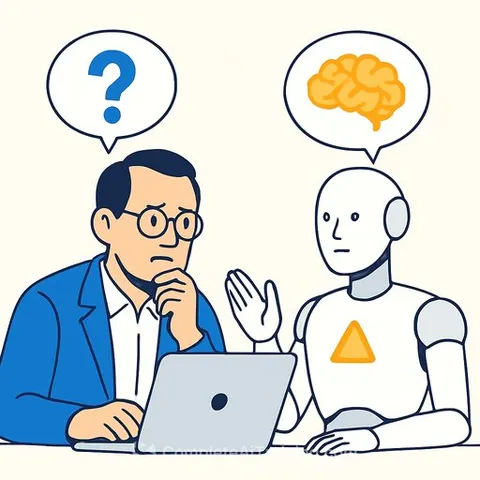
Frontier AI firm Anthropic published new research on its language model Claude last week, claiming to find signs of a "mental workspace" that resembles a leading theory of human consciousness. Anil Seth, professor of cognitive and computational neuroscience at the University of Sussex, immediately pushed back, arguing that the observed patterns are no more evidence of sentience than a weather simulation is evidence of a real hurricane.
Anthropic's team, led by Jack Lindsey, developed a method to examine the statistical interactions between inputs and outputs in Claude. They found activity that formed a kind of internal workspace, holding words and phrases relevant to the current conversation, maintaining something like short-term memory, and showing selective attention to the task at hand. The model also displayed traces of step-by-step reasoning. The researchers noted that these features are similar to those described by global workspace theory, a prominent framework in human consciousness research.
The global workspace theory link
Global workspace theory, introduced by Bernard Baars in the 1980s and elaborated by Stanislas Dehaene, proposes that conscious experience arises when information is broadcast widely to different parts of the brain. The "workspace" Anthropic observed inside Claude appeared to spontaneously organize relevant information before the model decided what to say. The similarity is striking, but Seth cautions against reading too much into it.
"The information processing unfolding inside Claude is no more likely to result in consciousness than a simulation of a weather system is likely to generate a real hurricane," he said. The findings, he added, show that both living brains and silicon computers can converge on similar solutions when faced with similar problems-just as flight is possible with flapping wings or with jet engines.
Why intelligence is not consciousness
Seth draws a sharp line between intelligence and consciousness. Consciousness, he says, is about feeling and being-the "something that it is like" to be an organism, as philosopher Thomas Nagel put it. Intelligence is about doing, about performing functions. In humans, the two go together, but that doesn't mean they go together in general. "A common mistake people make when it comes to AI is to confuse the two-to take signs of intelligence as evidence for consciousness," Seth said.
The Anthropic research is valuable precisely because it doesn't rely solely on that psychological bias. It looks for signatures of information processing that might be shared by humans and machines. Yet, Seth points out, the model lacks recurrent activity-a specific kind of feedback loop seen in the human brain-and the differences run deeper than that.
The computer metaphor and its limits
For Seth, the very possibility of conscious AI rests on the assumption that consciousness is purely computational. But the closer we examine real brains, the clearer it becomes that they are not simply computers made of meat. In brains, you can't cleanly separate what they do from what they are-the software from the hardware. The computer, he argues, is a powerful metaphor for the brain, but still a metaphor. "We will always get into trouble when we confuse a metaphor with the thing itself-the map with the territory," he said.
Claude is a computer program running on silicon, while conscious animals are living creatures with bodies embedded in worlds. That embodiment, Seth suggests, may be fundamental to consciousness in a way that no language model can replicate.
Why this matters for science and research professionals
For professionals in AI for Science & Research, the debate underscores the need to define consciousness rigorously before attributing it to any system. The patterns Anthropic found are impressive, but they may reflect a convergent solution to a language task, not an emergent mind. When evaluating claims about machine consciousness, test them against the same criteria used in biological systems-and remember that simulation is not the same as instantiation. The distinction between intelligence and sentience is not merely philosophical; it shapes how we deploy, regulate, and relate to increasingly sophisticated AI.