The AI Licensing Shift: Creative Weight Attribution Is Resetting How Music Gets Paid
Generative AI moved from the lab to the backend of everything. In music, that's exposed a simple truth: training first and asking permission later won't cut it for the next decade. If you make, manage, or protect music, the priorities are consent, transparency, and attribution you can verify-not mystery datasets and retroactive deals.
Why "train first, ask later" is breaking trust
Most large AI models ingested recordings, compositions, artwork, and metadata pulled from the open web-material protected by copyright. Legal analyses now point out that building and processing these datasets involve copying that triggers the right of reproduction when done without permission.
Recent guidance from the U.S. Copyright Office states that AI training and deployment implicate reproduction rights and that blanket fair-use assumptions are shaky. Licensing outputs after the fact doesn't fix missing consent at the source-a point underlined by ongoing lawsuits against AI developers.
See U.S. Copyright Office AI guidance
Big-label AI deals are signals, not a mandate
Major labels are negotiating expansive AI licenses that may cover training and AI-assisted generation, with payments tied to usage. The actual terms aren't public. Many artists say they weren't consulted, and some deals may sit on top of contracts that never contemplated AI training or voice/style use.
For the independent sector, this creates a dangerous default: music looks "available" for AI unless explicitly excluded. Collective management organizations (CMOs) are already flagging that risk.
The real problem: who gets credit inside the model?
Traditional pro rata payouts split money by plays or market share. That was never a great proxy for influence. In AI, it breaks entirely: tying royalties to prompt counts or generated tracks hides which works actually shaped the model.
Music recognition isn't reliable enough to detect influence in outputs. The hard problem is attribution inside the model-how much a specific work informed the model's internal representations and behavior over time.
Creative Weight Attribution: a practical path
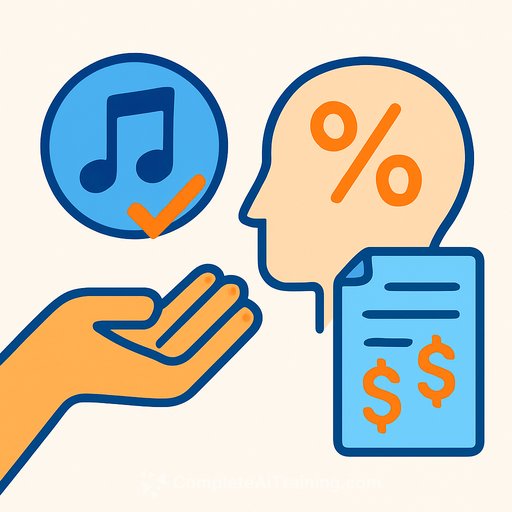
Independent CMOs and research groups are testing a different approach: measure the creative weight of works in training and generation. Don't treat every input equally. Quantify influence and pay accordingly.
This demands neutral, audit-able methods: reproducible experiments, transparent training documentation, and metrics that third parties can validate. Historical performance data, genre and territory context, and long-tail usage matter-so legacy catalogs don't get sidelined by whatever's trending on a platform's private logs.
Who's building it
AIxchange and the Berlin-based AI Think Tank are pushing Creative Weight Attribution from concept to tooling-so creators, CMOs, and AI developers can strike consent-first, measurement-backed deals. With research partners like the Fraunhofer IDMT Institute, the focus is on method integrity and cross-industry standards.
"At this stage it is important for Paradise Worldwide to explain via the Think Tank that distribution tech has to clear both rights (master + extended publishing data), on top of that it requires consent," shares Ralph Boege, CEO of Paradise Worldwide and an advisor for AIxchange. "This new legal-tech ecosystem will change the industry and is leading to new ownerships."
"We have partnered with the AIxchange because we also believe in Creative Weight attribution-a new way of working together with AI platforms, integrating CMOs and eventually PROs. In cooperation with the AFEM, we have worked on the AI principles. I think we as an industry can do better and we should not repeat old habits like doing business based on market share or DSP results. We question the 'deals' which are in place between the majors and AI platforms-I can hardly imagine that they have fulfilled the here described new ecosystem conditions."
"As pioneers in the field of audio matching (fingerprinting) and metadata enrichment and extraction, we have been providing media companies, CMOs, and others with the tools for measuring music usage for more than 20 years," says Steffen Holly of the Fraunhofer Society. "Building on this expertise in proven content matching technologies, we want to make an active contribution to developing fair, transparent and meaningful content attribution technologies."
From legal theory to distribution architecture
CMOs are reframing AI as a distribution architecture problem. Tools like extended collective licensing or private-copying regimes could help-but only with transparency about what was ingested and how it's used. Otherwise, valuation is guesswork.
Cross-border training is routine, so coordination matters. In the Netherlands, AIxchange and Buma/Stemra are piloting Creative Weight models to identify how individual works influence model behavior-an early step toward shared standards, reference datasets, and data-access norms that global AI firms can't route around.
Consent must be specific, informed, and revocable
Intermediaries can't license rights they don't hold. Contracts and collective mandates need to spell out training, embedding, and generation rights. Global opt-outs or generic "industry deals" won't satisfy consent if individual creators never agreed.
For AI companies, the path is clear: permission-based datasets, detailed records, and the ability to turn access off if consent is withdrawn. That's how you earn long-term access to high-value catalogs.
Emerging markets are setting their own terms
Across Africa, platforms and policy makers are prioritizing creator and state sovereignty over platform dominance. The focus: knowledge transfer, tools for attribution, and licensing templates that keep value in the local economy.
Nigeria is emphasizing opt-in training and treating voice/style projections as unique identifiers under existing copyright. The Africa Rising Music Conference is launching the Music in Tech (Africa) format, hosting the AI Think Tank in May 2026 to strengthen Berlin-Johannesburg ties and build Pan-African content independence.
What this means for working creatives
- Audit your contracts. Add explicit clauses for AI training, embedding, generation, and voice/style use.
- Register with your CMO/PRO and ask about Creative Weight pilots. Participate early to influence standards.
- Maintain clean metadata. ISRC/ISWC, splits, alternates, stems, territories-organized catalogs earn leverage.
- Opt-in where you want exposure; opt-out where terms are fuzzy. Consent should be adjustable, not one-way.
- Document usage signals: past radio, sync, live setlists, niche scenes. Historical influence supports attribution claims.
- Treat voice and style as identifiers. Clarify rights in band/producer agreements now, not after a dispute.
What CMOs and indie orgs can do next
- Define clear consent flows and revocation paths. No consent, no ingestion.
- Require training-data disclosures and reproducible tests in all licenses.
- Stand up shared reference datasets and benchmarks across territories.
- Adopt open, independently verifiable attribution metrics with research partners.
- Price licenses by projected model impact (creative weight), not just usage counts.
- Coordinate cross-border enforcement to avoid being sidelined by platform forum-shopping.
The next 12-24 months: what to expect
- Court decisions on whether unlicensed training infringes reproduction rights.
- Regulatory guidance on transparency and consent obligations for training and deployment.
- The first scaled licensing schemes between rights holders and AI firms-tests for attribution and auditing.
- A default standard: either consent-first with verifiable attribution, or black-box deals that leave creators out.
Bottom line
If your work trains a model, you deserve a say and a share. Creative Weight Attribution gives the industry a way to measure influence and route money where it belongs. Pair that with explicit consent and shared standards, and AI becomes an engine for fair growth-not a one-way extraction.
Helpful links
- U.S. Copyright Office: AI Policy and Guidance
- Fraunhofer IDMT: Audio and Media Technologies
- AI Research Courses
- Complete AI Training: Latest AI Courses (get fluent in the systems you'll negotiate with)
Your membership also unlocks: