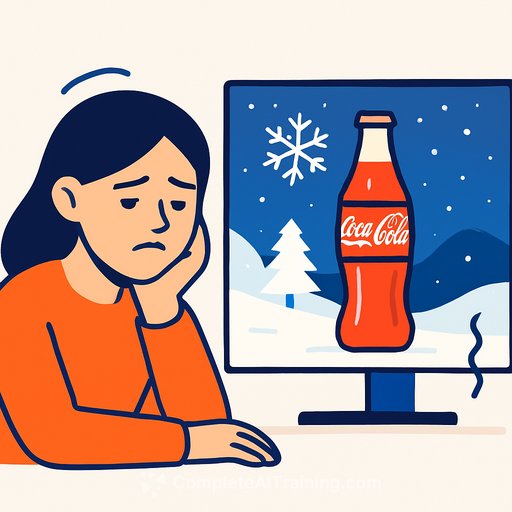
Can We Buy the World a New Coca-Cola Ad?
The holidays are here. So is the second wave of backlash to AI-made holiday ads. The issue isn't the tech. It's the decision to let the tool own the story.
This year's Coca-Cola spot looks like a cosplay of a cosplay: glowing trees, animals staring on cue, a crowd-cheer audio vibe, then an uncanny Santa. It hits composition. It misses connection. It feels like a brand remembering how to be itself.
Execution vs. Expression
We're watching teams confuse "how it's made" with "what it means." The process became the pitch. In this case, even the core message-Real Magic-ended up branding the AI pipeline, not the story. When the tech takes a bow, the audience stops feeling and starts inspecting.
Result: a minute of scenes that almost connect. A copy of a copy. An asterisk after "Real Magic" that says "this is fake." Do it two years in a row and the subtext becomes the text.
AI Knows Patterns. Your Audience Needs Purpose.
AI can remix what's been said. It can't care why you're saying it. That gap is where sentiment dies. Reports of 100+ people and 70,000 prompts don't signal ambition-they signal drift. Volume doesn't equal meaning.
What PR and Comms Leaders Should Do Now
- Define the point before touching a tool: What are we trying to say, why now, who is this for, and what should they feel?
- Ban "process as message": If the sell is "look how we made it," you've already lost the room.
- Separate craft from concept: AI can help with scale, options, and polish. It cannot be the spine of the idea.
- Audit for coherence: Does each scene advance a single point of view? If you can shuffle shots without breaking meaning, there is no meaning.
- Protect the brand's human voice: Pick one emotion and one truth to carry through every frame and line.
A Simple Framework for AI-Assisted Campaigns
- Statement: One sentence on what you believe (not what you can render).
- Moment: One timely tension your audience cares about right now.
- Feeling: Name the emotion you want held in the final two seconds.
- Line: A tagline that stands without an asterisk or apology.
- Use of AI: List specific tasks (variants, storyboards, alt lines, comp shots). If "core concept" shows up here, start over.
Quality Bar: Tests Before You Publish
- The "Why Me" Test: Could any brand swap logos and run it? If yes, stop.
- The "One Breath" Test: Can a spokesperson explain the idea in one breath without mentioning the tech?
- The "Cold Watch" Test: Show it to five people who haven't seen your brief. Ask what they felt, not what they saw.
- The "Asterisk" Test: Any disclaimer that undercuts the line or the promise means the line or the execution is wrong.
Where AI Fits-and Where It Doesn't
- Good: research synthesis, moodboards, rough comps, alt copy, versioning, production assists.
- Bad: the core insight, the thesis, the emotion, the voice.
Use the tool to clear noise. Use your team to decide what matters.
The Real Risk
If success gets measured by prompt count and headcount, we'll keep producing content that looks like a campaign but feels like a placeholder. The cost isn't one holiday ad. It's trust. And trust is the only asset you can't automate.
Keep the Point. Then Press Export.
Experiment. Test. Play. Make weird prototypes. But feel the work before you approve it. If the work can't pass through a human heart first, it won't make it to anyone else's.
If your team needs structure for using AI without losing the story, see our practical course paths for comms and marketing roles here: Complete AI Training: Courses by Job.
Your membership also unlocks: