Cornell joins Schmidt AI in Science: What it means for your research
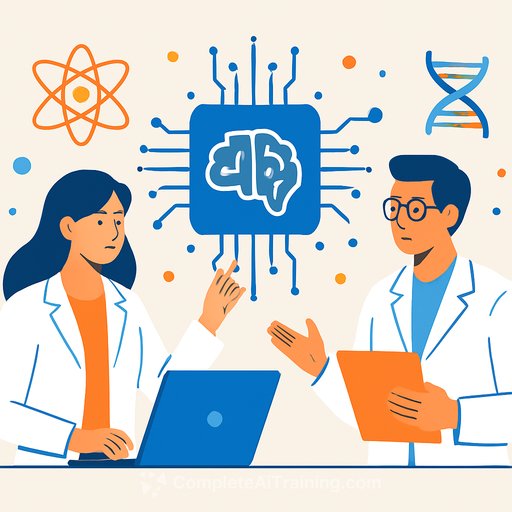
Cornell University has joined the Schmidt AI in Science Postdoctoral Research Initiative, a program backed by Eric and Wendy Schmidt to push AI deeper into scientific discovery. The core idea is simple: place postdocs at top research hubs, pair them with strong labs, and apply machine learning to real scientific problems and advance AI Research.
For scientists and PIs, this means more talent, tighter links between computation and experiments, and faster iteration on data-heavy projects. For postdocs, it's access to mentorship, compute, and cross-department collaboration that actually moves work forward.
Why this matters
- AI methods are now central to experimental design, simulation, imaging, and data analysis across fields.
- Interdisciplinary teams ship results faster-especially when model development and lab work happen in the same loop.
- Institutions that grow AI fluency across departments build a durable pipeline of researchers who can work at the interface of theory, data, and engineering.
How Cornell will put it to work
Postdoctoral fellows will be hosted across computer science, engineering, physical sciences, and life sciences. Expect joint mentorship, shared datasets, and projects that span modeling, instrumentation, and large-scale experiments. Life-science fellows may find the AI Learning Path for Biochemists a useful way to align skills with lab needs.
The emphasis is on practical outcomes: improving analysis pipelines, building reusable tools, and connecting computational groups with laboratories that can validate results quickly.
What fellows can expect
- Mentorship from domain experts and AI methodologists.
- Access to compute, data resources, and active collaborations.
- Professional development that sets you up for lab leadership or industry research roles.
Program structure at a glance
Appointments are postdoctoral, placed within Cornell labs and departments. Fellows are expected to collaborate across groups, publish, and contribute tools or methods that other teams can reuse.
Applications and selections are coordinated across participating institutions. Specific timelines and eligibility details are typically posted through each university's research offices and partnering programs.
Broader impact
This initiative is part of a larger shift: AI for Science & Research is becoming standard practice in scientific workflows, not a niche add-on. By embedding postdocs inside research hubs, the program helps translate models into experiments, and experiments back into better models.
If you're at Cornell: fast ways to engage
- PI or lab lead: Map 1-2 high-value problems where ML could compress timelines or improve sensitivity. Prioritize those with available data and clear metrics.
- Computational researcher: Identify one lab partner and propose a shared benchmark, dataset, and success criteria. Keep scope tight; iterate weekly.
- Postdoc candidate: Prepare a one-page concept note with the scientific question, model class, data access, and validation plan.
If you're outside Cornell: how to plug in
- Track the initiative and participating universities for calls and timelines. Details are commonly posted by the program and host institutions.
- Build a lightweight portfolio: a reproducible notebook, a small dataset, and one figure that shows lift over a baseline on a real problem.
Useful links
Bottom line
More compute-literate scientists, closer collaborations, and tighter feedback loops. If you have a problem that bottlenecks on data or modeling, this is a clear path to unstick it-and publish faster with stronger evidence.
Your membership also unlocks: