Cornell Professor Brings Typewriters to Class to Combat AI-Written Assignments
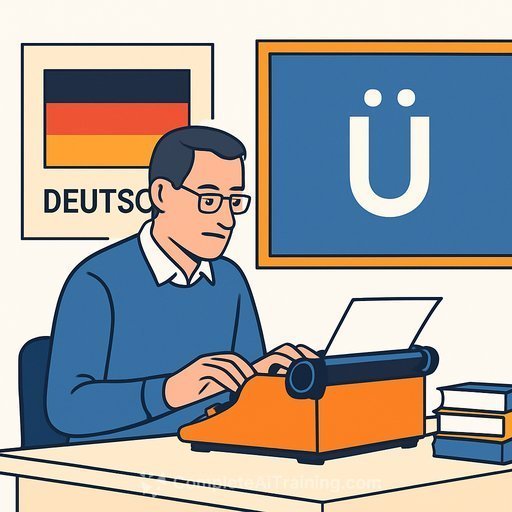
Grit Matthias Phelps, a German language instructor at Cornell University, pulls out manual typewriters once each semester. Students sit at desks with machines that ding at the end of each line, forcing them to write without spellcheckers, online dictionaries, or delete keys.
The exercise started in spring 2023 after Phelps watched students submit grammatically perfect assignments written by AI and translation software. She wanted to know: could they produce the work themselves?
"What's the point of me reading it if it's already correct anyway, and you didn't write it yourself?" Phelps said.
She sourced dozens of used typewriters from thrift shops and online marketplaces and created what her syllabus calls an "analog" assignment. The approach reflects a broader trend across American colleges: in-class pen-and-paper exams and oral tests designed to prevent students from using AI on laptop-based work.
The Typewriter Learning Curve
Students arrive unprepared for the mechanics. Catherine Mong, a 19-year-old freshman, had seen typewriters in movies but didn't understand how they worked.
"I didn't know there was a whole science to using a typewriter," she said.
Phelps demonstrates the basics: feeding paper manually, striking keys with force but not so hard letters smudge, understanding that the bell signals the line's end and the need to manually return the carriage. One student had an epiphany: that's why the key is called "return."
Most students lack the finger strength for touch-typing and resort to pecking with their index fingers. Mong, who had a broken wrist, typed with one hand.
Fewer Distractions, More Thinking
Ratchaphon Lertdamrongwong, a sophomore computer science major, noticed something unexpected while writing a critique of a German film. Without screens, notifications disappeared. Without instant answers at his fingertips, he asked classmates for help.
"While writing the essay, I had to talk a lot more, socialize a lot more, which I guess was normal back then," he said. "But it's drastically different from how we interact within the classroom in modern times."
Without a delete key, he paused before typing. Mistakes meant thinking through problems independently rather than delegating to AI or search engines.
"I was forced to actually think about the problem on my own instead of delegating to AI or Google search," he said.
Embracing Imperfection
Mong initially resented her messy pages-odd spacing, misspellings, pencil marks where she'd written X's over errors. As a perfectionist, the visual disorder frustrated her.
Then she reframed it. She played with the page's visual boundaries, indenting and fragmenting lines in the style of poet E.E. Cummings. She saved all her drafts, mistakes included.
"This thing I handed in had pencil marks all over it and definitely did not look clean or finished. But it's part of the process of learning that you're going to make mistakes," she said.
Mong found the assignment "fun and challenging" and plans to hang her drafts on her wall.
Phelps brings her two children, aged 7 and 9, to serve as "tech support" and ensure no one uses their phones during the exercise. She describes the effect plainly: "Everything slows down. It's like back in the old days when you really did one thing at a time. And there was joy in doing it."
For writers managing the pressures of AI-assisted content creation, the lesson extends beyond the classroom. AI for Writers resources address how professionals navigate these tools. Teachers and institutions exploring similar approaches may find value in AI for Education frameworks designed for academic integrity.
Your membership also unlocks: