COUR Q4: AI Product Expansion and Udemy Merger - What Product Teams Need to Know
Coursera posted a solid Q4: revenue beat, in-line EPS, and an upbeat Q1 revenue outlook. Under the hood, the story is product execution-AI-first content, a cleaner learner journey, and a new platform fee to fund the roadmap.
The near-term tradeoff: Q1 EBITDA guidance is lighter than the Street expected as the company keeps investing in AI and go-to-market. If you build products, this quarter reads like a case study in balancing growth, margins, and speed.
Q4 CY2025 Highlights (at a glance)
- Revenue: $196.9M (+9.9% YoY), a 2.7% beat vs. $191.7M consensus
- Adjusted EPS: $0.06, in line
- Adjusted EBITDA: $11.2M (5.7% margin), 23.7% beat vs. $9.05M consensus
- Operating Margin: -16.4%, flat YoY
- Paying Users: 197M, up 28.8M YoY
- Billings: $200.2M, up 9.6% YoY
- Q1 CY2026 Revenue Guide: $195M midpoint (above $190.2M consensus)
- Q1 CY2026 EBITDA Guide: $13M midpoint (below $19.01M consensus)
- Market Cap: ~$1.00B; stock at $5.96 near print
Why this matters for product teams
Management credited AI-driven course launches and a redesigned learner experience for record new learner adds and stronger engagement. Partnerships (including with AI leaders) fueled demand for Generative AI and LLM content, with enrollments more than doubling year over year.
International growth got a lift from geo-based pricing and Translation - 100+ courses now support five languages. That's a practical model for localizing at scale without bloating headcount.
Coursera also introduced a new 15% platform fee on eligible new sales. It's intended to fund ongoing platform work and improve gross margins over time without raising customer-facing prices.
The product playbook (distilled)
- Ship AI where outcomes are clear: Personalized learning paths, role-play simulations, and collaboration tools are next. These features map cleanly to retention and upsell.
- Monetize the platform, not just the user: A platform fee can fund heavier infra and AI costs while keeping pricing steady for learners. Expect margin benefits to show up later due to subscription revenue recognition.
- Localize with leverage: AI translation plus geo pricing can open new markets fast. Start with your top enrollments and translate high-intent pathways first.
- Enterprise needs focus: A new GM and a refreshed GTM are in motion to improve net retention. Don't expect instant results-build the engine, then scale it.
Udemy merger: what to expect if you build and ship
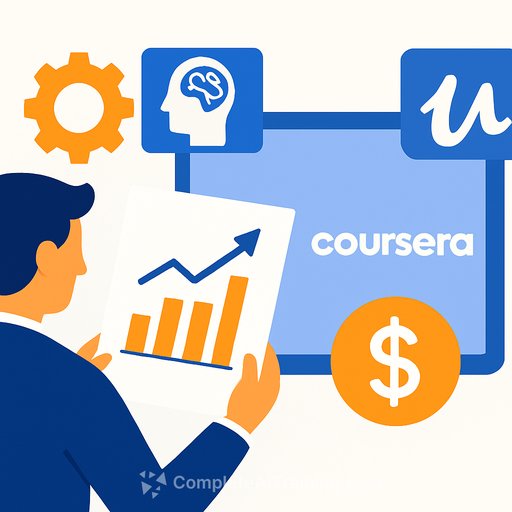
The proposed combination with Udemy could increase catalog breadth, balance consumer and enterprise revenue, and create operating efficiencies. Bigger content surface area = more entry points for learners and more data for personalization.
Integration risk is real: regulatory timelines, tech stack alignment, catalog dedupe, pricing harmonization, and sales motions need careful sequencing. If approved, the first 6-12 months will likely be about harmonizing content metadata, unifying identity, and aligning packaging.
Signals for your own roadmap
- AI-first learning: Double down on features tied to measurable outcomes (time to skill, assessment pass rates, job-role readiness). Build feedback loops into cohorts and projects.
- Packaged value: Position premium features (simulations, projects, collaboration) inside subscription tiers. Make the upgrade path obvious.
- International by default: Bake translation, currency, and regional compliance into your design system. Don't bolt it on later.
- Partner strategy: Content and credential partners can compress time to relevance. Prioritize partners that bring both brand and distribution.
Management commentary (decoded)
- AI content is working: Generative AI catalogs are seeing strong demand, helped by partnerships and faster course creation.
- Marketing + UX cleanup: A redesigned learner journey and better localization improved engagement and additions.
- Platform fee: Implemented in January; benefits should build through the back half as subscriptions and enterprise contracts recognize over time.
- Enterprise rebuild: New leadership and GTM changes aim to lift net retention. Expect a lag before metrics move.
What to watch next 2-3 quarters
- AI feature adoption: Usage of personalized pathways, simulations, and collaboration features; uplift in retention and conversion.
- Gross margin mix: Platform fee impact-more visible in H2; watch consumer first, then enterprise by 2027.
- Enterprise NRR: Early signs from cohorts under the new GM and GTM motion.
- International share: Enrollment and billings mix in localized markets.
- Udemy integration milestones: Regulatory approvals, integration plans, initial synergies without user friction.
Context on partnerships and AI
Coursera highlighted fast rollout of generative AI courses via university and model partners. If you're evaluating your own AI education stack, it's worth tracking model providers like Anthropic for capability shifts that affect course design, assessments, and simulations.
Bottom line for product leaders
This quarter shows a clear bias to build: ship AI features tied to outcomes, internationalize with AI at the core, and fund the roadmap with platform economics. The near-term EBITDA guide is softer, but the strategy points to healthier unit economics over time if execution holds.
If your team is planning AI-forward education or skills products, the play is clear: measure learning outcomes, price on value, and let partnerships compress your time to market.
Further learning
Want a curated view of practical AI courses and certifications by job role? Start with the AI Learning Path for Training & Development Managers.
Your membership also unlocks: