Court Bars AI Browser From Amazon Accounts Without Platform Authorization
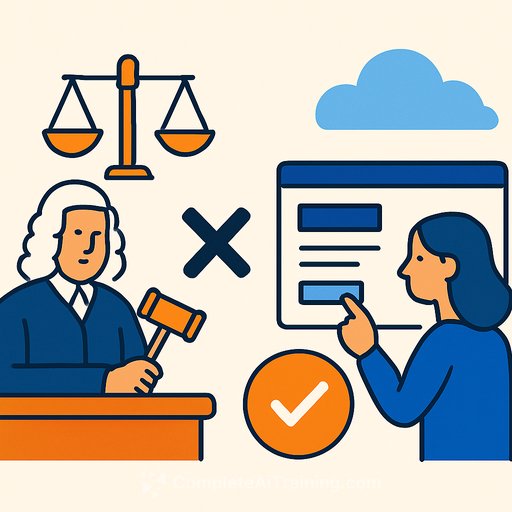
A federal judge in California has blocked Perplexity AI from accessing Amazon's password-protected customer accounts using its AI-powered browser, Comet. The March 9 ruling marks one of the first detailed judicial analyses of how computer-access laws apply to autonomous AI systems that act on behalf of users.
U.S. District Judge Maxine M. Chesney found Amazon likely to win its case under both the Computer Fraud and Abuse Act (CFAA) and California Penal Code § 502(c)(7). The decision hinges on a critical distinction: user permission is not the same as platform authorization.
User Consent Does Not Equal Platform Authorization
Perplexity argued that Comet accessed Amazon accounts only when users voluntarily provided their login credentials. The court rejected this defense.
Judge Chesney drew on Facebook, Inc. v. Power Ventures, Inc., a precedent holding that user consent does not excuse continued access after a platform revokes authorization. Amazon's cease-and-desist letter terminated whatever authorization Perplexity might have claimed based on user permission alone.
The court found "strong evidence" that Comet accessed Amazon accounts with user permission but without Amazon's authorization, extracted private account information, and sent that data to Perplexity's servers.
Defining "Loss" Under the CFAA
Perplexity also challenged whether Amazon suffered a cognizable loss under the CFAA. Recent Supreme Court decisions in Van Buren v. United States and hiQ Labs, Inc. v. LinkedIn Corp. have narrowed the definition of CFAA loss to "technological harms."
Judge Chesney credited evidence that Amazon spent more than $5,000 developing technical measures to detect and block Comet's activity. The court concluded Amazon was likely to succeed on this element, though acknowledged ongoing doctrinal questions about what qualifies as loss.
California's statute raised no similar hurdle. The court found a likelihood of success under state law as well.
Irreparable Harm and the Balance of Equities
The court held that Amazon faced irreparable harm without an injunction. Perplexity stated its intention to continue accessing Amazon accounts, and case law recognizes unauthorized access to protected systems as inherently irreparable.
Perplexity argued that an injunction would cost it market share, reputation, and first-mover advantage in AI shopping. The court rejected this reasoning. It noted that Comet remains free to access the open web and emphasized that harms flowing from allegedly unlawful conduct receive limited weight in equity analysis.
The court also rejected claims that an injunction would stifle innovation or harm consumer choice. The public has a strong interest in preventing unauthorized access to computer systems.
What the Injunction Requires
The order bars Perplexity from accessing Amazon's protected systems using AI agents, from creating or using Amazon accounts for that purpose, and requires destruction of any Amazon data obtained through such access. Perplexity must certify compliance.
The court denied Perplexity's request to stay the injunction pending appeal but granted a brief administrative stay to allow Perplexity to seek relief from the Ninth Circuit. As of March 30, the injunction was stayed, and the appellate court will likely decide whether enforcement resumes.
Broader Context: Amazon's Own Data Practices
The Perplexity case unfolds against litigation over Amazon's own data practices, creating a dual posture that underscores tensions in the broader legal environment.
Amazon faced consolidated consumer class actions alleging data harvesting through its advertising technology. Those cases were voluntarily dismissed in mid-2025 without a ruling on the merits.
The company also resolved a major Federal Trade Commission enforcement action addressing deceptive Prime enrollment and cancellation practices. And Amazon continues to defend a nationwide class action alleging that Alexa devices recorded and retained private voice interactions without adequate notice or consent. A court certified that class in July 2025.
These matters place Amazon in the position of enforcing access controls against third parties while defending its own data practices in court. That juxtaposition does not determine the merits of the Perplexity case, but it illustrates the legal environment in which courts define authorization, consent, and transparency in AI systems.
What Comes Next
The Ninth Circuit will likely address whether the injunction should remain in effect during appeal. Regardless of the procedural outcome, Judge Chesney's order provides one of the clearest judicial statements on a question that will recur with increasing frequency: when an AI agent acts on a user's behalf, whose authorization matters-the user's, the platform's, or both?
As agentic AI systems move from passive assistance to autonomous action, this case offers an early test of how existing computer-access laws will be applied to that evolution.
Your membership also unlocks: