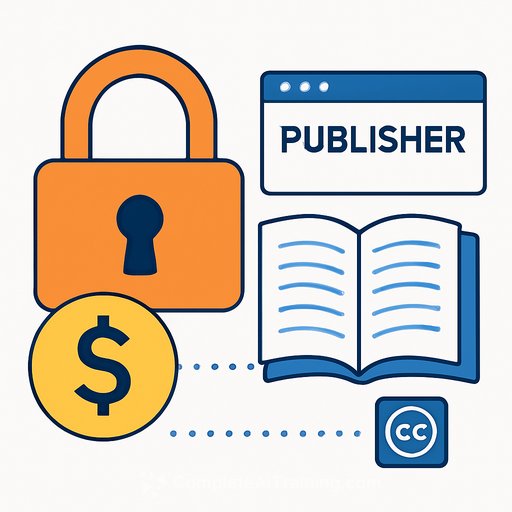
Creative Commons backs "pay-to-crawl" (cautiously). Here's what it means for creatives
Creative Commons (CC) just signaled cautious support for "pay-to-crawl" - tech that charges AI bots when they scrape website content for training or updates. It folds into CC's push for an open AI ecosystem with legal and technical rails for dataset sharing.
The shift matters because search referrals are drying up. People get answers from chatbots and never click through. That's crushing traffic, ad revenue, and subscriber funnels for publishers and independent creators.
What "pay-to-crawl" actually is
Think of it as a meter for machines: AI crawlers pay when they access your content. Companies like Cloudflare are leading implementation, while others - Microsoft, ProRata.ai, TollBit - are building marketplaces and tooling around it. A newer spec, Really Simple Licensing (RSL), sets rules for what crawlers can access without hard blocking, and major CDNs have begun to adopt it.
Big media has already cut deals with AI providers (OpenAI-Condé Nast, Axel Springer, Perplexity-Gannett, Amazon-The New York Times, Meta-various publishers). Smaller teams don't have that leverage. Pay-to-crawl could level the field.
CC's stance: supportive, with guardrails
CC says pay-to-crawl could help sustain content creation and keep work accessible instead of forcing everything behind tighter paywalls. But they warn about power concentrating in a few platforms and the risk of locking out researchers, nonprofits, educators, and cultural institutions.
They propose principles: don't make pay-to-crawl the default for the entire web, avoid one-size-fits-all rules, support throttling (not just blocking), preserve public-interest access, and keep systems open, interoperable, and standardized.
Why this matters to you
If you publish online - newsletters, portfolios, blogs, resource libraries, tutorials - your work is likely being scraped. Pay-to-crawl could turn that extraction into direct compensation and give you control over how bots access your site. For many creatives, it might be the difference between sustaining public content and hiding it behind paywalls.
Downside: if handled poorly, it could wall off knowledge, reduce fair access, and centralize gatekeeping. That's why CC's "cautious" approach focuses on flexibility and public-interest carve-outs.
Practical steps for creatives and small publishers
- Define your bot policy: which crawlers are allowed, throttled, or billed. Keep it simple and adjustable.
- Adopt an access signal: explore RSL-style rules to declare what's crawlable and at what rates/limits.
- Use your CDN or host: check if your provider supports pay-to-crawl or bot metering. Start with throttling, not blanket blocks.
- Create a fair-use lane: whitelist or discount researchers, nonprofits, educators, and cultural heritage institutions.
- Track machine traffic: tag and log bot requests separately from human visits to measure value and set pricing.
- Publish a simple "AI access" page: state terms, accepted crawlers, and contact info for licensing questions.
- Test and iterate: start with conservative limits, collect data, then tune pricing, quotas, and exceptions.
Quick checklist
- Bot access rules: allow | throttle | bill | block
- Public-interest exemptions documented
- Pricing or rate-limit tiers ready
- Logging and analytics turned on
- Contact and licensing page live
Who's building what
Cloudflare is investing heavily in pay-to-crawl infrastructure. Microsoft is working on an AI marketplace for publishers. Startups like ProRata.ai and TollBit are experimenting with pricing and metering models. The RSL Collective introduced a standard that CDNs like Cloudflare, Akamai, and Fastly have adopted, with backing from organizations across media and tech.
The takeaway: Set your policy now. Keep access open where it should be open, get paid where value is extracted, and use throttling instead of blunt blocks. That balance protects your work and keeps your audience growing.
Learn more straight from the source: Creative Commons and the Cloudflare ecosystem via the Cloudflare Blog.
Want to upskill for the AI era?
Build practical leverage with focused training built for working creatives: Courses by job and a curated set of tools for writers and content teams: AI tools for copywriting.
Your membership also unlocks: