
AI news ·
Creative schools say AI complements human skills rather than replacing them
63% of Canadian creative workers fear AI will limit their job prospects, a Harris Poll found. Workers with verified AI skills earn up to 30% more than peers without them, per LinkedIn data.
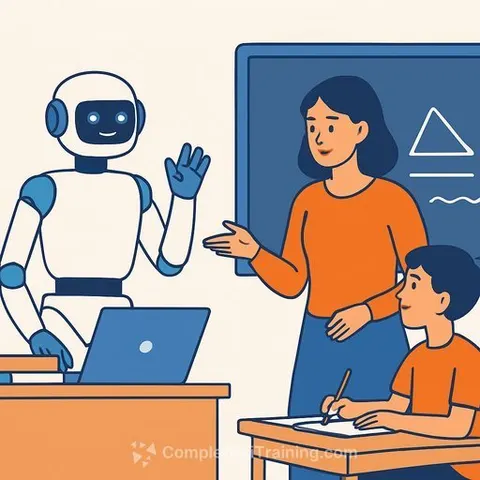
63% of Creative Workers Fear AI Will Limit Job Opportunities. Industry Leaders Disagree.
A Harris Poll found that nearly two-thirds of Canadian workers worry AI will significantly constrain their career prospects. Half fear their jobs could disappear entirely. For students and creatives weighing career choices, the anxiety is real.
Industry professionals see something different.
"AI can't currently navigate tasks requiring genuine empathy, emotional intelligence, or refined judgment," said Adam Till, Vice President of Academic Affairs at Toronto Film School. "Human guidance remains essential. Those who understand how to use AI tools properly are more likely to excel."
History Suggests Adaptation, Not Replacement
The creative industries have weathered technological disruption before. The shift from film to digital editing didn't eliminate filmmakers-it freed them to experiment without losing original source material. Motion capture technology didn't replace directors; it expanded what they could create.
"AI is far from the first disruptor the creative industries have faced," said Andrew Barnsley, President of Toronto Film School. "We adapt, then we tend to forget what the business was like before."
The World Economic Forum reports that 1,000 surveyed companies identify AI as the leading driver of business transformation by 2030. The London School of Economics found that creative firms-historically early adopters of new technology-are developing tailored AI tools and creating new roles in the process.
The Financial Case for AI Literacy
LinkedIn's Economic Graph shows a wage premium of up to 30% for workers with verified AI literacy compared to peers in similar roles without those skills.
Rose Luckin, Professor Emerita at University College London and founder of Educate Ventures Research, frames the shift this way: "AI is now a basic requirement of informed citizenship, not just a specialist technical skill. When AI is used as a collaborator rather than a substitute, it can expand what is possible. The goal is not to compete with AI. It is to do what AI cannot."
Craft First, AI as Tool
Toronto Film School integrates AI into its curriculum without replacing foundational training. Filmmaking students still learn scripting, directing, producing, cinematography, and editing as core skills.
"AI represents another step in technological transitions," said Emilija Davidovic, program director of the Film Production program. "Students who understand both craft and technology will find themselves better equipped. AI is positioned as a workflow tool, not an author."
Acting students continue learning their craft. "Nothing will ever replace a real-life actor," said Hart Massey, program director of Acting for Film, TV and the Theatre. "Audiences want to believe in someone who's real."
Writing instructors emphasize the irreplaceable element of voice. "AI can never replace a writer's voice," said Michelle Daly, program director for Writing for Film and TV. "Their unique perspective and lived experience is what sets one writer apart from another."
AI in Game Design and Graphic Design
Video game developers use AI to speed up prototyping and assist with complex systems design-freeing creators to focus on imaginative problem-solving.
"AI allows developers to focus more of their time on imaginative problem solving," said JP Amore, program director for Video Game Design & Development. "By integrating AI literacy into our program, we are preparing students to collaborate with these tools effectively."
Graphic designers learn the same principle: AI supports visual communication but doesn't replace the designer. "We treat AI the same way we treat any other technology: as a tool that supports visual communication, not as a substitute for the designer," said Pheinixx Paul, program director for Graphic Design & Interactive Media. "Students learn craft first through concept, composition, and visual storytelling. Then they learn how to use AI responsibly to streamline parts of the workflow and expand their exploration."
For designers looking to stay current, AI Design Courses offer practical training in responsible tool use. Creatives in animation and visual arts may find Generative Art Training relevant to understanding how AI fits into production workflows.
The Path Forward
Every technological disruption in creative industries has eliminated some jobs and created others that didn't exist years prior. The difference between those who adapt and those who don't comes down to one thing: understanding both the tools and the fundamentals.
"Our focus is on bringing current industry practices into the classroom in a practical, applied way," Till said. "We're not teaching AI for its own sake; instead, where it's being used meaningfully, we reflect that in our programs so students graduate prepared not just for today's jobs, but the opportunities of tomorrow."