
AI news ·
Creatives count the real costs of AI as clients leave, skills erode and stolen work goes unpaid
Designers are losing clients to generative AI right now - not as a future risk. Two illustrators share what's at stake and how junior creatives can protect their careers.
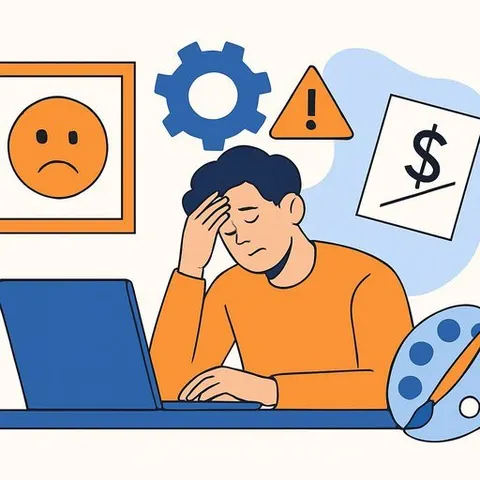
Generative AI is already costing creatives real work
Designer and illustrator Jason Roberts has lost two clients in recent months. Both switched to generative AI for illustrations and marketing material. The reason was straightforward: cost cutting.
This isn't speculation about future risk. It's happening now. The question Roberts and other creatives face is whether this trend will accelerate, stabilize, or eventually reverse.
What leaders are actually saying
Roberts points to candid statements from AI company executives as evidence that replacement, not augmentation, is the real goal. An OpenAI CTO said some creative jobs "will go away, but maybe they shouldn't have been there in the first place." Anthropic's CEO predicted AI would wipe out white-collar jobs.
These aren't hypothetical warnings. They're public statements about the intended direction of the technology.
Roberts rejects the idea that AI itself is neutral and only harmful when misused. "That's similar to pushing carbon footprint responsibility onto individuals instead of oil companies," he said. "The negative impacts should be the responsibility of AI companies."
The ethics of training data
Illustrator Carole Chevalier, who has worked in the industry for 15 years, has a specific concern: the models were trained on work that wasn't offered freely.
She describes generative AI as something that "vomits a mix of stolen art to create something that has no soul." The environmental cost compounds the ethical problem. Server farms require rare earth minerals and enormous energy consumption.
Chevalier points to a concrete example: AI-generated videos presented as stop-motion animation. Studios spend a year crafting genuine stop-motion work. AI can produce a convincing fake in hours, requiring no animation skills.
"How is a studio going to compete with AI if they need to work a whole year on something that AI can fake in a day?" she asked.
The sustainability paradox
There's a built-in contradiction in the generative AI model that Chevalier identifies. The systems need constant new creative work to train on. But if creatives are pushed out of work, where will that content come from?
"What worries me is that everything will start looking the same, and there will be no genuine creativity any more," she said. "If all creatives are out of work, where is AI going to find the content to feed on?"
The cognitive cost to younger workers
The impact extends beyond lost commissions. Nicolas Petit, senior innovation project manager at TotalEnergies, uses AI as an audience simulator to test pitches. It's useful. But he's concerned about what it means for people entering their careers.
"The fact that young generations won't think by themselves any more, but just rely on AI, is troubling," he said. "No more personal thinking, no more free will."
Junior creatives face a choice: lean on AI tools and risk becoming dependent on them, or build skills that machines struggle to replicate.
What junior creatives should actually do
Roberts advises junior creatives to keep distance from generative AI while studying what it can and can't do. Understanding its limits reveals where human skill genuinely matters.
"Embrace learning a broader range of tools and skills," he said. "If all you know is AI prompting, you might find yourself more at risk when clients or employers no longer need someone else to do the prompting."
Chevalier's advice is similar: avoid AI tools and focus on building a distinctive voice and style. "Concentrate on showing off your unique style and voice, the skills you have to offer, and your sincere interest in helping their clients solve a problem without using shortcuts."
The human cost of generative AI in the creative industry is mounting. But the path forward isn't despair. It's clarity about what you stand for, what you offer, and why it matters.
The one thing AI cannot replicate is a genuine human perspective - hard-won and entirely your own. That's worth fighting for.
For creatives looking to strengthen their position, AI for Creatives resources can help you understand the technology without becoming dependent on it. AI Design Courses also cover how to integrate AI tools strategically while preserving the skills that clients actually value.