
AI news ·
Creatives oppose proposed AI copyright exemptions for $50bn datacentre investment
A cabinet proposal offers AI firms copyright exemptions for a $50 billion datacentre investment. Artists protest the plan, demanding fair licensing instead of a dirty deal.
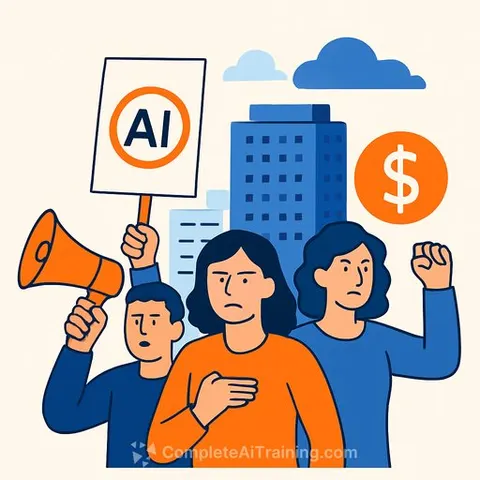
A proposal offering AI companies special copyright exemptions in exchange for a $50-billion-plus datacentre investment and a $350 million annual fund for artists has been put to federal cabinet, triggering a fierce backlash from creatives and independent senator David Pocock, who labelled it the "ultimate dirty deal".
The government insists it has no plans to weaken copyright protections, but the information - revealed by Pocock - has spooked authors, musicians and other artists, who staged a press conference at Parliament House on Wednesday demanding the government hold the line.
The proposed trade-off
Industry sources say the cabinet proposal would give AI companies a text and data mining exemption, allowing them to scrape copyrighted creative content without permission. In exchange, the tech firms would finance the artists' fund and commit to building large-scale datacentres on Australian soil. The overall investment is valued at more than $50 billion.
Pocock told parliament the plan was the "ultimate dirty deal", selling out Australian musicians, writers, authors and other creatives in return for an "eye-wateringly large investment in AI data centres, which, as we know, are currently wildly unregulated in this country." He called on the government to "categorically rule out any carve-out, any exemption, any watering down of copyright exemptions now and into the future."
The government rejected Pocock's claims as inaccurate. A spokesperson for Attorney-General Michelle Rowland said there are "no plans to weaken copyright protections when it comes to AI" and that the administration wants a "fit-for-purpose copyright framework that protects and supports Australia's creative and media industries while unlocking AI innovation."
Creative sector pushback
On Wednesday, a delegation of creatives voiced their concerns directly. Paul Dempsey, lead singer of Something for Kate, said, "The idea that copyright law should be watered down or chiselled away at to provide a freebie or a handout to gigantic multinational, multi-billion dollar companies to train their AI models makes absolutely no sense to me."
Author Anna Funder described herself as a "victim of crime," saying her books, which she has lived off for decades, "have all been hoovered up in many editions, in many countries, in many languages by big tech, broken down for parts and used for them to make money."
Musician Holly Rankin, who performs as Jack River, addressed both sides directly: "To the government we say, 'don't back down, do not sign our rights away', and to big tech we say 'ask us, get permission, pay us, we are here ready to do deals with you'." She and others say they are not opposed to AI but want fair licensing, not an exemption.
Political divisions and timeline
Guardian Australia understands there are splits within the government. Former industry minister Ed Husic, who argued for strong AI guardrails, was dumped from cabinet in 2025. His successor Tim Ayres is said to favour a lighter-touch approach. Prime Minister Anthony Albanese is expected to give a major speech on AI in July and met with representatives of AI firm Anthropic last week.
Pocock said he had information that Albanese was preparing to announce a datacentre plan on or about 15 July. He noted the government had criticised him but "has not denied it, because it is true."
The government is urging tech giants and creatives to negotiate deals that "support innovation while ensuring creators are compensated." But many artists fear the imbalance of power could see them on the losing end without strong legal protections.
Why this matters for creatives
If a text and data mining exemption takes hold, Australian copyright law would effectively allow AI companies to ingest entire catalogues of music, literature, and visual art without consent - a shift that could undercut the economic foundation of creative careers. Understanding how AI models train on content is no longer a niche tech concern; it directly affects royalty streams, licensing income, and the control artists hold over their work. As the policy fight intensifies, AI for Creatives Courses can help you learn how these systems use your data and what tools exist to protect your rights.