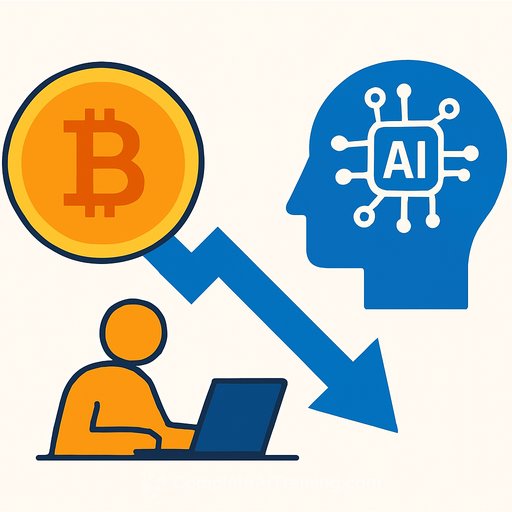
75% Plunge in Crypto Development Activity: Did Everyone Pivot to AI?
Developer activity across crypto has taken a sharp hit. Since early 2025, weekly code commits are down about 75%, and active contributors are down roughly 56%.
For context: weekly commits slid from the 800,000-900,000 range to closer to 200,000. Active contributors fell from over 10,000 at peak to fewer than 5,000 per week. That is a serious contraction for an ecosystem that once moved at breakneck speed.
What the data signals
This isn't just a quarterly wobble. It looks like a structural reset. Fewer hands are touching repos, and the ones who remain are shouldering more of the critical path for core clients, wallets, and infra.
Independent tracking like the Electric Capital Developer Report and broader OSS trends in the GitHub Octoverse echo the shift: talent and attention have rotated, and the opportunity surface has moved with it.
Is AI pulling developers away?
Yes-funding and excitement have gravity. AI startups and research orgs soaked up capital, roles, and mindshare. Engineers who spent the last cycle on L1 clients, L2 infra, wallets, and DeFi stacks are now building generative AI tools, ML platforms, and evaluation pipelines.
Crypto isn't "dead," but the shape of the contributor base changed. Many protocols now depend on smaller, senior-heavy teams. Whether new talent returns will hinge on incentives, clear product wins, and better onboarding paths.
What this means for engineers
You have three practical paths: double down on core crypto, go hybrid (crypto + AI), or pivot to AI full-time. Each is viable if you pick the right problems and ship.
Skill transfers that actually map- Low-level systems (Rust/C++): inference runtimes, compilers, GPU kernels, distributed training.
- Smart contracts + audits: formal verification, security tooling, AI safety evaluations, policy engines.
- Distributed systems + networking: data pipelines, vector DB infra, feature stores, real-time serving.
- Cryptography/ZK: privacy-preserving ML, verifiable inference, key management, secure enclaves.
If you're pivoting, the AI Learning Path for Software Developers can shorten the ramp from crypto stacks to AI tooling and workflows.
What this means for crypto teams
- Protect the maintainers: rotate on-call, fund grants, and reduce bus factor on core repos.
- Pay down infra debt: deterministic builds, reproducible nodes, CI that catches consensus breaks.
- Automate more: fuzzers, formal specs, property tests, and differential testing between clients.
- Narrow the roadmap: prioritize security, uptime, and a few user-visible wins over broad feature sprawl.
- Open source incentives: bounties for well-scoped issues, clear contribution guidelines, fast PR reviews.
How to separate signal from noise
- Commit volume ≠ impact. Track releases, client diversity, testnet stability, and mainnet incident rates.
- Watch maintainer health: time-to-merge, issue backlog aging, and reviewer coverage.
- Security posture: critical CVEs closed, audit follow-through, and reproducible builds.
- Adoption indicators: node count trends, client mix, light-client usage, and real transaction quality.
Scenarios for the next 12-18 months
- Consolidation: Smaller, senior teams keep core infra stable; fewer net-new protocols ship.
- Product-led rebound: Clear user wins (payments, gaming, identity, verification) pull developers back.
- AI x Crypto crossover: Verifiable inference, on-chain provenance, and AI agent payments create fresh demand for hybrid skill sets.
Action plan for individual developers
- Pick a 2-3 skill stack: e.g., Rust + ZK + Python ML tooling. Depth beats scatter.
- Ship visible work: public repos, reproducible demos, and short write-ups that show judgment.
- Automate your workflow: codegen, test scaffolds, repo hygiene, and small E2E environments.
- Learn evaluation: benchmarks for models, protocols, and infra. If you can measure, you can lead.
- Join fewer, better projects: stable maintainers, sane roadmaps, and clear contribution paths.
Action plan for crypto orgs
- Fund the backbone: reviewers, release engineers, devrel that actually closes PRs.
- Shorten contributor ramp: one-command dev environments, realistic localnets, and issue templates.
- Publish specs and invariants: make correctness testable by outsiders.
- Integrate AI where it helps: triage, test generation, static analysis-measurable wins only.
- Align incentives: milestone grants and maintenance rewards, not just "new feature" bounties.
The takeaway
Developer attention is scarce. AI has it right now. Crypto can keep shipping-just with tighter teams, cleaner scopes, and better incentives. If you're an engineer, pick a lane, build leverage, and let results compound.
Your membership also unlocks: