AI in Africa: A Creative Shift Challenging Hollywood Fears and Limits
In Dakar, a six-minute short called "Rose" is being built on a shoestring and big ideas. Senegalese director Hussein Dembel Sow shot for two days with his niece and a local actor, then handed the heavy lifting to an AI video model, Marey by Moonvalley.
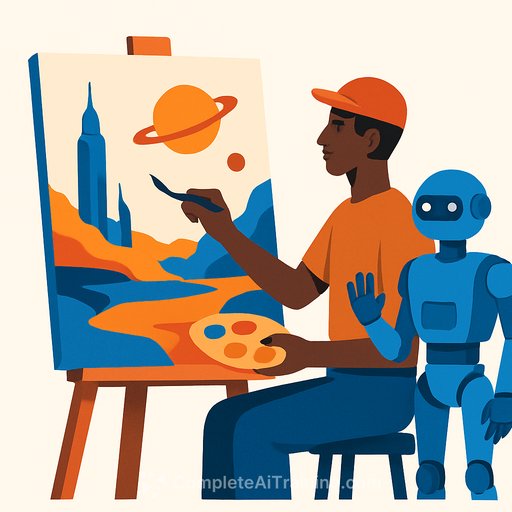
The premise is bold: a colorblind girl tries hypnotherapy and, guided by her grandfather, paints entire worlds with her mind. The twist is practical-what would've required expensive VFX is now possible in a few months for roughly $1,000.
Why this matters for creatives
- Budget is no longer a hard stop. A small crew with clear ideas can now produce concept-level visuals without a VFX army.
- Speed favors risk-takers. Faster iteration loops let you test stories, styles, and formats before you burn time and cash.
- Geography is irrelevant. If you can shoot, you can ship. Distribution is global. So is your market.
The lean AI filmmaking playbook
- Concept and script: Keep it location-light and effect-driven. Design scenes that let AI shine-dreams, memories, stylized worlds, surreal transitions.
- Look development: Build a tight mood kit: 10-15 frames that lock color, texture, lighting, and composition. Consistency beats complexity.
- Storyboards and previs: Rough animatics are enough. Focus on eyelines, motion direction, and edit rhythm.
- Shoot smart: Use locked shots where effects need clean plates. Light for separation. Capture reference passes of empty frames and texture close-ups.
- AI passes: Use your model for environments, style transfers, and transitions. Keep effects narrative-first-each pass should serve the beat.
- Compositing and polish: Blend AI outputs with live footage. Add practical elements (dust, light leaks, smoke) to unify the frame.
- Sound and score: Minimal music, strong foley. Sound sells scale when visuals are abstract.
A sample $1,000 micro-budget
- $300 talent and crew stipends
- $200 locations, permits, transport
- $250 software, cloud, and model credits
- $150 lighting and grip rentals
- $100 contingency (props, meals, pickups)
Adjust the mix, but keep one rule: spend where it shows on screen.
Quality without a big VFX house
- Design for constraints: Stylization hides seams better than photoreal attempts on a tight budget.
- Short shots, firm edits: 2-4 second shots reduce artifacts and make AI blends feel intentional.
- Texture continuity: Reuse patterns, palettes, and light angles across scenes to maintain visual identity.
- Shoot references: HDRI panoramas, surface textures, and lighting notes help align AI outputs to your footage.
Ethics that build trust
- Informed consent: Make sure on-camera talent understands any AI usage and transformations.
- Credit clearly: List tools and models alongside human roles. Transparency earns audiences.
- Respect likeness and IP: Don't replicate faces, voices, or styles without explicit permission.
What Hollywood can learn
- AI won't erase jobs-it reshapes them. Roles shift toward direction, taste, and curation.
- Original voices win. Lower costs mean more first-time directors testing bold ideas.
- Smaller crews, tighter cycles. The advantage goes to teams who can write, shoot, and iterate quickly.
Action steps this week
- Write a 3-5 minute script built around a single visual idea you can repeat and escalate.
- Create a 12-frame style bible that locks tone and color. Print it. Bring it on set.
- Plan a two-day shoot: day one for principal footage, day two for plates and pickups.
- Run three AI tests on your hero shot. Compare outputs, choose one direction, commit.
- Release a 30-second teaser first. Watch feedback. Refine the final cut accordingly.
Want a curated toolkit?
Explore practical AI video tools and courses built for working creatives:
- Popular AI tools for generative video
- Courses by creative job role
- AI Learning Path for Video Editors
Hussein Dembel Sow's "Rose" is a proof point: tight story, light crew, smart AI. If you're creative and hungry, the gate is open. Build something people talk about-and do it on your terms.
Your membership also unlocks: