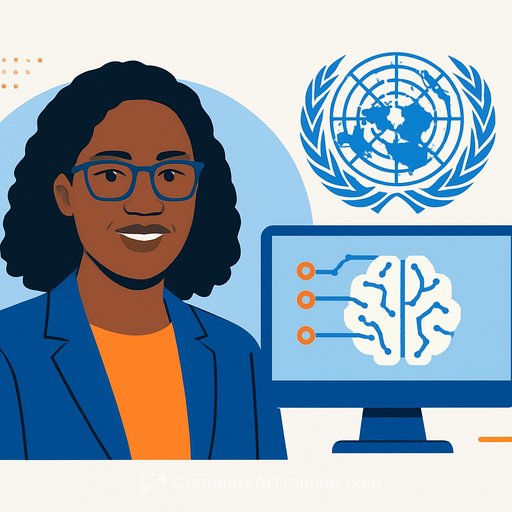
Dr. Rita Orji appointed to UN's Independent International Scientific Panel on AI
Dalhousie Computer Science Professor Dr. Rita Orji has been named one of 40 members of the United Nations' new Independent International Scientific Panel on Artificial Intelligence. Announced Thursday, Feb. 12, 2026, she is one of only two Canadians on the panel. Over a three-year term, she will focus on human-centred, equitable, and responsible AI.
Dr. Orji has consistently pushed for inclusive AI that works for underserved communities and the Global South. Her work blends technical depth with real-world impact-how systems influence behaviour, how culture matters, and how design choices affect outcomes.
Why this matters for science and policy
The UN General Assembly established the Scientific Panel on AI in August 2025 as a global scientific body dedicated to AI's development, implementation, ethical use, and broader impact. In February 2026, 40 members were selected from more than 2,600 candidates, forming a multidisciplinary group that is geographically diverse and gender balanced.
The panel's mission is to deliver independent, impartial assessments of AI's opportunities, risks, and impacts to inform the Global Dialogue on AI Governance. For researchers, this is a direct path for evidence to shape standards, policy, and deployment practices across sectors. See Research for related resources. Leaders and policymakers looking to align governance and organizational strategy can also explore the AI Learning Path for CIOs.
- Independent assessments that help all Member States engage on equal footing.
- Synthesis of current evidence and identification of critical knowledge gaps.
- Guidance for responsible deployment in diverse cultural and resource contexts.
Dr. Orji's perspective
Her research on AI-driven persuasive systems, culturally adaptive technologies, and digital health fits the panel's mandate. As Canada Research Chair in Persuasive Technology and director of the Persuasive Computing Lab at Dalhousie, she studies how AI systems influence human behaviour-and how to implement them responsibly and equitably.
- Design principles that respect user autonomy while enabling meaningful behaviour change.
- Methods to reduce cultural bias and improve inclusion across regions, including the Global South.
- Evaluation approaches that connect algorithmic performance to real-world outcomes.
"Rita is a powerhouse," says Faculty of Computer Science Associate Dean Research, Dr. Nur Zincir-Heywood. "We are continually impressed with her accomplishments and the incredible way she represents our Faculty and institution. I know she and the panel will achieve amazing things."
Her appointment follows years at the intersection of AI and human behaviour and recent recognition as a Fellow of the African Academy of Sciences and recipient of NSERC's Arthur B. McDonald Fellowship. Learn more about the fellowship's impact on early-career researchers via NSERC.
Evidence and solidarity: the larger context
The Global Digital Compact, adopted in 2024 as part of the UN's Summit of the Future, called for an independent scientific panel on AI to ensure international deliberations are informed by the best available evidence and solidarity. "In a world where AI is racing ahead, this Panel will provide what's been missing - rigorous, independent scientific insight that enables all Member States, regardless of their technological capacity, to engage on an equal footing," said UN Secretary-General António Guterres.
The UN scientific panel on AI: quick facts
- Established by the UN General Assembly in August 2025.
- 40 members selected in February 2026 from more than 2,600 candidates.
- Multidisciplinary, geographically diverse, and gender balanced.
- Three-year terms focused on independent, science-driven guidance.
What to watch next (for researchers)
- Calls for evidence, data, and expert input across disciplines.
- Guidance on evaluation standards for AI in health, education, and public services.
- Recommendations on equitable access to AI infrastructure and data-especially for low-resource settings.
If you're building skills in responsible AI, you can explore role-specific learning paths such as the AI Learning Path for Regulatory Affairs Specialists.
Your membership also unlocks: